At a new-employee orientation in San Antonio in 2017, Eric Schmacker talked about the drive to work. He was leading Mission Trail Baptist Hospital, on the former Brooks Air Force Base, and the surroundings had made an impression. “I love coming to work every day and driving onto Brooks,” he told the new arrivals. The attraction, he explained, was the environment.
It is an agreeable departure from the usual welcome speech. An executive has a captive audience and a fresh supply of people who have yet to learn where the stationery lives. There are many opportunities to discuss organizational charts. Schmacker chose to talk about the place they were entering.
Brooks was changing its own introduction. A former military installation was becoming a mixed-use community. For a former Army aviator now working there in civilian leadership, the setting offers a useful opening to his story. His career moves through institutions with substantial titles; its more revealing episodes often happen just outside the job description.
Twenty-one years before the corner office
Schmacker served in the U.S. Army for 21 years. He flew Black Hawks in a combat aviation brigade and later held administrative and strategy assignments. Those are distinct chapters in one military career, spanning aviation and the work of running large organizations.
His education took him through West Point, Baylor University and the University of Florida. He earned a bachelor’s degree in systems engineering, a master’s degree and a doctorate. The progression brings a technical undergraduate foundation together with further study in administration, research, management and policy.
His military appointments included chief of strategy at the Army Medical Department Center and School and operating responsibilities at Army institutions. The job titles establish the breadth of his assignments without requiring a cinematic account of life in a cockpit. There is plenty of substance in the sequence itself: flight, strategy, operations and sustained study. The Black Hawk is the detail that catches the eye. The 21 years give it its proper scale.
before the civilian chapters
San Antonio, one responsibility after another
In civilian employment, Schmacker served as senior vice president of shared services at Intermedix before joining Tenet. His San Antonio career included the chief operating officer role at North Central Baptist Hospital. By December 2014, he was also among the 58 people selected for the Greater San Antonio Chamber of Commerce’s leadership program.
That selection placed him alongside participants from finance, education, law and other parts of the city’s working life. A leadership class is a modest entry on a résumé, but it has a different geography from a corporate reporting line. Its organizing unit is the city.
On August 1, 2016, he became president of Mission Trail Baptist Hospital, succeeding Andy Harris. In November 2018, he was named to succeed the retiring John Knox at St. Luke’s Baptist Hospital. The appointments trace a progression from chief operating officer to the leadership of two organizations in the same system.
His name also appears on an archived University of the Incarnate Word advisory board roster as Mission Trail’s president. Alongside the successive appointments, these civic and academic connections add another dimension to the San Antonio years: an executive career taking place within a wider local network.
A birthday party with a purpose
In July 2017, Brooks celebrated two anniversaries at once: a century since the founding of the air base and 15 years since its rebirth as a mixed-use community. The organizers called the occasion a “Quincetennial.” Even a birthday can acquire a committee-approved name.
The celebration took place at the Embassy Suites on the Brooks campus and raised more than $40,000 for the newly formed Brooks Community Foundation. Schmacker chaired the foundation’s board. Its purpose was to support nonprofit organizations working in the surrounding neighborhoods.
His comments at the time linked development to the prospects of the wider South Side. He spoke about employers, jobs, housing and amenities, and about supporting charities working nearby. The foundation gave that neighborhood interest a formal vehicle, with a board and a fundraising occasion attached.
This is a particularly useful episode because it puts a clear boundary around his contribution. He was the foundation’s board chair; the event raised the money. The neighborhood ambitions belonged to a collection of organizations and people. His part in that collection was specific, public and close to the place where he worked.
“At Mission Trail, we are big advocates for Brooks and for the whole South Side.”Eric Schmacker, 2017
Making room for other names
Another San Antonio episode shifted attention from an executive’s title to employees’ names. In a Baptist Health System video post, Schmacker introduced Marisela Hernandez and Angie Anderson. The subject was a way for employees at St. Luke’s to recognize their peers.
The format matters. A president and CEO appeared in the introduction, while colleagues explained the recognition practice. The organization’s accompanying message thanked Hernandez for her dedication and Anderson for her leadership. A small piece of workplace communication gave individual employees a public place in the story.
It would be too much to turn one video into a complete theory of management. As an episode, though, it is concrete and telling: employee recognition was important enough to receive an executive introduction and a public audience. In the crowded genre of corporate announcements, making space for somebody else’s name is an economical editorial choice.
The door in Reno
By 2019, Schmacker had joined Centene and was leading SilverSummit Healthplan in Nevada. In 2020, he traveled from Las Vegas to see HopeSprings, a bridge housing project in Reno. SilverSummit had made a $100,000 donation toward the project.
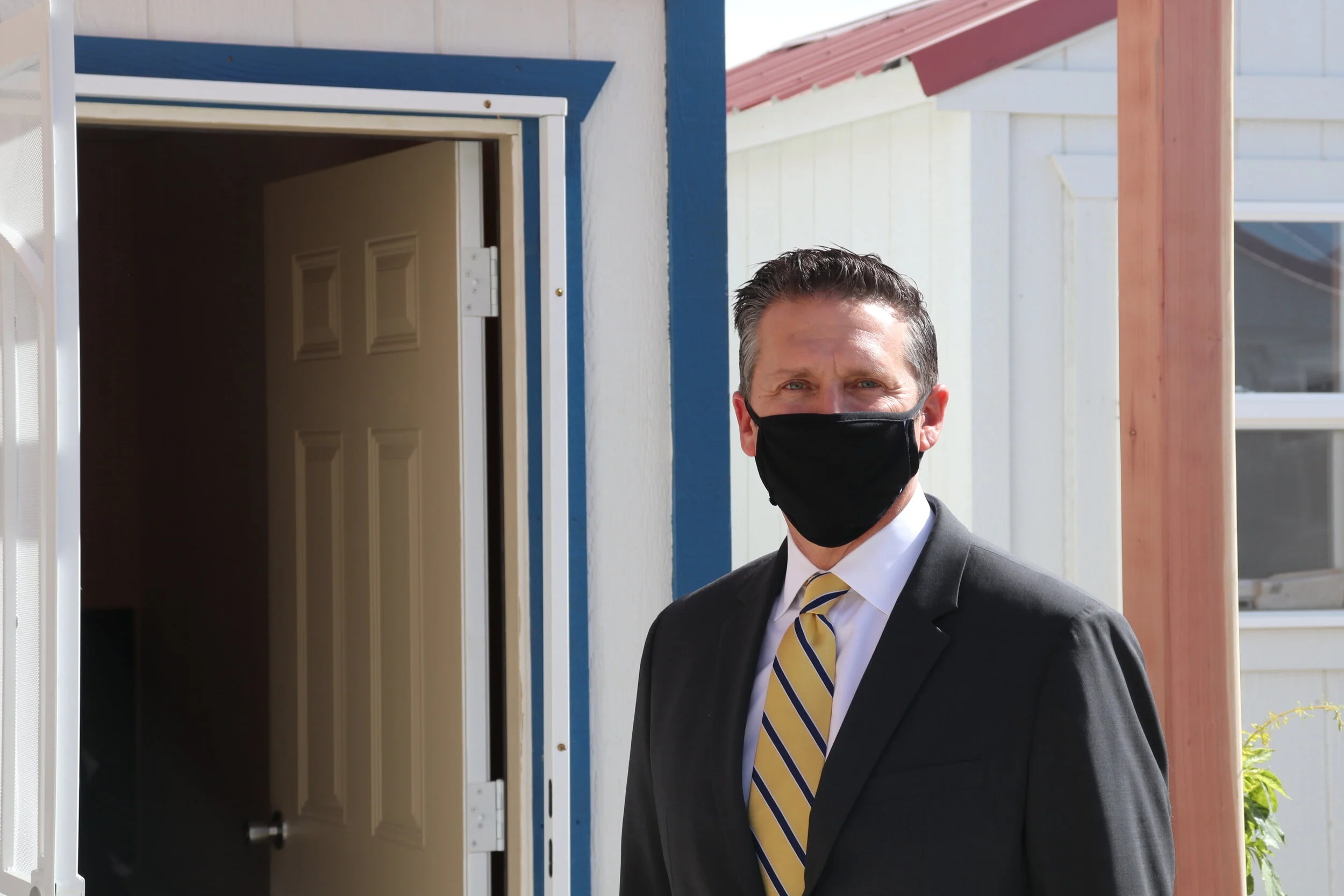
A photograph from the visit places him beside a small home’s open doorway. His observations concerned the balance between shared space and privacy. He noticed that people would have places to gather and build relationships, as well as somewhere to be alone. It is a practical detail to notice during a tour: community requires company, and a home requires a door.
The following June, he appeared before Washoe County commissioners for the ceremonial presentation of a $75,000 donation to the county’s Affordable Housing Trust Fund through the Community Foundation of Northern Nevada. The county manager described SilverSummit’s interest following tours of the Our Place and Nevada Cares campuses.
These were company contributions. Their significance in his story lies in his visible participation in the local relationships around them. Reno added a different set of rooms to the executive itinerary: a housing development and a county commission meeting.
A seat at the workforce table
In September 2021, Schmacker and Dasya Duckworth were unanimously appointed to the Workforce Connections Board by the Local Elected Officials Consortium. Each appointment carried a three-year term. Duckworth came from Motional, where she worked in human resources and global operations.
The pairing is a reminder that a workforce board gathers people whose everyday employers may have little else in common. Its business brings those perspectives to the same table. Schmacker entered as a company leader with an extended military and administrative background; Duckworth brought experience in employment and organizational practices.
Workforce Connections later listed Schmacker as vice chair in its 2024 highlights, and its board roster lists him as chair. The roster brings together representatives from banking, organized labor, education, transportation, business and community organizations. The chair’s title sits among a broad collection of other affiliations.
This public service gives the Nevada chapter a continuity beyond his own employer. He joined a regional institution, then took on board leadership. It extends the civic involvement visible earlier in San Antonio, while giving it a different subject and a different set of colleagues.
President
Leadership
President & CEO
Football players, airmen and a shared thank-you
On February 8, 2024, SilverSummit and the Pro Football Hall of Fame held a Salute to Service event in Las Vegas. Hall of Famers Darrell Green, Warren Moon and Anthony Muñoz took part. The itinerary included Creech Air Force Base and concluded with lunch for 100 police officers at the Las Vegas Metropolitan Police Department.
Schmacker participated as both a company leader and an Army veteran. In his remarks, he thanked the football players for sharing their experiences with veterans and first responders. For an executive whose earlier career included military aviation, the event connected a present-day organizational role with a substantial part of his own past.
The occasion also changed the direction of the applause. Famous athletes were there to recognize people whose work normally brings a different kind of visibility. Football supplied familiar names; the day’s purpose was appreciation. It is another instance of Schmacker appearing in a public event built around somebody else’s contribution.
California, with the earlier chapters intact
In August 2026, Schmacker became Health Net’s plan president and chief executive officer after serving in the role on an interim basis. He moved from the leadership of SilverSummit, another Centene organization. He also became a California Chamber of Commerce director that month.
The new appointment is the latest turn in a career that has moved from military service through operational leadership, executive appointments and regional board work. Its geography now includes California as well as Texas and Nevada. Its recurring settings include classrooms, workplaces, neighborhood organizations and public meetings.
A title is useful shorthand, especially when the full career would overfill a business card. But Schmacker’s story becomes more legible when the shorthand is unfolded: the long Army service, the successive San Antonio assignments, the foundation fundraiser, the housing visit and the workforce board.
And there is still that orientation speech at Brooks. Among the appointments and acronyms, it preserves a recognizable human pleasure: arriving somewhere and being glad to be there. A working life can accumulate a formidable list of responsibilities. The drive through the gate remains a rather good place to begin.