A port can lose track of a laptop long before it loses track of a ship. The ship has a berth, a manifest, a destination. The laptop may have an owner in one system, a purchase record in another, and a retirement date nobody has entered. In an organization built to move things, the small things can become surprisingly hard to follow.
That is the world SDI Presence inhabits. The Chicago IT consultancy and managed services provider works with the complicated organizations behind ordinary life: government agencies, utilities, airports, transportation operators. Its work includes keeping existing systems running while helping customers replace the parts that have become liabilities. Progress here involves permissions, inventories, maintenance windows, and people who know whom to call.
- The work: modernize old IT, connect systems, and support daily operations.
- The buyers: public agencies and enterprises with complicated obligations.
- The twist: customer contracts can create paid routes into tech through Xchange Chicago.
The trouble starts between departments
Consider the unnamed port authority in SDI’s March 2026 case study. Its operations stretched across public terminals and private operators. Expanding digital operations had outgrown its legacy service and asset-management tools. Cybersecurity, compliance, and integration requirements made the gaps harder to tolerate.
The engagement put ServiceNow IT service management and Hardware Asset Management Pro in place. Incident, problem, change, and request processes were joined to inventory and hardware lifecycle workflows. The implementation also connected single sign-on, HR, and identity systems. The practical ambition was shared visibility: fewer mysteries about what existed, who used it, and what should happen next.
SDI reports better auditability, less manual effort, and improved purchasing decisions. These are company-reported outcomes. The useful detail is the mechanism: technology work crossed the boundaries between IT, procurement, finance, and HR. Installing software was one part of the assignment. Making those handoffs coherent was another.
“As a former CIO, he makes instant connections with other CIOs.”David A. Gupta, on CEO Hardik Bhatt · 2023
An engineering habit, carried forward
SDI’s roots help explain that practical bent. An internal IT division at engineering firm Environmental Systems Design preceded the standalone business established in 1996. Founder David Gupta returned as CEO in 2016, when the company took the SDI Presence name. The word emphasized being available to clients, colleagues, and communities.
Expansion followed. SDI bought California consultancy NexLevel in 2017 and secured a minority investment from Abry Partners in 2021. The stated purpose of that capital was national growth through acquisitions and organic expansion. In 2023, Hardik Bhatt became CEO and Gupta moved to executive chairman. Bhatt had been CIO for both Chicago and Illinois, alongside roles at AWS and Cisco.
That background matters in a market where a technically sensible proposal still has to survive a budget, a procurement process, and public expectations. SDI’s positioning combines industry experience with local delivery. Buyers can also consider national integrators, regional managed service providers, specialist consultancies, or their own staff. SDI’s argument rests on familiarity with the operating environment and responsibility beyond implementation.
One engagement can span the roadmap, the implementation, and the service desk.
The cloud has a ground floor
The service menu runs from advisory work and cybersecurity to hybrid cloud infrastructure, enterprise asset management, data, and AI. Customers can commission a defined project or buy ongoing managed services. A roadmap helps decide what to change; implementation makes the change; operational support deals with what happens afterward. The business earns its place by connecting those stages.
Sometimes modernization looks distinctly physical. In another published case, a regional energy provider wanted to replace fragmented leased telecommunications lines with company-owned infrastructure. The work involved site assessments, feasibility studies, engineering coordination, contractor scheduling, integration, and testing. SDI reports lower costs and reduced asset downtime. The transferable lesson is the sequence: establish requirements at each site before deciding what to install.
A buyer should examine its own sites, service obligations, and support needs before copying that choice. Owning infrastructure carries responsibilities as well as control. The case is useful as an account of coordination, rather than a universal instruction to stop leasing.
A customer order becomes an opening
SDI’s more unusual proposition concerns where the people doing the work come from. Xchange Chicago brings technology delivery and workforce development into Greater Grand Crossing on the South Side. Created with partners including P33 and the Comer Science and Education Foundation, its hub opened in 2025, with SDI as anchor tenant.
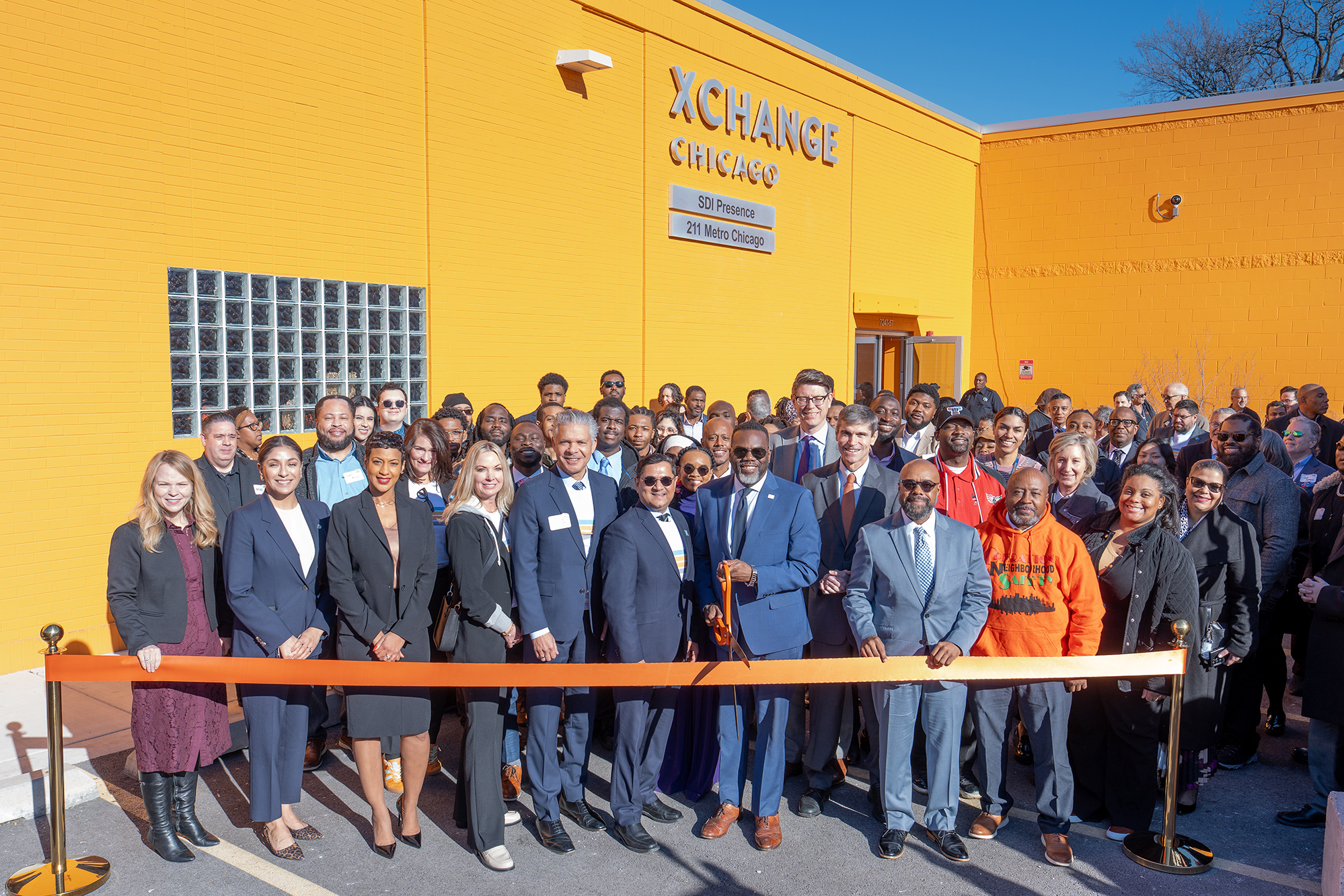
The facility was reported as a $20 million project. Separately, Chicago Development Fund describes support through New Markets Tax Credits and a model of paid, nine- to twelve-month apprenticeships following pre-apprentice training. Those figures describe a building and a training structure, rather than the price a customer pays for IT support.
There is a concrete customer example. In June 2025, clinical data exchange company MRO announced a three-year agreement for SDI to provision and support laptops for its U.S. workforce. SDI said the delivery model combines experienced professionals with emerging talent from Xchange. A routine corporate requirement becomes a source of practical work experience.
My reading of the model is straightforward: procurement can help create a workforce. A company buys a service it needs, while a provider organizes training and supervision around delivery. Copying it requires sustained customer demand, experienced staff, and work that can be assigned responsibly. A classroom alone cannot supply those conditions.
The next big thing needs an inventory
SDI’s October 2026 writing on enterprise AI returns to familiar ground: reliable data, workflow design, permissions, and accountable owners. Its advice is to start with one workflow, establish a baseline, and measure outcomes before expanding. The pattern echoes the port’s hardware problem. Before a system can act intelligently, somebody must understand what it is acting on.
For an organization considering SDI, the useful starting point is a specific operational problem: an unreliable service desk, disconnected asset records, or a migration that needs oversight. For everyone else, the company offers a less obvious lesson. The budget already being spent to keep an institution running can also shape who gets a chance to learn the work.
SDI Presence website ↗ · Project stories ↗ · Videos & conversations ↗ · Watch: Tayah’s route into tech ↗
LinkedIn · X · Instagram · Facebook · Company blog