Tuesday is an awkward day for a sermon. On Sunday it filled a room. By Tuesday, the sentences that landed so neatly have begun their quiet migration into an archive, sharing digital shelf space with last month's announcements and a Christmas service from three years ago. The pastor is already preparing the next message. The congregation is busy living through the questions raised by the last one.
Eric Kidwell noticed the waste because he had lived on both sides of it. For 14 years he worked in pastoral ministry in Rantoul, Illinois. He saw people need an answer after office hours. He saw useful teaching disappear into video libraries. He also knew the arithmetic of a small team: one person cannot be present for every late-night question, every first-time visitor and every member trying to remember the point made somewhere around minute 26.
His answer became LiveAI, then Bonfire AI, a software company built around an unglamorous but durable proposition. Organizations already possess a great deal of knowledge. Their trouble is retrieving it at the moment of need. A sermon, training manual or YouTube archive can hold the answer and still be functionally silent.
The front door had nobody standing at it
Kidwell talks about a website as the front door of a ministry. Most front doors on the internet, however, resemble a locked office with a clipboard taped to the glass. The visitor is invited to fill in a contact form and await developments. The form never asks a good follow-up question. It has yet to remember a sermon. Its bedside manner is that of a parking ticket.
LiveAI proposed a greeter instead. A church could connect its website, sermons, videos and documents. The software would answer from that material in the organization's language, then pass the conversation to a person when a person was required. In a July 2025 interview, Kidwell called AI a kind of traffic cop. It could direct the question and make a connection. It was not there to dismiss the people waiting down the road.
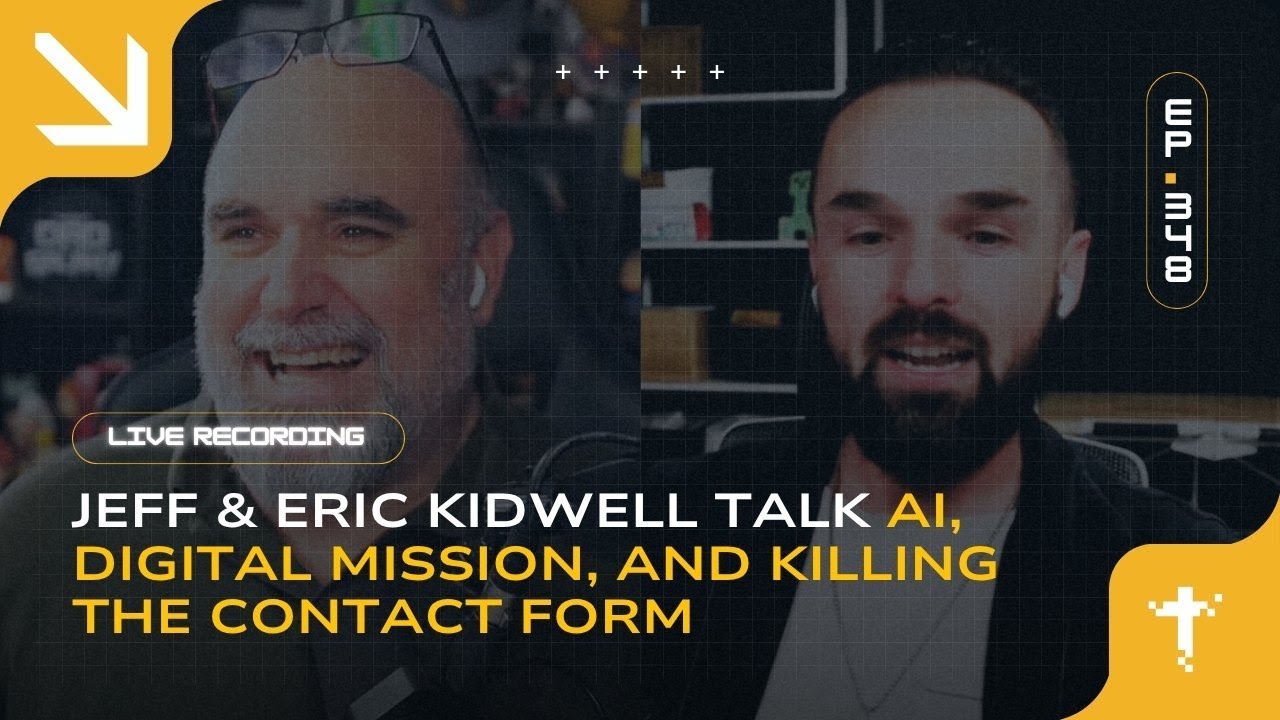
The first alpha arrived on Thanksgiving. Kidwell told his team they had given him a particularly good reason to be thankful. A beta followed around Easter. By the time of that summer interview, he said 50 organizations had used the young product and 50,000 messages had passed through it. These were not scale-at-all-costs numbers. They were evidence that people would converse with a church website if it had something more helpful to say than “we'll get back to you.”
A creative career in disguise
Bonfire can look like a sharp turn toward software. Kidwell's earlier work makes it look more like several roads meeting. He studied at Danville Area Community College, then graduated magna cum laude from Greenville University in 2008. His campus life included the student association, choir, chess club and a stock market team, an assortment broad enough to sound like four people sharing one name.
After college he worked in financial services at MassMutual. By 2010 he was serving in creative arts and pastoral work at Christian Life Church. In 2014 he founded And Studio, where the output included websites, mobile apps, logos, videos, e-commerce work and marketing campaigns. His own account of the studio placed the emphasis elsewhere. The thing he did best, he wrote, was build relationships by asking questions and listening to what customers said and what they did not.
That sentence is an early sketch of the Bonfire product. A conversational interface must listen. A useful one must grasp the values behind the words. Kidwell's work was moving from pages that displayed an institution's identity toward software that could respond from it.
His life in Rantoul also supplied a practical education in institutions. He led the local Ministerial Co-op from 2015 to 2017, bringing area pastors together each month, and continued as a member afterward. In February 2020, municipal minutes record him opening a Rantoul Village Board meeting with an invocation. These are small civic details, but they locate the founder's grand technological questions in a specific place. Bonfire was not conceived in a mythology of garages and venture capital. Its founding problem arrived in church offices and ordinary conversations.
Software with a stopping point
Kidwell's argument for ministry AI depends on limits. Bonfire's guide is supposed to use the leader's material, stay within guardrails, cite its sources and hand off when a conversation needs human care or judgment. This is technology described as an extension, not an understudy waiting for the lead to miss a performance.
The restraint matters because the product enters a sensitive relationship. A church leader's voice carries trust accumulated through years of work. An answer that merely sounds plausible can borrow that trust without deserving it. Kidwell's team includes Preston Pope, the software architect behind the infrastructure, and Nick Smith, a product leader who also serves as a senior pastor in Texas. The team presents that mix of ministry and product experience as a reason to take boundaries seriously.
It also explains the company's preferred word. Bonfire calls the product a guide, not a chatbot. The distinction is commercial, certainly, but it reveals the ambition. A chatbot talks. A guide knows where it is going, what map it may use and when the journey exceeds its competence.
A merger, a naming problem and one useful fear
Before Bonfire, there were two products: LiveAI and TAPOS. Kidwell publicly asked his network for help choosing a name when the two were being combined. It was a revealing way to handle a rebrand. Rather than emerge with a secret committee's polished answer, he made uncertainty part of the conversation. The eventual name suggests a source of warmth that can be shared, tended and carried onward. Conveniently, it also makes writing headlines about sparks almost irresistible. We have resisted, mostly.
His public notes on founding show the same appetite for small experiments. Kidwell has written about FOMO, the fear of missing out, and its quieter accomplice, FOTO, the fear of trying out. His remedy is a small bet: write the assumption, design the tiniest test, set a budget and timebox, then learn. It is advice with fewer trumpets than the average founder manifesto and more chance of surviving contact with a calendar.
The Kidwell test: turn a large wager into a one-percent bet. Cap the time, money and possible damage. Replace “what if we miss it?” with “what will we learn by day 14?”
There is playfulness around the edges. Kidwell's older personal biography lists songwriter, dreamer, worship leader, coffee drinker and Oreo eater with democratic equality. During his 2025 interview, a Google device woke while he was describing a hypothetical 2 a.m. search. He unplugged it, announced that Google was listening and continued. He introduced himself with a pastor friend's line: call him anything but late for dinner.
The jokes keep the project from floating into abstraction. Bonfire concerns presence, but Kidwell's premise begins with human absence. A leader is asleep. A staff member is busy. A visitor is anonymous. Software fills a narrow interval, then gets out of the way. The company says a setup can begin with a website URL and expand to videos, Google Drive files and uploads. What once sat in separate drawers becomes material for one guided conversation.
The ambition after the answer
Kidwell has described a five-year hope in two parts. First, he wants churches to regard Bonfire as a trusted AI layer, defined as much by what it will not do as by what it can. Then he wants to move beyond the front door and help ministries notice the revolving back door: the moment a person begins to disengage and might benefit from timely human attention.
That second ambition returns the story to relationships. The software answers a question, but the hoped-for outcome is not an immaculate transcript. It is a better connection between people. Kidwell's own phrase for the leadership problem is the move from “always available” to “always accessible.” Availability consumes the leader's hours. Accessibility lets hard-won knowledge travel while preserving the leader as a finite person.
This is an old concern dressed in new software. Teachers have always wanted lessons to last. Pastors have always wanted Sunday's words to remain useful on Tuesday. Organizations have always struggled to remember what they already know. Bonfire's novelty is to make the archive answer back, politely, within bounds, and with directions to the humans.
Kidwell is still building the proof. The product has changed names, gained co-founders and moved from an experiment toward a broader platform for churches and businesses. Its central question, however, has stayed pleasingly small. When somebody arrives at the digital front door after everyone has gone home, must they find only a form? Kidwell thinks the porch light can do a little more.