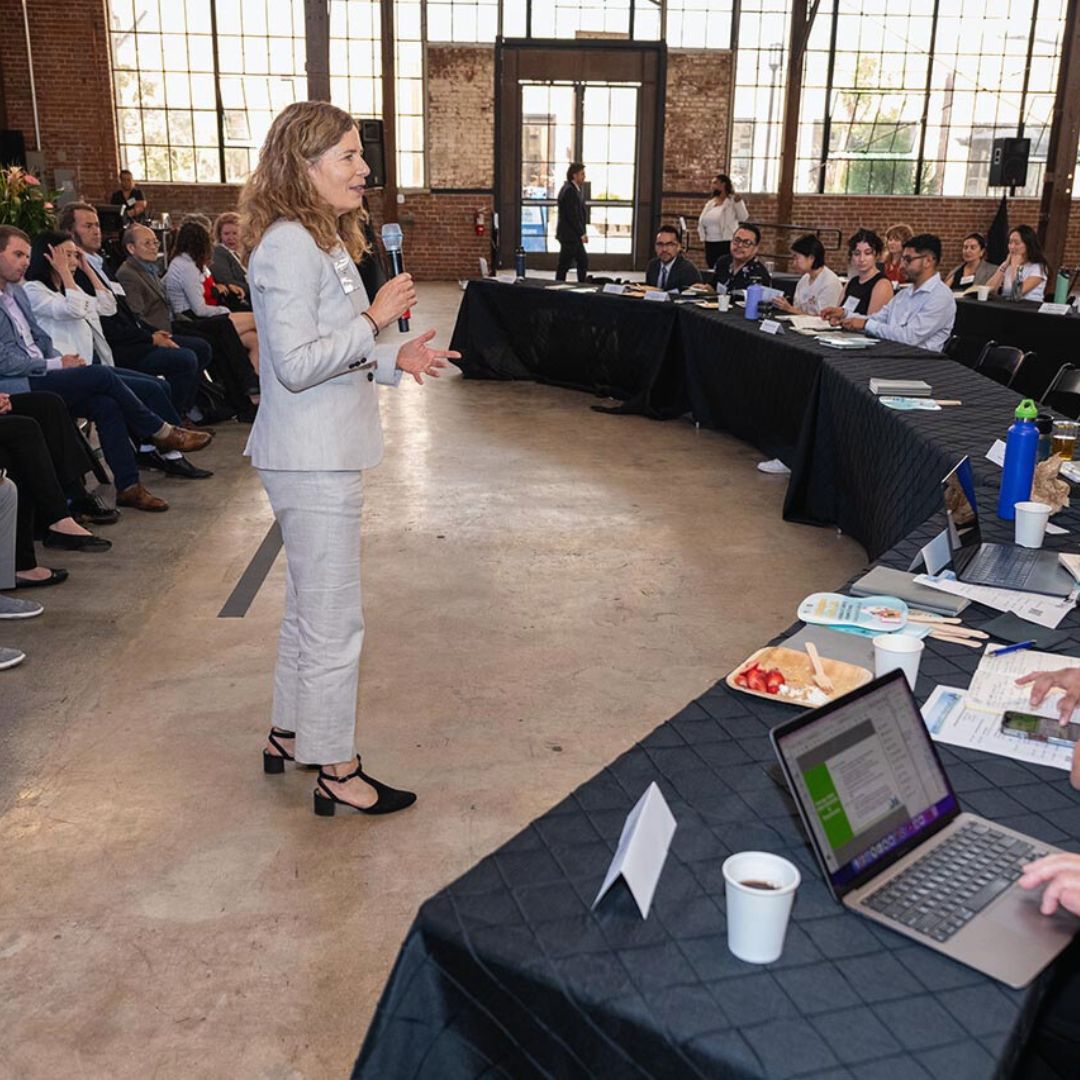
A public meeting has a peculiar geometry. The officials sit at one table. The consultants sit at another. Residents arrange themselves in rows, as if awaiting a delayed flight. A microphone stands in the aisle. Everyone has been invited to talk, but the furniture has already told them who gets to decide.
Kearns & West enters before that geometry hardens. The San Francisco firm is hired when a water plan, transmission line, habitat agreement, transportation program, or climate policy has accumulated more interests than its sponsor can comfortably hold. Its people interview participants, map issues, design the sequence of meetings, facilitate the argument, translate technical material, collect input, and leave behind a record of what happens next.
This is consulting, but the object being engineered is not the bridge or the rule. It is the encounter around the bridge or the rule. Since 1984, co-founders Ken Kearns and Anna West have turned that nearly invisible layer into a national professional-services business.
The actual productA room with an operating system
The company's service menu can sound broad: mediation, strategic planning, outreach, communications, social media, research, analytics, data visualization, training, and digital engagement. Read more closely and it describes one system. First learn who has standing and what each party fears. Then decide how information will enter the process. Convene people under explicit ground rules. Finally, document commitments so the meeting does not evaporate when everyone closes a laptop.
A 2022 report on the Western Oregon State Forests Habitat Conservation Plan shows the method in miniature. Before the larger public sessions, Kearns & West conducted 15 interviews with agency and university representatives, nine individual stakeholder interviews, and four small-group interviews. The sequence matters. The firm did not begin by asking a crowded room to discover its own agenda. It studied the room before building it.
What fails first in a difficult public process is often the format. A three-minute comment period is asked to carry years of mistrust. A technical deck arrives before anyone agrees on the question. The loudest objection is treated as the only objection. Kearns & West's wager is that better choreography will not erase the dispute, but it can make the dispute legible.
“We are impartial and do not take positions on projects, policies, or law.”Kearns & West’s published principle
Where it earnsNeutrality, sold by the hour and by the assignment
The buyers are agencies and organizations with consequential decisions and crowded maps of influence. The firm's published roster includes federal departments, California agencies, cities, transit authorities, utilities, tribes, environmental groups, universities, and companies. EPA and FEMA appear beside PG&E and Southern California Edison; BART beside Uber; the Sierra Club Foundation beside engineering firms. They are not all partners in one cause. That is the point.
Kearns & West makes money through professional-services contracts, master agreements, task orders, and government purchasing schedules. Public records put real numbers on an activity that can otherwise look like a few people, a whiteboard, and coffee. In 2023, the Bay Area Air Quality Management District increased one facilitation agreement from $95,000 to $350,500, then later to $525,500. In 2025, the Denver Regional Council of Governments authorized negotiations for $2.3 million of community engagement on building decarbonization, with a $1.7 million option. A Bureau of Reclamation task order reached roughly $2.185 million. Sonoma County approved up to $324,120 for outreach, needs assessment, and feasibility work on climate resiliency centers in 2026.
The price of the conversation
Selected ceilings and awards in public records, not company revenue.
*Includes a $1.7 million renewal option. Contract ceiling is not the same as money spent or an outcome achieved.
The cost rises with geography, duration, language access, the number of stakeholders, research demands, and the burden of documentation. A facilitator may be visible for two hours; the contract pays for the weeks that make those two hours useful.
The differenceThe firm refuses the most tempting role
Strategic-communications agencies are normally paid to sharpen a client's position. Engineering consultancies often conduct outreach around a solution they are also helping design. Kearns & West does communications and works beside technical firms, but its distinctive claim is procedural impartiality. It says it will not take a position on the underlying project, policy, or law; will avoid conflicts; and will accept collaboration work only when participants understand the neutral role.
That is both an ethical stance and a competitive boundary. The company is not selling the winning argument. It is selling confidence that the argument was heard, tested, and recorded under rules that did not quietly change halfway through.
Its market sits between several alternatives. A public agency can use its own planners and communications staff. It can hire a public-relations firm, a specialist mediator, or a large engineering and environmental consultancy with an engagement practice. Kearns & West combines those fragments: neutral facilitation, policy fluency, communications production, and the administrative muscle to run a long, multi-party process.
The model also explains the firm's concentration in water, energy, land, marine resources, transportation, and climate. These sectors mix technical uncertainty with legal obligations and unequal consequences. A decision can be lawful and still lack legitimacy; popular and still ignore evidence; beautifully messaged and still arrive too late for anyone to shape it.
A useful imitationCopy the sequence, not the theater
You do not need a government contract to borrow the method. A product team arguing over a roadmap and a town arguing over a substation share one awkward fact: positions arrive before interests. “Build it” and “stop it” are positions. Reliability, cost, safety, control, and recognition are interests. The productive work begins when the latter become discussable.
The five moves worth stealing
- Interview participants separately before asking them to perform agreement in public.
- Write down the decision, the decision-maker, and what influence participants actually have.
- Translate technical claims into a shared evidence set before debating conclusions.
- Offer more than one doorway: live meetings, small groups, digital input, and accessible materials.
- End with owners, dates, unresolved questions, and a next-step memo everyone can inspect.
Notice what is absent: a promise that everyone will agree. Consensus may be an intended goal, but the firm's own language leaves room for other outcomes. A well-run process can identify the real disagreement, improve a plan, produce an agreement, or simply give a lawful decision a more honest record.
Nor is neutrality magic. Kearns & West's principles make the conditions explicit. Participants must accept the facilitator's impartial role. The sponsoring organization must be genuinely committed to collaboration. Conflicts of interest disqualify the assignment. If leaders have already made the decision and want participation as decoration, the method loses its load-bearing beam.
The firm does not chiefly change minds. It changes the order in which minds meet: listening before convening, interests before positions, shared information before conclusions, and written next steps before the room empties. That order is the product. The microphone is merely where we happen to see it.