Before Eren Bali helped build a marketplace for other people’s knowledge, he had a problem with the local supply. He was growing up in Durulova, an apricot-farming village in Turkey’s Malatya region, and the mathematics he wanted to learn had outgrown the mathematics available nearby. His family’s used computer offered an unusual solution: ask people who lived somewhere else.
The machine had been bought for his older sister. Bali found his way to online mathematics communities, where strangers posted problems and discussed solutions. Some replies were encouraging. Others supplied an early education in the manners of the internet. He kept working. A village schoolboy could now put a question to people he would otherwise never meet.
There is a temptation to rush from that computer to the companies. Udemy, which he co-founded in 2010, became a public company in 2021. Carbon Health followed as another founding venture in 2015. Today he is co-founder and CEO of Monogram, working on a visual interface for artificial intelligence. The intervening years deserve a slower reading. They show someone repeatedly trying to make complicated things easier to reach.
Five grades, one room, no shortage of questions
Bali’s parents were teachers who returned to their village when recruiting teachers there was difficult. His mother taught five grades in a single room, moving between them and looking after the schoolhouse itself. Some children walked miles to attend. Learning already mattered intensely in this household; the computer widened the circle of people who could help.
Summer brought apricot farming and herding animals. His father made him wooden chess pieces, and Bali spent hours playing. Chess and mathematics offered problems that could hold his attention long after a lesson ended. The details have a pleasingly homemade quality: a family producing its own teaching, its own chess set, and eventually its own route into a much larger conversation.
His account gives the other learners and teachers a place in the picture. The village contained eager children, dedicated adults and real limits on what could be taught nearby. An internet connection changed the size of the available classroom. It also left plenty of work for the pupil. Having access to difficult problems and being able to solve them remained separate achievements.
In 2001, representing Turkey at the International Mathematical Olympiad in Washington, Bali won a silver medal. His score was 20 out of 42. Two problems earned him full marks; another earned zero. Even the official results resist the tidy version of a prodigy’s biography. Here was a teenager learning how to stay with something difficult, with a score sheet to prove both the success and the difficulty.
Points at the International
Mathematical Olympiad
medal
The prototype that needed a different address
At Middle East Technical University in Ankara, Bali studied computer engineering and mathematics. Around the computer science labs, he and friends built things: a music player, a news aggregator, online services they could try themselves. His friend Sertac Karaman remembered his interest in turning lessons into things people could actually use. The academic material kept acquiring buttons.
His first attempts at an online teaching business preceded Udemy. In 2007, he worked on a live education platform in Turkey. The ambition was straightforward enough: publishing a lesson should become as accessible as publishing a video or a blog. Making the business work proved less straightforward. In a later account of that attempt, he identified problems with the product, the timing and the place.
He also worked as an engineer at SpeedDate. This part of the biography is useful precisely because it is ordinary employment: software to build, users to serve, practical experience to accumulate. The future founder of an education marketplace was acquiring an education in how an internet business ran.
In 2009, Bali and Oktay Caglar moved to the United States and joined the Founder Institute. There Bali met Gagan Biyani. The three co-founded Udemy in 2010. An idea carried from Turkey was finding collaborators and a different setting. Moving supplied proximity to people who understood internet businesses, though investors still needed persuading. A Silicon Valley address did not come with an automatic yes.
Could the teacher be anybody?
The proposition behind Udemy gave expertise a wider definition. A person could know something useful without holding a university teaching post. A learner could want a particular skill without wanting an entire degree. Connecting those two people meant building tools for instructors, a place to discover courses and a way to make teaching worth the instructor’s time.
That last part mattered. In 2012, Bali described instructors earning money alongside those sharing a passion or building a professional reputation. An open platform still needed reasons for people to contribute. For teachers, the prospect of an audience and an income made preparing a course a more practical undertaking.
He also argued for learning that continued throughout a working life. People needed to pick up skills when their circumstances changed, wherever they happened to live. The idea made sense for the boy who had searched for mathematics outside his village. It also made sense for an adult trying to learn something useful after work, with neither the schedule nor the budget for another spell at university.
By 2014, Bali had been named to Forbes’ 30 Under 30 list in education. That year, Dennis Yang succeeded him as Udemy’s CEO, while Bali moved toward product and strategy. The business now required a different allocation of responsibilities. Having the original idea and doing every senior job indefinitely are separate ambitions, and his career would include several more changes of title.
Quiet confidence, detailed arguments
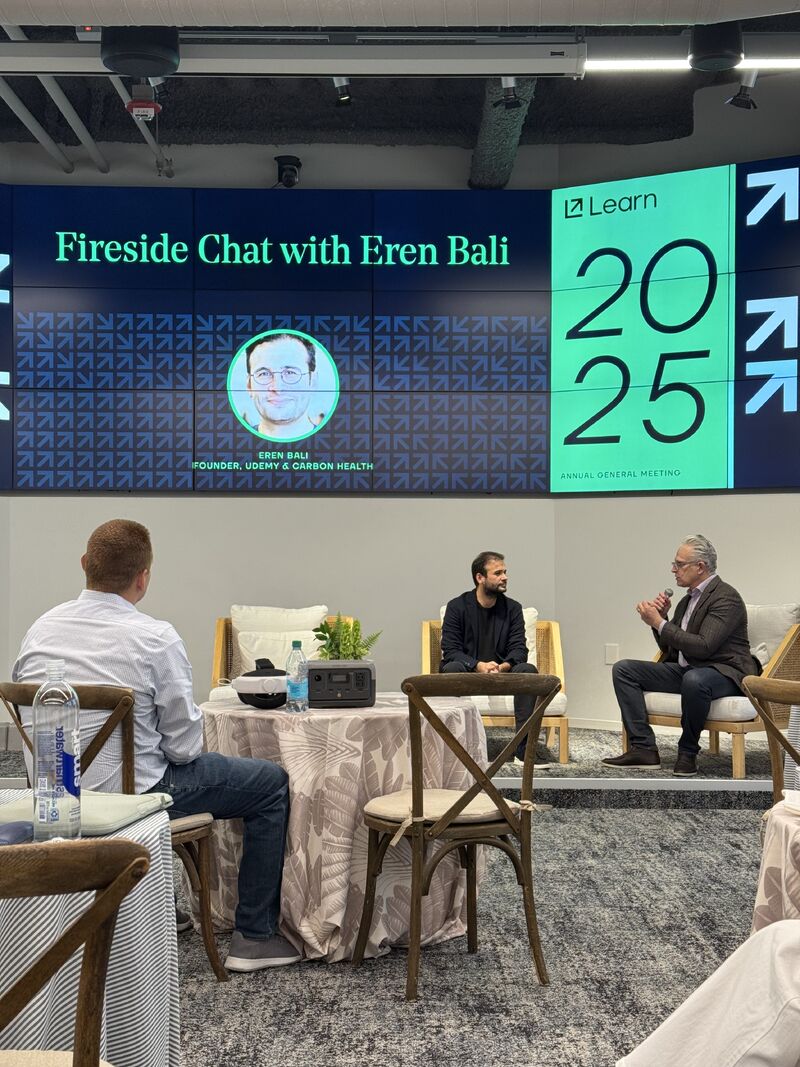
The people who have worked with Bali offer a useful corrective to the booming voice often expected of a startup founder. Investor and friend Paul Lee described “a weird, quiet confidence about him.” Karaman recalled his appetite for “deep discussions about minute details.” Neither description suggests someone content to remain at the level of the pitch.
Those observations fit the engineering work, the mathematics and the willingness to keep rebuilding an education product. They also help explain why his ambitions can sound unusually large beside his manner. A person can speak softly and still propose changing how millions of people do something. The interesting test is what happens when the proposal encounters all those minute details.
Bali has used the phrase “commercial idealism” to describe the possibility of pursuing broad social ambitions through a company. His parents’ example gives that idea a personal history. Their work centered on making an opportunity available where it was scarce. His companies require employees, customers and financing, but the question of who gets access keeps returning.
His 2013 TEDx talk put the educational version of that belief plainly: “learning to learn by yourself.” The phrase leaves responsibility with the learner. A useful platform can bring material within reach, while curiosity and practice still have to do their part. Bali’s own medal arrived after the computer, with many problems between the two.
“Learning to learn by yourself.”
Eren Bali / TEDxBayArea, 2013
A founder can come back with a different job
Udemy went public on October 29, 2021. For a company built around people teaching one another online, the stock exchange was a conspicuously formal destination. Bali’s founding letter looked back to the apricot orchards and the opportunities an internet connection had opened. The distance traveled was considerable; the starting problem remained easy to recognize.
In August 2024, he returned to Udemy as chief technology officer. He stepped down from its board and took responsibility for engineering, data and technical program management. He had also moved from CEO to executive chairman at Carbon Health. These changes placed him back inside the daily technical work of the education company he had helped start fourteen years earlier.
Another adjustment came in June 2025, when Udemy appointed Ozzie Goldschmied as CTO and moved Bali into a newly created Head of Innovation role, focused on product strategy and artificial intelligence. The sequence makes a useful career timeline: founder, CEO, board member, returning technical executive, then a role built around developing what might come next.
Co-founds
Udemy
Udemy lists
on Nasdaq
Returns
as CTO
Launches
Monogram app
The next lesson should be easier to use
Monogram, co-founded with Edouard Tabet and Murat Akbal, puts Bali back at the beginning of a product. Its October 2025 manifesto argued for a more visual, collaborative way to use AI. The team wanted software that could adapt its interface to the task, reducing the work people had to do to turn an answer into something useful.
On July 7, 2026, Bali publicly announced Monogram’s iOS app and a $40 million seed round led by DST Global Partners and Lux Capital. Its examples were everyday activities: choosing a film, finding a recipe, planning a trip. The product generates interactive visual responses. The aim is to make the next action easier to see and take.
There is a familiar question beneath this new project: how much useful capability remains out of reach because using it takes too much effort? At Udemy, building a course marketplace gave teachers and learners a place to meet. At Monogram, the interface itself is the work in progress. Bali has chosen another problem whose answer must eventually make sense to someone outside the engineering team.
The used computer in Durulova could not supply a finished education. It gave a curious boy somewhere to begin, and people to ask. Years later, Bali is still building around that opening: the moment when someone encounters a subject they do not yet understand, finds a way in, and decides to keep going.