In the winter of 2023, somebody at a Tyson Foods plant could encounter a cheerful yellow character named Ty Wellbe in a place where advertising people rarely imagine their work: beside a time clock, inside a locker room, on a bathroom door. Ty was round, grinning and usually holding a phone. His task was to persuade workers to register for an employee wellbeing program. This sounds like a mascot assignment. It was really a logistics problem.
Tyson had 449 locations in the campaign and a workforce measured in six figures. Registration required several steps, including multi-factor authentication. Many employees did not sit at desks. Many spoke languages other than English. Before the campaign, 8,716 people were enrolled, or 6.9 percent of those eligible. The target was 15 percent. The message was not merely competing with other ads. It was competing with a shift change, a password and the reasonable suspicion that one more corporate program might require more effort than it returned.
Encore, the Longview, Texas agency hired to work on the problem, made a live-action video with members of Tyson's HR team. Then it built a plant competition, a manager toolkit, an animated film, posters, handout cards, digital signs, QR codes and simpler visual instructions for authentication. Seven weeks later, enrollment stood at 14,164. That was 5,448 new registrations, an increase from 6.9 percent to 11 percent.
The interesting number is not 11. It is 449. A campaign at that scale cannot survive on a clever line alone. It needs local distributors, visible progress and instructions that work while somebody is standing under fluorescent lights with a phone in one hand. Encore's work suggests a modest proposition: the unit of marketing is not the impression. It is the next action.
A small agency made of smaller agencies
Encore was founded in 1994 by Dean Waskowiak. In 2005, it formed EDSuite around a very particular customer: the economic-development organization. These are the people charged with making a city or county understandable to site selectors, employers, residents, officials and local businesses, sometimes all on the same webpage. EDSuite says it has launched more than 200 economic-development websites, served more than 70 Texas clients and won 29 International Economic Development Council awards.
In April 2022, Erik Halvorson acquired Encore Multimedia and EDSuite through Encore Communications. A second specialist identity, Encore HR Communication, was formalized in 2023. It focuses on employer branding, recruiting, benefits and employee experience. The company itself remains small - the supplied record counts 19 employees, while LinkedIn places it in the 11-to-50 range - but its work includes Tyson Foods, the Texas Department of Agriculture, banks, school districts, manufacturers, health systems and local governments.

The architecture is the point. Niche strategists sit close to the customer. Behind them is one shared bench of writers, designers, developers, videographers, photographers and media planners. A tiny specialist firm might understand an economic developer but outsource the difficult production. A broad agency might own the production but need weeks to learn why a site selector behaves differently from a tourist. Encore is attempting to split the difference.
“Aim small. Win big.”Encore's current positioning
This is not a software company disguised as an agency. Its business model is familiar: strategy and creative services sold directly to organizations, usually as custom projects or campaigns. Its offerings cover research, planning, copy, design, video, photography, websites, media buying and campaign management. What changes is the wrapper. The same production talent can build a recruitment spot for a school district, a capital-campaign film for a cancer center or a website for a manufacturer. The account knowledge stays narrow.
What failed first was the easy path
The Tyson campaign began with a familiar communications failure: availability was being mistaken for usability. A wellbeing platform existed. Employees could register. Yet the baseline remained at 6.9 percent. The obstacle was not one dramatic breakdown. It was a pile of little frictions - authentication steps, language differences, a dispersed workforce and limited access to a desk during the day.
Encore changed the environment around the decision. Managers and wellbeing champions received materials. Plants competed on registration percentages, with updated standings shown every two weeks. QR codes collapsed the distance between seeing and doing. Technical guides were redrawn. Ty Wellbe gave the campaign a visual speaker that could travel more easily across cultures than a paragraph from headquarters.
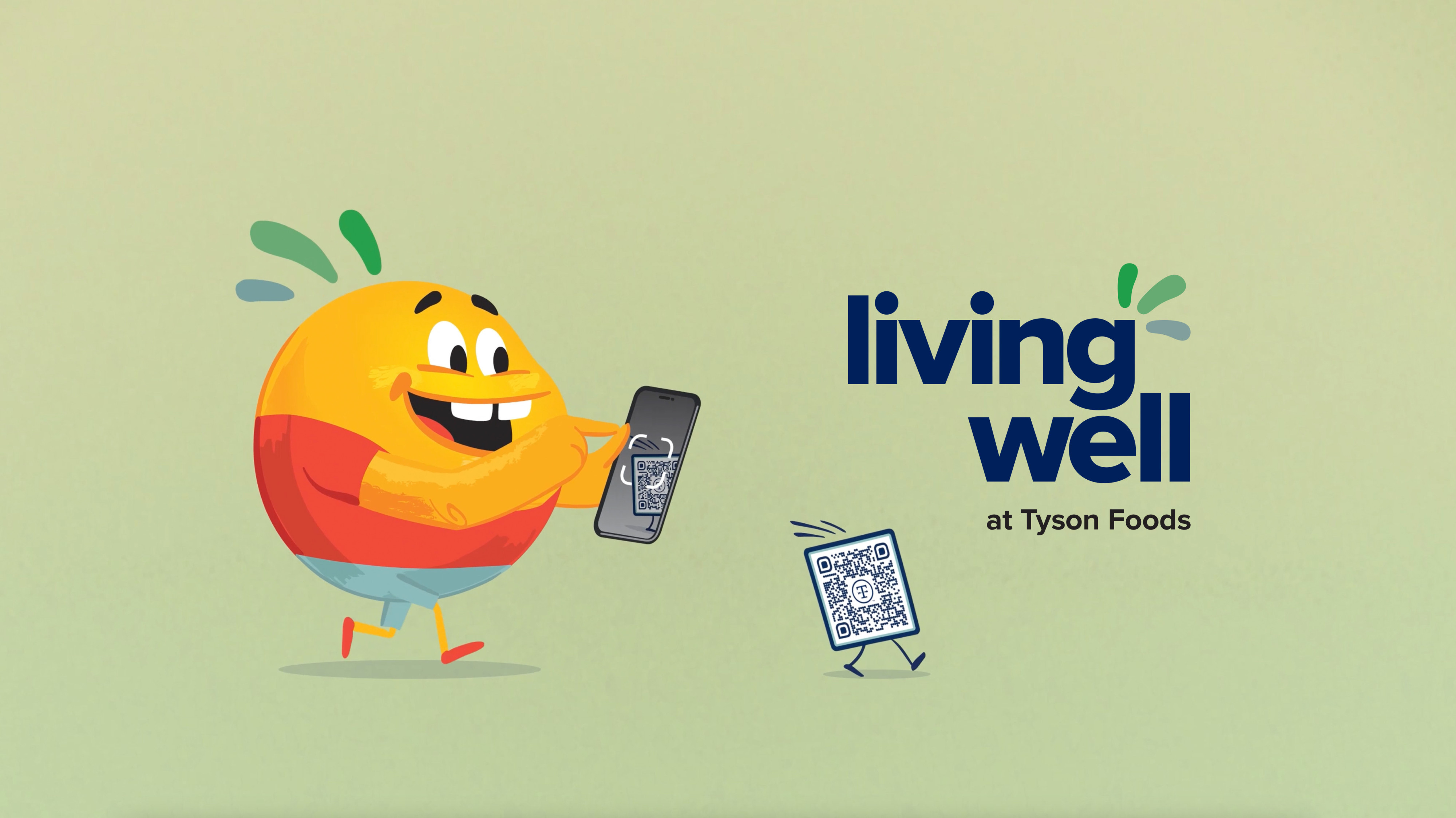
The campaign did not reach its stated 15 percent ambition during the seven-week contest. That matters. A result can be useful without being magical. It also reveals the conditions underneath the playbook. A QR code is powerful when workers have phones, connectivity and permission to use them. A plant contest works when local managers distribute materials and employees trust the incentive. A character can bridge language, but not replace accurate translation. The method depends on operational cooperation, not just creative approval.
The pandemic moved the media plan
Encore had already learned a version of this lesson with Longview Independent School District. The agency's multi-year “Education with Purpose” work used television, radio, print, billboards and grassroots materials to explain the district's magnet, Montessori, STEAM and International Baccalaureate programs. Then campuses and cinemas closed during the pandemic. The audience did not vanish. Its routines changed.
Digital became a larger part of the plan: search ads, retargeted display, geofencing, YouTube, connected television and Hulu. The change was not a declaration that old media had died. Billboards and printed materials remained useful. It was a practical response to where parents had gone. The same pragmatism later appeared in the Tyson work. QR codes, newly familiar after the pandemic, became the hinge between physical signs and a digital enrollment flow.
Encore's portfolio is full of these small translations. Ten East Texas bank branches operating under four names were confusing customers and inadvertently competing with one another. Encore helped consolidate them as First National Bank of East Texas, then presented ten logo directions. For a MyPlates commercial, the agency staged a home-renovation reveal in which the garage door opens and the only improvement is a new embossed license plate. For CHRISTUS Health, it paired a fundraising film with a physical card containing its own video screen. The channel follows the moment.
The useful sequence to steal
There is no need to copy the mascot. The repeatable part is less photogenic. Encore starts by giving the audience a sharper name than “the public.” It establishes a baseline. It looks for the first point at which intention turns into abandonment. Then it gives the campaign to people already trusted inside the system and makes progress visible while there is still time to change the result.
Not “employees,” but shift workers across 449 facilities, with uneven desk access and many first languages.
In this case, registration and multi-factor authentication needed visual simplification before more promotion.
Managers and local champions carried the campaign into routines a remote marketing team could not see.
Biweekly standings made the plant competition observable and gave lagging locations time to react.
This sequence also explains Encore's newest packaged service. The agency currently advertises an AI Optimization Audit for small businesses. It reviews website content and structure, directory profiles, reputation signals and schema markup, then delivers recommendations and, where access permits, hands-on profile updates. The price is public.
The product is different from a national employee campaign, but the intellectual move is identical. First define the peculiar audience. This time the audience is partly a machine trying to understand what a local business does. Then structure the information so the next step becomes easier.
Local does not mean small
Encore occupies an awkward and potentially useful place in the agency market. It is too broad to be merely a web shop and too small to behave like a holding-company network. Its alternatives are regional full-service agencies, specialist consultancies, freelancers and in-house teams. The wager is that clients will prefer one accountable group, provided that group already understands the audience.
That wager has limits. Shared specialists become a bottleneck if too many campaigns peak together. Niche knowledge ages unless people keep doing the fieldwork. A 19-person team cannot plausibly be expert in every vertical it names. And measurement is only as good as the client's data. The Tyson result is persuasive because it includes a baseline, a period and an outcome. Many agency portfolio pages stop at the deliverable.
Still, the Longview location is instructive. Encore's office is far from the standard agency centers, yet it works on national employee communications and public-sector marketing across states. Its local roots have not prevented reach. They may have encouraged the habit of specificity. In a smaller market, “the audience” is less likely to remain an abstraction. It is the parent at the school, the worker at the plant, the business owner two blocks away.
The best thing Encore made for Tyson was not Ty Wellbe. It was a chain of small permissions: permission to notice the message, to understand it, to begin, to ask for help and to see that other people had begun too. Advertising loves the grand reveal. Behavior usually changes one ordinary obstacle at a time.