Emily Kirsch’s first encounter with clean energy came with coffee and chocolate. After high school, she changed her plans to attend a school in New York and moved to an organic farm in Costa Rica. The farm ran on solar power and storage. At night, the lights worked without the racket and fumes of a generator. She remembered the quiet. Electricity, that most taken-for-granted convenience, had suddenly become interesting.
Years later, in Oakland, Kirsch would build a business around a different kind of connection. Entrepreneurs had technologies. Corporations had customers, infrastructure and money. Investors had capital. Getting these people into a useful conversation became the work of Powerhouse, which she co-founded in 2013. The farm had shown her a working alternative. Oakland gave her a place to help alternatives find a market.
The farm before the fund
There is something pleasingly inconvenient about this origin for a venture investor. The story begins outside the usual sequence of internships, consulting jobs and introductions to introductions. A farm supplied the demonstration. The experience was domestic and immediate: light after sunset, with the machinery of producing it unusually visible.
That detail helps explain the appeal of her later work. Clean energy can become an argument conducted in units, percentages and distant deadlines. On the farm, it did something ordinary. The distance between an impressive technology and a useful service had already been crossed. Kirsch had the chance to live on the other side.
She went on to study Sustainable Urban Development at San Francisco State University. Her undergraduate program was a major she shaped herself, bringing together questions about energy, water, transportation and infrastructure. A student interested in how systems fit together was assembling an education out of the same impulse. The shape of the problem mattered more than the convenience of a ready-made course of study.
Oakland, with an unexpected soundtrack
Before Powerhouse, Kirsch worked at the Oakland organization founded by Van Jones. Her responsibilities included workforce development, climate policy and state ballot initiatives. She helped launch the Green Jobs Corps and was the founding convener of the Oakland Climate Action Coalition. That work put clean energy alongside training, employment and the practical business of getting a city to act.
Community organizing is an education in who can do what. A proposal needs supporters. A training program needs participants and opportunities. Someone has to keep the relationships moving long enough for an idea to survive its encounter with everyday life. Kirsch’s early career put her close to those negotiations, well before she was making venture investments.
Then came Mosaic, the solar-finance startup founded by Billy Parish and Dan Rosen. Kirsch helped with its Oakland pilot and first customers. The project had an unlikely benefactor: Prince. Through his friendship with Jones, the musician supported the pilot with a philanthropic grant. Kirsch described the gift as part of his anonymous giving. The purple connection was real; the work on the ground was finding people who could use the service.
Mosaic let her see how valuable customer connections could be to a young company. She began looking for an organization that brought clean energy founders, investors and corporations together. When she did not find the model she wanted, she and Danny Kennedy started Powerhouse. Their first investor put in $50,000. Kirsch was 27 when she left her job to make it her work.
The early setting was shared office space, with Mosaic, kWh Analytics and other startups nearby. In Kirsch’s recollection, Richard Matsui’s little office contained a suitcase; he seemed perpetually in shorts and flip-flops. It is a useful corrective to the gleaming retrospective version of startup life. Sometimes the future of an industry is being worked out beside somebody’s luggage.
“Trust is always a work in progress.”Emily Kirsch, 2019
When the room became too small
Powerhouse began as an incubator and accelerator. It offered a place where founders could work near one another, with the conversations and introductions that proximity allows. By 2016, the organization’s record included 40 startups and four acquisitions from its incubator. Its companies had collectively contributed to 156 megawatts of solar installation during 2015. Those were figures from that early chapter, when solar was the central focus.
There was also a party. New Dawn brought the community together, and a 2016 account pictured Kirsch onstage celebrating with entrepreneurs. A business concerned with decarbonization could apparently accommodate an evening out. The social part had a practical purpose: people who might later work together had a chance to meet before anybody needed a formal decision.
But a shared office and a scheduled accelerator create boundaries. The available desks limit who can join. A cohort’s calendar determines when help arrives. By 2020, Kirsch was explaining why Powerhouse had changed its model. She wanted to reach founders nationally and globally, and to back companies when the opportunity arose, beyond a program’s fixed cycle.
The evolution took Powerhouse into corporate innovation work and, in 2018, a separate venture fund. Keeping the original purpose required changing the form. That is a less tidy entrepreneurial story than inventing a model and defending it forever. It also seems a more useful one. The first arrangement had created relationships; those relationships were making a different arrangement possible.
for founders
venture fund
$75 million
Buying time for the technologies that work
Powerhouse Innovation and Powerhouse Ventures serve related needs. The consulting business helps corporations and investors find and evaluate startups. The fund invests in seed-stage software companies across energy, mobility and industry. Kirsch leads both, as founder and CEO of the former and founder and managing partner of the latter.
The software focus gives the investing work a particular question: how can technologies that already work become easier to deploy? A wind turbine or solar panel exists in a world of finance, operating decisions and customers. Software can help people navigate that world. It is a way to work on the practical barriers around physical equipment, where a useful invention can still face a slow journey to widespread use.
The fund’s first exit provided an example. In May 2021, SparkCognition acquired Ensemble Energy, which used predictive analytics for renewable-asset operations and maintenance. Understanding when equipment might fail has consequences for production and revenue. Kirsch’s account of the deal connected a software company’s capabilities with an acquirer seeking a way into renewable energy.
Fundraising brought its own interval of uncertainty. For the second fund, Kirsch described an initial target of $50 million and a period when commitments stalled around $30 million. The eventual total was $75 million. Microsoft anchored the fund, with other corporate and individual investors joining. Having more capital widened what the firm could do while preserving its interest in young companies.
The number is useful because it marks a change in capacity. It is also easy to let it swallow the story. A fund still depends on choosing companies, understanding their markets and working through the disappointments that money cannot preempt. Kirsch’s work remains close to the question that attracted her to Mosaic: who needs this, and how do the people building it reach them?
A microphone for the unfinished journey
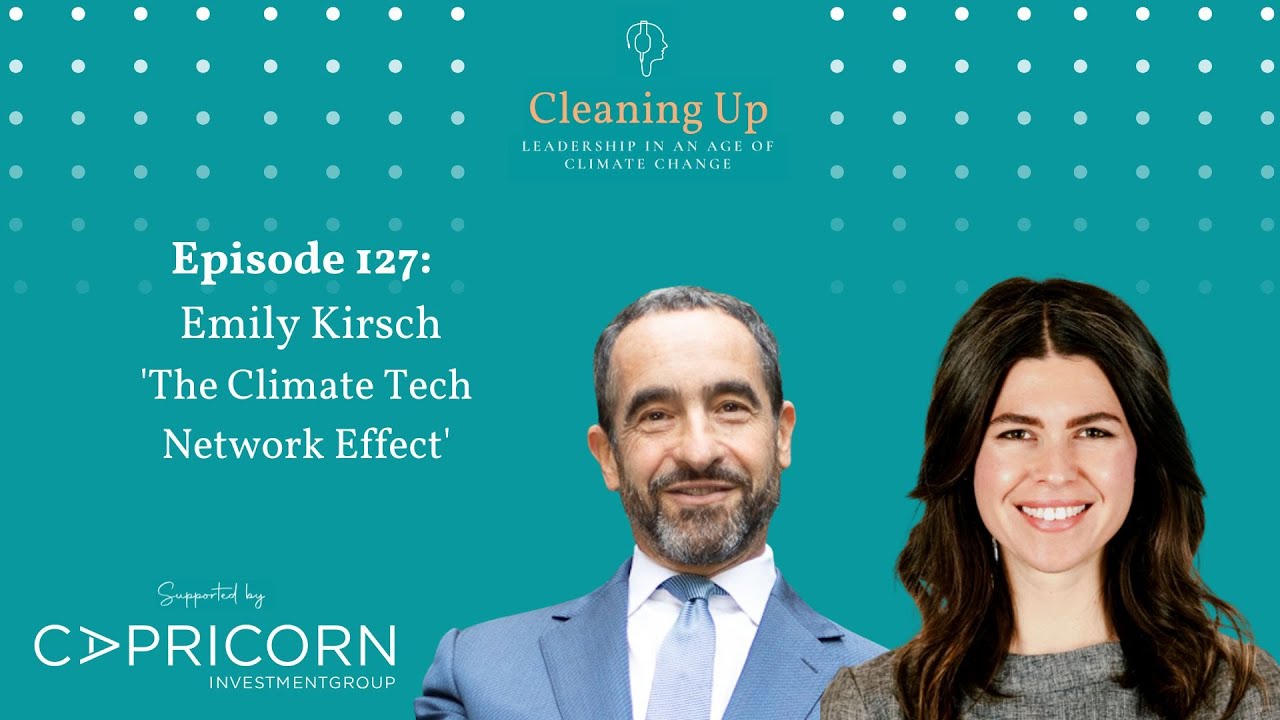
Kirsch has another way of bringing people together. On Watt It Takes, she interviews founders about how they built their businesses and how their lives brought them there. The name gets its electricity joke out of the way early. The conversations have room for childhood, risk, failure and the choices that disappear from a polished company biography.
The podcast began with a discussion at an Oakland wine bar involving Kirsch, Shayle Kann and Emily Fritze. Kirsch had heard industry leaders at conferences and saw limits in the format: attendance was expensive, the audience was bounded by the room, and the conversation tended to concentrate on companies and technologies. A recorded founder conversation could travel farther and ask different questions.
Watt It Takes aired through The Energy Gang from 2017 to 2021, then launched independently in April 2021 with Google as its exclusive launch sponsor. Stephen Lacey continued producing it. When the microphone turned toward Kirsch herself that July, Kann interviewed her about the journey behind Powerhouse. The person asking founders how they endured the early years had early years of her own.
In a 2020 conversation about podcasting, she singled out her interview with Mosaic’s Billy Parish as especially meaningful. Their histories were connected. The show had also featured SunPower founder Dick Swanson and Sunrun co-founder Lynn Jurich alongside founders earlier in the process. Hearing someone whose business is established can be useful; hearing someone still working through uncertainty can be useful in a different way.
Seeing the next person in the room
In 2017, Kirsch received the C3E Entrepreneurship Award. She had attended a C3E gathering while launching Powerhouse and met women who mentored and encouraged her. Her acceptance supplied a compact description of why that mattered: “C3E is a testament to the idea that if you can see it, you can be it.”
Recognition followed elsewhere, including selection as a World Economic Forum Young Global Leader in 2019 and the San Francisco Business Times’ influential-women list in 2020. Her current C3E biography also lists board roles at ThinkLabs AI and Sesame Sustainability, plus a place on Activate’s Leadership Council. These connections extend the work into grid software, industrial decarbonization and support for emerging innovators.
The person behind that calendar still has other ambitions. Her official venture-team biography lists long hikes, bike rides and aspiring wingfoiling. The last sounds like a useful opportunity to practice being a beginner. Away from investment decisions and interviews, there is at least one pursuit in which staying upright is a perfectly respectable objective.
As of October 2026, Powerhouse is preparing for New Dawn on October 22 in Oakland. The gathering remains part of the organization’s life, even as its work stretches beyond the city. Kirsch’s recent public posts have also emphasized hiring leadership for Powerhouse Innovation and the importance she places on a cohesive team.
The continuity is in the people. A farm made electricity tangible. An Oakland pilot made customer connections tangible. A shared office made community tangible. Kirsch kept building around those experiences, changing the business as she learned where it could be useful. Somewhere between a founder’s idea and a customer’s decision, there is a conversation that still needs to happen. She has made a career of getting it started.