A roofing contractor can finish the roof and still be waiting for the money. Materials have been bought. Workers need paying. The insurer’s payment moves to a different timetable. For SquareDash, a Texas fintech company, that gap was the business opportunity. For Emerline, the engineering company it hired, the interesting problem began with something that already worked: a prototype.
- Emerline builds custom software and supplies the teams that keep developing it.
- Its customers range from roofing fintech SquareDash to lubricant manufacturer FUCHS.
- The useful lesson: prove demand cheaply, then decide which constraints deserve a custom build.
Founded in 2011, Emerline is a software engineering business within LeverX. Its offering makes more sense when viewed from that awkward moment between demonstration and daily use. Someone must decide what to preserve, what to rebuild, and which responsibilities the next version must carry. Those decisions are where an outside engineering team earns its fee.
The demo had done its job
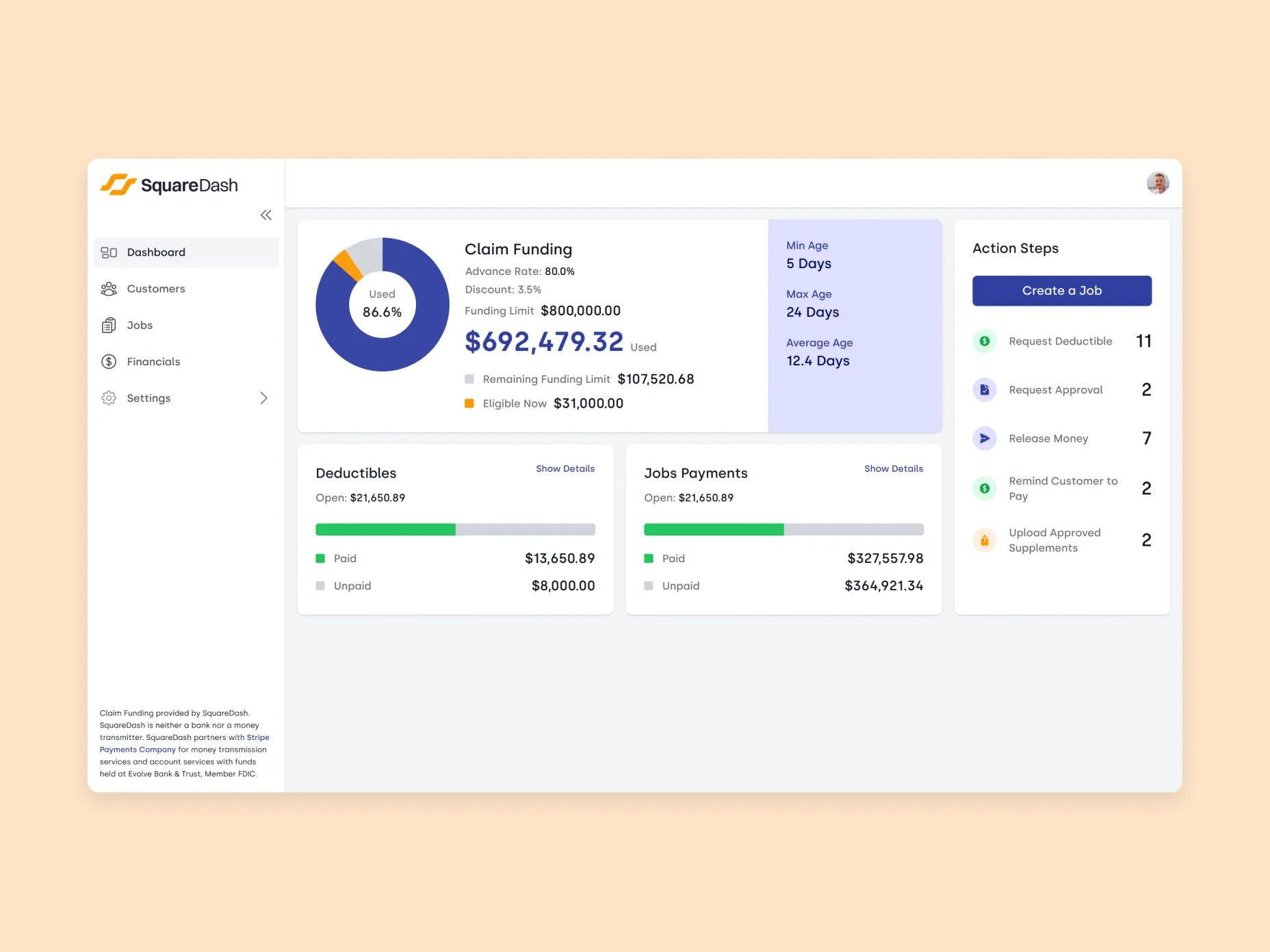
SquareDash had tested its idea using an open-source expense and payments system. The response was promising. The foundation, however, restricted the changes its next product would need. Emerline’s account describes a deliberate rebuild, with a cross-functional team and short delivery cycles. A production version was completed in April 2024 after 14 months.
The work connected job management, payments, cash advances, and insurance-document processing. Operators could check extracted line items. That human checkpoint matters: automating paperwork still requires a way to correct it. The practical lesson is to separate evidence of demand from confidence in an architecture. A prototype can supply the first while leaving the second unresolved.
The contractor who stayed
Another customer had intended to make a different kind of replacement. CPG Data’s president and CEO, Tracy B. Neal, says he initially saw Emerline as a temporary arrangement until he could afford a technical team in the United States. Instead, the relationship continued. In a testimonial published by Emerline, he calls its people:
“an important part of our strategic Team”Tracy B. Neal / President and CEO, CPG Data
The original brief involved helping beverage distributors upload photographs of product displays. It grew into a sales analytics platform with reporting and additional modules. Emerline documents successive changes to its backend, frontend, database, and infrastructure. The useful distinction is continuity of knowledge alongside changing technology. A long-running team can remember the customer’s business while replacing the machinery underneath it.
A factory is a demanding user
At FUCHS, the lubricant manufacturer, the problem involved scattered operational information, manual collection, and equipment monitoring. Emerline says its engineers visited manufacturing sites before settling the initial feature set. They cut some proposed features, built around Microsoft Azure, and connected sensors, reports, and technician workflows.
One detail deserves more attention than a cloud-platform logo: the technician application works offline. A factory does not reorganize itself around an app’s preferred internet connection. The international rollout also required regional infrastructure adaptations in China. These are useful reminders that deployment conditions belong in the design brief. A solution that depends on uniform connectivity or identical services everywhere would have missed the workplace.

You buy a team, then keep making decisions
Emerline operates as part of LeverX, with a service offering that runs from product discovery and interface design through engineering, testing, cloud deployment, and support. It sells project delivery, dedicated teams, and consulting. Web and mobile applications sit alongside data engineering, AI integration, commerce implementations, and legacy modernization.
Its customers include startups and established enterprises. Espresa, for example, used Emerline to develop an employee-services platform connecting benefits and third-party services. The documented integrations include calendars, Slack, and Stripe. That helps explain the market position: businesses hire this kind of partner when their product must coordinate several systems and reflect their own operating rules.
The LeverX connection gives Emerline access to a wider enterprise technology ecosystem. Its partner page lists AWS, Microsoft, and Google Cloud relationships through the group. The distinction a buyer should investigate is how that experience reaches the proposed team: who designs the architecture, who handles integration, and who stays after launch.
A proposal should make that division of responsibility concrete. Ask for the people who will own difficult decisions, the assumptions behind the estimate, and the mechanism for changing scope. Compare the same brief across an internal hire, a dedicated external team, and a packaged product. Each option places the management burden somewhere different.
The budget outlives the launch
Clutch lists Emerline at $50-$99 per hour, with a $25,000-plus minimum project size. Those directory figures are a starting point for a conversation. Scope, staffing, integrations, and support determine the actual bill. Emerline’s own website advertises flexible engagements without project-size restrictions, so buyers should resolve the terms directly.
$25,000+ listed project minimum. Indicative figures, not a quote.
Ownership brings recurring decisions about maintenance, infrastructure, security, and the next release. As a purchasing judgment, a conventional workflow already handled well by packaged software is a weak reason to commission a bespoke system. The case strengthens when a specific limitation costs customers time or prevents the business from doing something valuable.
AI joins the integration business
Emerline’s newer positioning puts AI and enterprise data near the center. In January 2026, it announced participation in the Databricks and Snowflake partner ecosystems as part of LeverX. In August, it reported AI-related recognition across five industry platforms. These announcements describe direction and visibility; a buyer still needs evidence from a relevant implementation.
The underlying question remains familiar: what information does the system need, where does that information live, and can someone trust the result enough to act? Emerline’s older projects make that question tangible, whether the input is a store photograph, an insurance document, or a reading from industrial equipment.
- 01Prove the need
- 02Name the constraint
- 03Scope the build
- 04Fund what follows
For a prospective client, the useful demonstration would therefore follow one complete task. Bring a real document or a representative workflow. Watch the handoffs, the corrections, and the permissions. A polished answer on a screen reveals less than a visible path from messy input to a checked result that another system can actually use.
Copy the sequence
A useful reading of these projects starts before vendor selection. Validate the need. Observe the work. Identify the constraint. Trim the initial feature list. Budget for what follows. That sequence is available to any buyer, including one who never hires Emerline. The prototype earns its keep by teaching you what deserves to be built next.
Emerline website ↗ Customer projects ↗ News & engineering blog ↗ LinkedIn ↗ X ↗ Instagram ↗ Facebook ↗