A medical image has a surprisingly busy life. It must leave a machine, reach storage, turn up in the right place and become available to someone who can interpret it. For a radiologist, those steps are interruptions. For Light IT Global, they are a business opportunity. The company’s radiology work tackles the movement and management of images, the kind of engineering that rarely earns a product-launch spotlight but can determine whether a digital service is useful.
This is a revealing way into a company whose service menu runs from artificial intelligence to mobile apps. Light IT Global earns its place behind the interface: connecting systems, organizing information and building the machinery that lets other businesses operate. Its services span discovery, development and continuing support. The resulting product usually carries a client’s name. The engineering company’s contribution is easier to see when you follow the work.
Before the code, there were old buildings
Light IT Global’s origin story takes an unexpected detour through historic landmarks. In its account of the company’s early years, the business describes restoring and modernizing local buildings before changing direction completely. Web design and development offered a different kind of construction. The operation became SMK-Vision and began that chapter with just three people.
By the end of 2008, the company says, it had completed hundreds of small projects for more than 50 clients, all local or in neighboring regions. Its history places the next outward push in 2011, with 25 full-stack specialists and ambitions beyond the home market. The stated reason for changing direction was appetite: the team wanted to create things and take on more demanding work.
The business dates its founding to 2006 in Ukraine. The British company, LIGHT IT GLOBAL LIMITED, was incorporated in June 2018. Those dates describe different milestones. Today’s London address belongs to an organization with a much longer Ukrainian history, and a delivery footprint extending across Europe.
A million images, and the work between them
The radiology case study begins with fragmented workflows, repetitive manual tasks and staff switching between viewing environments. That was the practical problem to fix. Light IT Global built multiple tools: one for managing MRI studies and another running in the background to exchange and process medical-device data.
The account describes asynchronous processing, so tasks need not wait in a single queue, and more than 100 rules governing how DICOM medical-image files move, change and get stored. Its reported results include more than one million scans processed and parallel sending of 800 studies in 36 seconds. These are figures from the company’s project account, tied to that implementation.
The useful lesson is to examine the journey of a file before redesigning the screen displaying it. A prettier viewer would leave much of the underlying workload intact. Here, the opportunity was in the handoffs: receiving, organizing, transmitting and retrieving the material that clinicians already needed.
A laboratory needs a checkout, too
A separate project for a Swedish cancer-genomics startup shows another side of the business. Scientists with specialist knowledge still need a way for customers to find them, book consultations, submit information and pay. Light IT Global built the web platform around those interactions.
The application accommodated researchers, consultants, content editors, investigators and administrators, with different permissions. It supported sequencing files, consultation bookings and orders for services such as DNA extraction and primer design. The company lists an 11-person team and a six-month engagement.
What makes the example interesting is the boundary of the assignment. The client brought scientific expertise; the developers built a route to commercializing it. The same distinction matters when buying AI development: ask who owns the specialist method and who is responsible for turning it into a dependable service.
The million-dollar figure belongs to the client
In finance, Light IT Global describes building a white-label customer-management system for a European fintech vendor. Brokers needed to handle client onboarding, reporting, payments and connections to trading platforms. The engineering approach put APIs first, allowing additional services without repeatedly redesigning the whole system.
The delivered software included audit logs, customer assessment, identity-checking workflows and real-time synchronization. According to the case study, AvaTrade uses the client’s platform. Light IT Global also reports that its client exceeded $1 million in annual recurring revenue during the first year. That number describes the customer’s commercial outcome; it is not Light IT Global’s revenue.
This is the company’s market position in miniature. A specialist business owns the product and its relationship with buyers. An outside engineering team helps construct the operational core. The attraction is access to skills without assembling every discipline internally. The buyer still needs to understand the business those skills are supposed to serve.
Even a virtual classroom has plumbing
Education supplies a less obvious example of the same pattern. Light IT Global’s K-12 tutoring-platform case describes more than 1,500 students, over 700 tutors and lessons across more than 50 subjects. Matching learners with teachers is only the beginning. A usable lesson also needs communication, scheduling and a way to manage the exchange.
For professional-education provider Edacy, the assignment involved an existing platform and a five-person dedicated team over 16 months. The work included online classrooms, a video library, exercises, live chat and automated testing. One requirement deserves particular attention: supporting low-capacity devices. Accessibility here included the hardware students actually had.
Another six-month learning-management project in Norway used a phishing simulator and an achievement system to teach cybersecurity awareness. The training subject and the teaching mechanics were connected: employees practiced responses to suspicious messages, while managers could monitor progress. These projects show how much of education software sits outside the lesson content itself.
- 01Find the frictionFiles, roles, approvals, handoffs.
- 02Build the serviceConnect the work to an interface.
- 03Keep it runningTest, support and improve.
The price tag starts before the first sprint
There is a concrete starting point for buyers. Clutch lists a minimum project size of $25,000 and an hourly range of $25-$49. Its pricing snapshot identifies $50,000-$199,999 as the most common project band among 42 reviews. These are directory figures and reported engagements, not a quote for a new application.
An hourly rate cannot tell a buyer how many integrations need repairing, how much historical data needs moving or how many people must approve a release. The practical move is to buy a defined investigation first when those questions remain open. Light IT Global offers discovery, prototyping and software audits alongside development.
The commercial model also changes the management job. A full project asks the supplier to coordinate delivery. A dedicated team creates a longer relationship around a product. Staff augmentation adds people to an existing organization. Each can be sensible, but the client needs to choose deliberately. Otherwise, responsibility can disappear into the space between the two teams.
“They had excellent developers who really cared about the project and took real ownership to make them great!”
Matthew Doka, CTO at SumUp · company-published testimonial
The team is part of the product
For a services business, recruiting and retaining engineers is part of what customers purchase. Light IT Global’s company page reports 170 software engineers and a 17-month average project duration. Those figures suggest work that continues well beyond a demonstration. The same page says more than 200 students received free IT education through Light Academy, with 40 alumni becoming employees.
Training therefore has a practical connection to the business. It gives newcomers a route into technical work and gives the company a route to future colleagues. The mission is similarly commercial: help clients grow through reliable software and shared technical knowledge. The test is whether that knowledge remains useful once a project meets everyday operations.
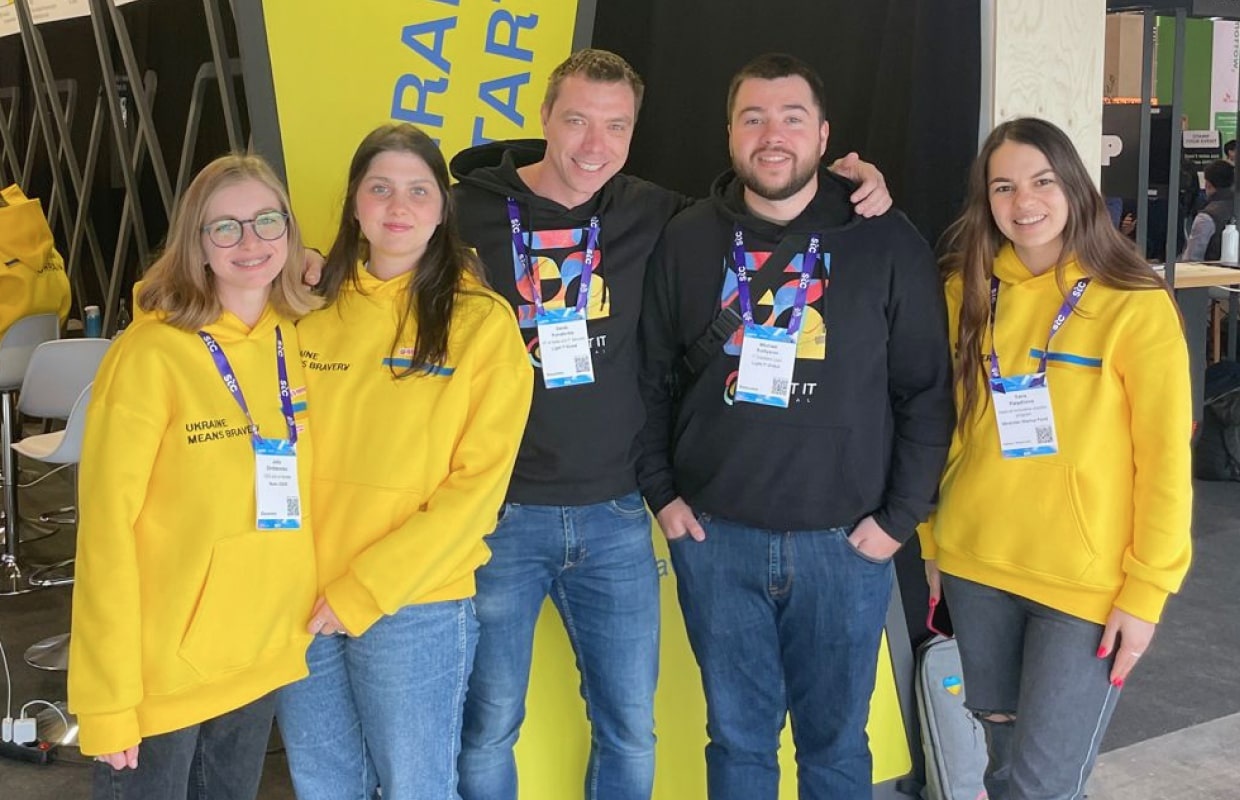
The company’s November 2025 sustainability report adds a more consequential account of continuity. It says employees serving in Ukraine’s armed forces retained their positions and describes donations and volunteer support. These are company-reported commitments. Alongside the earlier report’s description of remote working, they show an employer managing obligations that extend beyond project schedules.
Buy a bottleneck solved
Recent public activity keeps that mix of people and engineering visible. ECHAlliance announced the company’s membership in October 2024, connecting it with an international healthcare network. In March 2026, its own Portal LightIT corporate app received a stability update. The app provides company news, public employee profiles, contacts and events: ordinary internal needs, expressed as software.
The strongest reading of the portfolio is a practical one. Light IT Global fits buyers who can point to a process that existing software handles badly, and who need outside engineering capacity to change it. Its range across healthcare, finance and education matters because the work involves different users, permissions, data and integrations.
Custom development becomes harder to justify when a standard product already fits, when nobody can own decisions or when the organization cannot support the system after launch. Those are buying conditions, not coding problems. The part readers can copy is simple: name the delay, identify who experiences it and decide what a successful change would look like. Then ask for software.
Follow the work
Website · Company blog · Client reviews · LinkedIn · X · Instagram · Facebook