A care manager makes a call. The patient does not answer. Later, another call goes to voicemail; a third reaches someone who has a medication question, a transport problem, and roughly three minutes of patience. None of this looks like the dramatic part of medicine. It is, however, where many care plans quietly come apart. Ellipsis Health has built a business around that unglamorous interval between a clinician's intention and a patient's next visit.
Its product, Sage, is an AI voice agent that can place and receive care management calls for health plans, health systems, and specialty care organizations. It can introduce a program, check eligibility, complete an assessment, follow up after discharge, ask about medication, and route a patient to a person when a situation calls for one. Its maker describes it as an AI care manager. The less theatrical description is also the more useful one: a phone worker for the large stack of calls healthcare organizations already mean to make.
In brief / The operating idea
- Who pays: healthcare organizations buying enterprise software, rather than patients downloading a consumer app.
- What it does: Sage handles enrollment, assessments, check-ins, and other routine care calls; clinicians retain clinical decisions.
- Why it is unusual: the agent grew out of years of research into depression and anxiety signals in natural speech.
- What the bill is: $26 million raised in 2021 and $45 million announced in 2025; standard product pricing is not public.
The call that started it
Founder and CEO Mainul Mondal has pointed to his mother's experience managing chronic conditions as the source of the idea. Anyone who has watched a relative repeat their history to yet another care line will recognize the problem. The patient needs more time; the professional on the other end has less of it. Mondal founded Ellipsis in 2017 with Susan Solinsky and physician Michael Aratow. Their first answer was narrower than Sage: study the voice itself.
The company developed software to estimate depression and anxiety severity from how someone speaks and what they say. It began commercializing that screening technology in 2021, after years spent collecting and labeling clinical speech. In an early collaboration with Ceras Health, Ellipsis says it screened 465 people with chronic illness and found signs of depression in 110. With Augmedix, it worked to bring mental health scores into clinical encounters. These were tools for a care team to notice a possible problem sooner, not a replacement for a diagnosis.

That first product also created the asset behind the second. Ellipsis says its conversational system has been trained on millions of real clinical calls. A generic voice bot can say its script politely. A care call asks more: notice hesitation, recognize a drug name, answer the question the patient actually asked, and remember that a worried person may not sound like a tidy form field.
A study with useful limits
In 2025, researchers from Highmark Health and Ellipsis published an analysis of 2,007 real care management calls. They removed the spoken depression questionnaire from the audio before testing the model, so it could not simply overhear the answers. On a blind test set, the voice system's estimates had a mean absolute error of 4.06 points on the PHQ-8 depression scale. Its ability to distinguish certain severity thresholds produced area-under-the-curve results between 0.79 and 0.83 across reported groups.
The study measures a screening signal, not Sage's performance as a full autonomous care manager.
That distinction matters. Four points on a depression scale can change how a case is categorized. The paper offers evidence that ordinary conversation contains useful signals; it does not turn a voice recording into a definitive clinical verdict. The researchers also note the need for careful workflow integration and more work on performance across populations. A sensible buyer would treat the score as a prompt to investigate, with a human care pathway waiting behind it.
“Sage doesn’t get into clinical issues - it handles the 80% of issues that don’t require a clinician.”Mainul Mondal, introducing Sage
From hearing a problem to handling a task
The commercial turn came in June 2025. Ellipsis unveiled Sage and announced a $45 million financing round led by Salesforce, Khosla Ventures, and CVS Health Ventures. It had previously announced a $26 million Series A in 2021. The change is easy to miss in a list of AI features, but substantial in practice. A screening tool gives a clinician more information. A voice agent takes responsibility for beginning, continuing, and documenting an interaction.
The company's public audio gallery makes the work concrete. One example shows Sage asking why a patient skips medication doses, then uncovering price and side effects. Another has the agent waiting through a multi-level automated phone menu. A third turns on a more delicate problem: a patient says they do not want to speak to AI. None of those moments is a grand medical discovery. Each is the sort of friction that prevents a program from reaching a patient at all.
Ellipsis reports a 60% reduction in administrative tasks, four times return on investment, and six times faster program enrollment on its website. Those are company claims, without the customer-level methods needed to compare every deployment. They indicate what the company sells: capacity and completed work. Its buyers are health plans, health systems, and specialty programs whose staff spend large parts of the day on outreach, surveys, and follow-up. The patient usually meets Sage through an organization they already use.
A distribution deal dressed as an integration
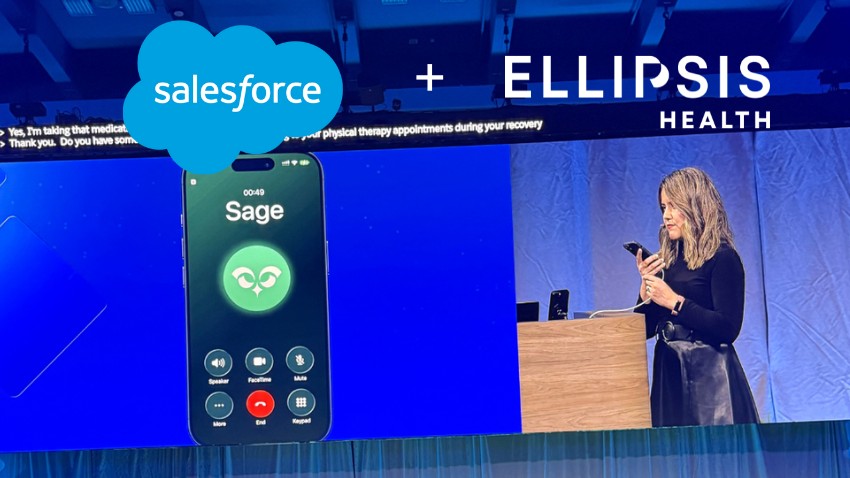
Sage became available on Salesforce AppExchange in January 2026, tied to Agentforce Health. The practical attraction is less glamorous than the word “agentic”: assessments can be launched from an existing system of record, and results can return to the care team's workflow. A Salesforce partner brief also describes an Epic integration option and FHIR support. NVIDIA is working with Ellipsis to add Riva Parakeet speech recognition, aiming to reduce transcription delay. In a live conversation, a few hundred milliseconds can be the difference between a natural pause and the unnerving sense that no one heard you.
The market has no shortage of alternatives. A provider can hire or outsource callers, use an IVR tree, or buy another healthcare voice agent. Ellipsis's argument is that real clinical speech data and its behavioral health research make Sage better suited to the messy middle of patient calls. That is a competitive claim, not a universal fact. A side-by-side trial would need to measure reached patients, completed tasks, correct escalation, patient preference, and actual staff time saved.
The useful lesson in the pivot
The first product had a smaller job: flag possible distress for a care team. But a score cannot clear a backlog of unanswered calls. Ellipsis spent four years researching before commercializing voice screening, then several more before launching Sage. The change of scope took years of data work and substantial venture capital. The payoff, if it lasts, lies in turning an interesting signal into an ordinary service.
That route offers a copyable idea for healthcare teams building AI. Begin with a task people already perform, count the cases that never get reached, and test on real conversations from that setting. Connect the tool to a record a clinician actually uses. Put the handoff rule in writing. Then ask patients what the call felt like, not just whether the model finished its checklist. This approach depends on usable phone access, patient trust, reliable speech recognition, and a care team ready to receive escalations. If any of those are missing, a completed call can become a misleading success metric. It is a slower method than showing a polished demo. It also exposes the question every care manager must answer, human or synthetic: did the person on the other end get what they needed?