Elliott Hill had already asked for the job. Then he asked again. For six months, after a Nike executive visited his graduate-school class, he kept following up. Eventually an offer arrived with a geographical condition: Memphis. Hill packed his car. The future chief executive’s first lesson in corporate mobility involved actually moving.
He joined Nike in June 1988 as an intern selling apparel. Thirty-two years later, he retired. Four years after that, Nike asked him to return as president and chief executive officer. It is an unusually tidy career summary. The work inside those dates was considerably less tidy: sales territories, retail operations, European assignments, marketing, and the business of persuading other people to care about a shoe.
His second first day, October 14, 2024, carried a different burden from the original. An intern needs to learn the company. A returning CEO must decide which lessons still apply. Nike had customers, products and competitors that could not be persuaded by a fond recollection. Hill’s familiarity bought him attention. What he did with it would have to buy something more durable.
The appeal of the story is obvious. Someone starts near the bottom and ends up running the place. Yet the interval outside Nike matters, too. Hill had stepped away from the institution that supplied most of his professional identity. Returning meant finding out whether belonging could become a useful operating skill.
Before the Swoosh, a schoolteacher
Hill grew up in Austin, Texas, in a working-class neighborhood where games filled the streets and the local recreation center. His mother raised two children while teaching school. He credits her example with his habit of treating people as worth stopping for, however crowded the day becomes. In his account, consideration belongs beside hard work.
At Texas Christian University, he worked in the athletics department to help pay his way. He graduated in 1986 with a kinesiology degree and worked on the Dallas Cowboys’ training staff before earning a master’s in sports administration at Ohio University in 1988. The sports business first appeared to him through teams and the people who kept them functioning.
Jamie Dixon, a TCU basketball player during Hill’s student years and later the university’s head men’s basketball coach, remembers the energy before the executive title. “He had attitude, energy and positivity,” Dixon recalled. The future Nike boss was doing the unglamorous work around a team, and people remembered how he did it.
A graduate-school assignment about Nike widened his sense of where a life in sport might lead. Tim Joyce, the visiting executive he pursued, became the connection between an academic interest and a practical opening. There is a useful distinction here between having a dream and making yourself available for its inconvenient first address. Memphis was available. Hill went.
Four dates. Two arrivals.
- 1988Apparel sales intern
Memphis, Tennessee - 2018President, Consumer
and Marketplace - 2020Retires after more
than 32 years - 2024Returns as
president & CEO
A sales territory is an education
His early work put him in front of independent retailers and regional stores. Within six months, he was handling 168 accounts; his old Chrysler minivan covered roughly 60,000 miles a year. That is a considerable amount of windshield time for an education in what people will actually put on a shelf.
A shopkeeper’s judgment is refreshingly immediate. A product needs a customer. A story needs someone willing to repeat it. Inventory needs to move. These are ordinary retail constraints, but they offer an explanation for why Hill’s experience with wholesale partners became so relevant when Nike brought him back.
His career expanded well beyond those sales calls. He worked across Europe and North America, eventually leading geographies and the integrated marketplace. In 2018 he became president of consumer and marketplace. Before retiring in 2020, his remit covered commercial and marketing operations for Nike and Jordan Brand, with responsibility across four geographies.
That last role matters because it complicates the comforting image of a lifelong salesman. Hill had experience with the machinery of a global business: different markets, channels, customers and operating demands. The company’s leadership biography credits him with helping Nike grow beyond $39 billion in revenue. Helping is the operative word. This was collective work over decades, rather than a solo achievement in a pair of trainers.
The people between the shoes
Some of Hill’s most revealing connections sit a little below the familiar roster of sponsored stars. In Denver during the 2005 NBA All-Star weekend, Sole Collector founder Steve Mulholland was staging a sneaker competition at NikeTown. Hill helped bring in senior Nike figures, including designer Tinker Hatfield and Jordan executive Gentry Humphrey, to judge collectors’ shoes.
The arrangement had a pleasing reversal. People who usually waited for a company to unveil its next product could show the company what they treasured. Executives became judges at an enthusiasts’ gathering. An interest that might have looked small from headquarters received a serious audience.
This is one way to understand Hill’s relationship-based reputation without turning it into a personality award. He knew people in different rooms and could get them into the same one. At a sportswear business, those meetings can change what the organization hears about its own products.
His return drew encouragement from former colleagues and industry acquaintances. Phil Knight’s approval carried particular weight: Hill has spoken about wanting to make Nike’s co-founder proud. But affection from people who know the business is a starting resource. It still has to survive the less sentimental judgments of customers deciding what to buy.
Retirement had an auction catalog
Leaving Nike in 2020 gave Hill an opportunity to sort through what a career had accumulated. The resulting collection was extensive enough for a public auction. In May 2022, the Hail Mary sale offered jerseys, apparel and memorabilia from his years at the company. The catalog listed 176 lots. Retirement, in this instance, required considerably more than clearing a desk drawer.
The sale supported educational opportunities for Portland students. Elliott and his wife, Gina, offered to match up to $750,000 from auction proceeds and direct donations. A collection built around athletic achievement became a way of paying for somebody else’s next step.
Their university giving follows a similarly personal line. TCU’s Hill Hall is named for the couple, and their support includes the Jo Frances Hill Endowed Scholarship, named for his mother. Hill has served on the university’s board of trustees since 2013. The student who once worked to afford college now helps sustain it.
These commitments provide a fuller picture than the standard executive biography. The relevant connections are to institutions that helped him enter the world he wanted to join. Education supplied access; later, he and Gina put resources back into it. A name on a residence hall makes the relationship visible, but scholarships do the quieter work.
“Whatever you’re interested in, chase it.”
Elliott Hill · Berkeley Haas conversation, 2026
The comeback has a scoreboard
Nike announced Hill’s appointment in September 2024, with Mark Parker backing his knowledge of the company, its partners and its industry. Hill succeeded John Donahoe the following month. He returned with an explicit attachment to the place: “I have an irrational love for Nike.” That is a candid thing to say about an employer, especially when rational decisions are about to become the job.
The commercial response has centered on sport, product and the places where people shop. Nike’s Win Now program identified North America, wholesale and running as early priorities. In the first quarter of fiscal 2026, wholesale revenue rose 7 percent on a reported basis, while Nike Direct revenue fell 4 percent. The unevenness was part of the story from the beginning.
By the full fiscal year ending May 2026, Nike reported revenue of $46.4 billion, flat on a reported basis and down 2 percent after currency adjustments. Those figures describe the company’s condition during Hill’s tenure. They do not isolate his contribution, and they do not settle the question of whether the changes will last.
The October 1, 2026 results sharpened the challenge. First-quarter fiscal 2027 revenue was $11.2 billion, down 4 percent year over year on a reported basis. Gross margin improved to 42.8 percent. Nike introduced Pace, an operating-model transformation intended to extend its sport-focused approach, while identifying Sportswear, Jordan Brand and Greater China as businesses needing further work. A homecoming can happen in a day. Commercial repair keeps a different calendar.
A mixed first quarter
Q1 fiscal 2027
Year-over-year change on a reported basis. Quarter ended August 31, 2026. Bars show magnitude of decline; each full track represents 10%.
Learning the place again
In a Berkeley Haas conversation published in May 2026, Hill described the perspective he gained while away: he experienced Nike as a consumer. He also explained the move toward smaller groups organized around particular sports. A runner and a basketball player may wear the same logo while asking entirely different things of it.
That approach puts a practical demand behind the language of listening. Someone must notice the difference, bring it into product decisions, and keep the organization close enough to respond. Technology has a role in that work; Hill described it as serving the strategy and culture. The priorities begin with people participating in sport.
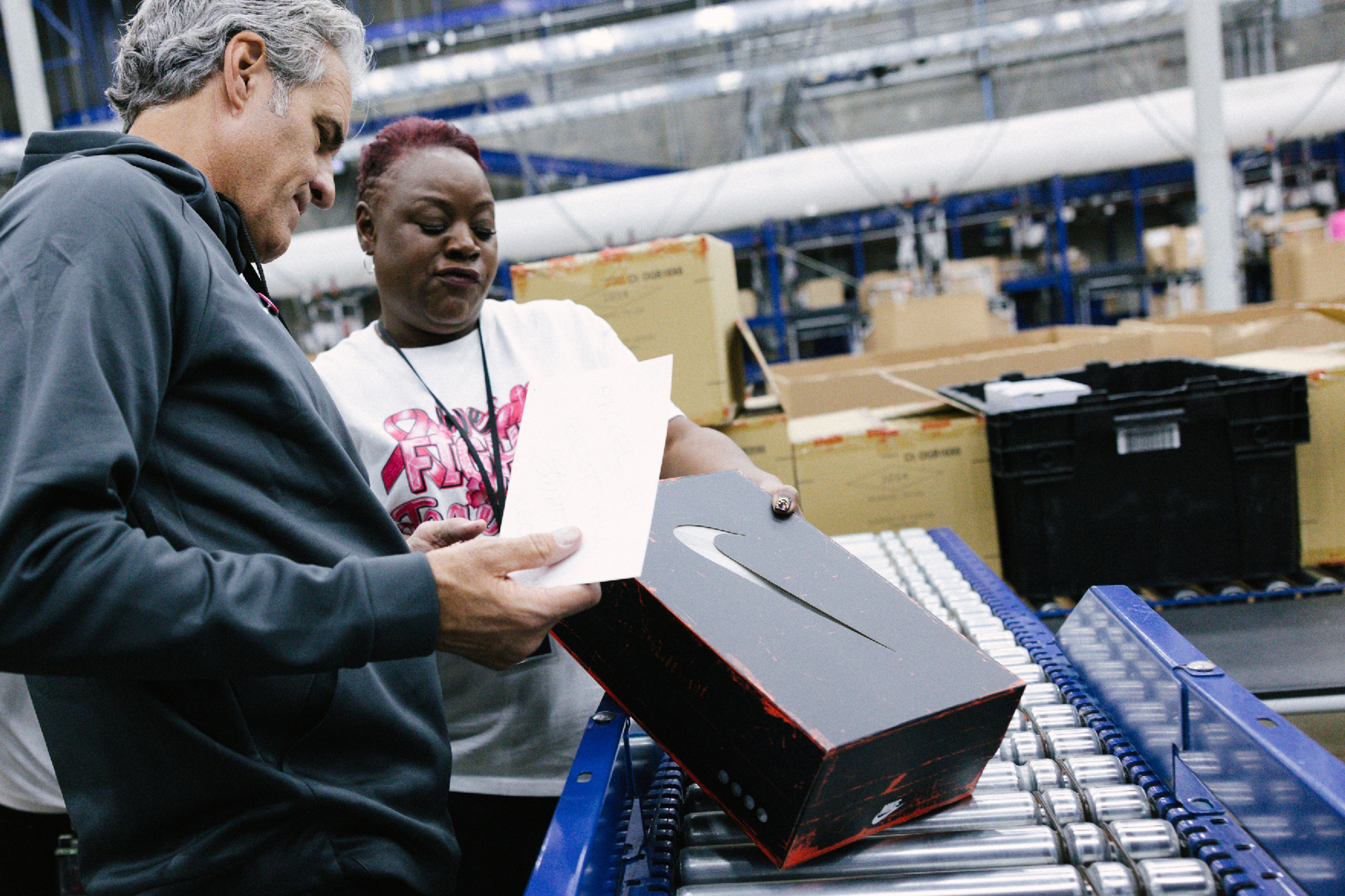
For all the scale involved, a small scene from his return is worth keeping. At Nike’s Memphis logistics campus, Hill wrote a handwritten note for a customer’s box of Air Max shoes. The gesture fits someone whose working life began with a sales territory and a drive to Tennessee. It also travels farther than a speech: all the way to the person opening the box.
Hill’s advice to students is to stay curious and keep learning as the world changes around them. His own second first day gives that advice an interesting test. He knows Nike intimately. He now has to notice what familiarity can hide, take seriously what customers tell him, and make enough good decisions for the next generation to have a company worth knowing.