The pivotal move in Ellen Praytor Faulkner’s career looked terrible on paper. She left a sales-and-marketing job at a Mobile magazine to become an account coordinator at Lewis, an advertising agency she admired. The new position paid half her salary. She had no agency experience. It was, in the narrow financial sense, a demotion. It also placed her in the room where she most wanted to learn.
Faulkner had already made one useful discovery about herself. She earned a visual communications degree at Auburn University and began working at Mobile Bay Monthly with the intention of becoming its art director. She got there, then realized she preferred sales and marketing. Some people spend a career protecting the identity on their diploma. Faulkner treated hers as a starting point. Design taught her how an idea takes shape; selling taught her that an idea must travel.
At Lewis, she learned the machinery in between: clients, schedules, new business, operations, profits, people. Within about ten years she was running the Mobile office. She would manage it for more than two decades, eventually serving as senior vice president and managing director. In May 2022, an incoming group of owner-managers chose her as Lewis’s fourth chief executive and the first woman to hold the job in the agency’s history.
An apprenticeship measured in decades
This was no ceremonial handoff to a fresh face. Faulkner knew the institution by repetition: the first client meeting, the first job sent into traffic, the first new-business win, the many ordinary decisions that either preserve a culture or quietly spend it. Her old role concentrated on growth and profitability. The broader preparation, she has said, was learning to balance strategy with execution without flattening the creative atmosphere that makes an agency worth hiring.
Lewis itself carries a long memory. Founded in Mobile in 1951, it expanded to Birmingham and Nashville and built a national client base while remaining independent. Faulkner inherited both the benefit and burden of that continuity. An old agency cannot live on its scrapbook; a modern one cannot sprint so eagerly toward novelty that it forgets why clients trusted it in the first place.
A career built sideways before it went up
Her answer has been to keep the creative ambition and make it answer a harder business question. Lewis spent years known for branding and craft. Its more recent model begins with the client’s commercial problem: revenue, demand, return. Senior leaders remain close to the work, while teams connect campaigns to outcomes that a chief executive can recognize without a glossary. Beautiful work is welcome. Beautiful work that also works is invited back.
The useful discomfort of letting go
Faulkner describes herself as a servant leader. In practice, that means less halo, more inconvenience. A leader serves the team, makes hard decisions, praises the people who do good work and takes responsibility when the organization gets it wrong. Her formulation is clean: success belongs to the group; failure stops at her desk. Then she apologizes, examines where the breakdown occurred and asks the people involved what they saw.
The subtler skill is resisting rescue. Advertising rewards the person who can make the impossible happen by Thursday. Executives accumulate authority partly because they are practiced fixers. Yet people do not develop when the boss constantly reaches across the table to finish the sentence. Faulkner’s lesson is to let the team run, which includes letting people make mistakes sturdy enough to learn from.
I’ve learned so many things the hard way that I should be brilliant by now.Ellen Praytor Faulkner
Her first rehearsal came at 16. Faulkner’s mother and aunt, both involved with the local March of Dimes, volunteered her to lead the organization’s first regional Teen Action Program. She coordinated students at several schools and organized car washes, walks and street-corner fundraisers. At year’s end, the two women surprised her with a trip to the national convention, where she received a national award. There are gentler ways to teach a teenager leadership. Few are as memorable.
Her mother, Jamie Praytor, was the larger example. A civic leader and the owner of the first woman-owned real estate company in the region, she supplied a piece of advice that Faulkner still passes on: worry about your own conduct. Do your best. Be fair. Be kind. Let the rest sort itself out. It is an antidote to the feverish comparison that can overtake any status-conscious business, especially one in which the product is attention.
That inheritance helps explain why community service at Lewis is treated as operating culture instead of seasonal decoration. It also explains Faulkner’s work with OwnIt, a group seeking to increase women’s ownership of advertising agencies. She wants the small share of women owners to rise, and she spends time mentoring people making the awkward jump from excellent practitioner to novice leader.
Faster machines, more human choices
The agency world Faulkner entered around 1990 is now a museum of obsolete tools and heroic deadlines. Lewis uses artificial intelligence across accounting, workflow, research, strategy, design, writing and video. Through the ICOM network, its people compare methods with independent agencies in Europe, Australia and North America. Faulkner has little patience for pretending the technology can be wished away. She thinks communicators who refuse it risk irrelevance.
Her enthusiasm comes with a useful distinction. AI supplies capacity. People decide what that capacity is for. In a recent reflection, she argued that the emerging advantage is not the ability to make the most material, but the judgment to choose what deserves to be made. Speed should buy room for thought, not merely a taller stack of deliverables.
That view is of a piece with her whole career. The visual-communications student became a seller; the seller became an operator; the operator now leads creative people through a technological reset. She does not romanticize a division between art and spreadsheets. Data can reveal something. A communicator must still turn the finding into the little click of recognition she calls an “aha.”
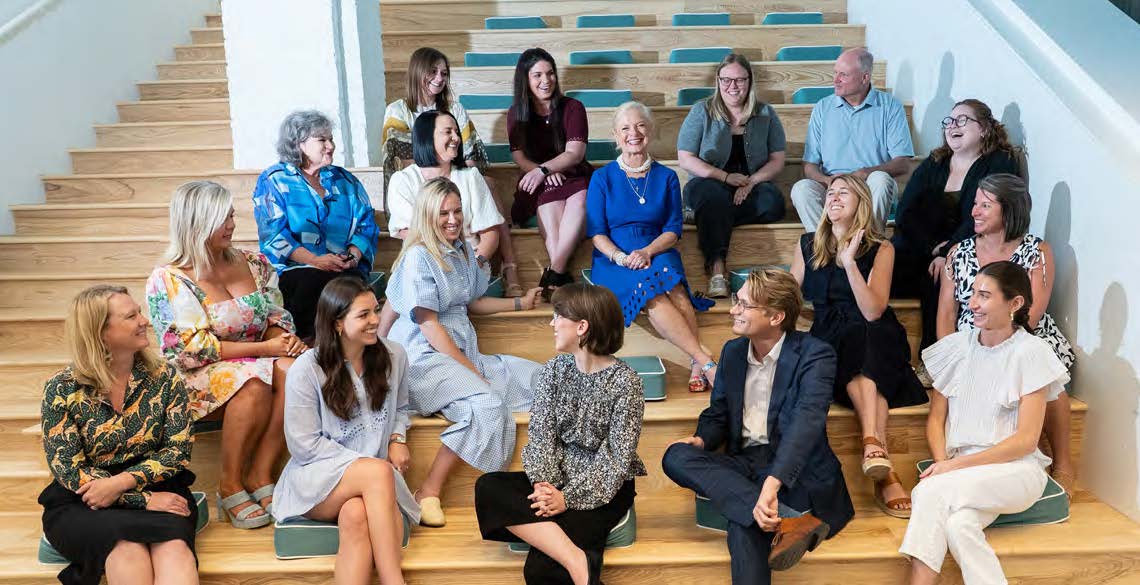
In 2025, as Lewis settled roughly 30 Mobile employees into a renovated downtown building, Faulkner talked about patios, a workout room, communal grandstand seating and the energy of returning to the city center. The details sound domestic because offices, at their best, are social instruments. The space was built to tempt people into useful collisions while the agency kept its hybrid flexibility. Faulkner supports balance and does not want anyone missing a child’s match or an important family occasion. She also believes mentorship and creative collaboration lose something when nobody walks the same halls.
The wider company makes the same argument at a larger scale. Mobile offers history and salt air; Nashville brings its music-business tempo; Birmingham supplies another established creative center. Fully remote colleagues fill out the map. Faulkner sees the distance as occasional friction with a considerable dividend: specialists can join the right assignment regardless of office, and employees can move cities without leaving the agency. The arrangement only works if three locations feel like one firm. Her favorite evidence is not a policy document but the energy that appears when colleagues visit another office and begin making something together. Culture, in this telling, is less a mood than a network of repeated invitations.
Growth for me means working myself out of a job and letting our very tenacious, brilliant and innovative leaders take the helm.Ellen Praytor Faulkner
The succession is the work
The most revealing ambition Faulkner has stated is to make herself replaceable. She wants to prepare Lewis’s next leaders and owners to take over her job. There is no announced clock on the plan. It is less a retirement timetable than a test of whether she has built an institution capable of renewing itself.
The thought carries a pleasing symmetry. Faulkner rose because experienced leaders gave her more to carry. She now measures her own leadership by how much others become capable of carrying without her. The woman who once halved her salary to get closer to the work intends, eventually, to give the work away.
Away from the corporate vocabulary, a more vivid person peeks through. She is an avid reader who wishes she could sing. She likes good wine and fresh flowers. She admires Mary Tyler Moore. She calls herself determined, values empathy, passion and curiosity, and says keeping her word is her most marked characteristic. She also claims to learn ten new things a day, an accounting system so optimistic that one suspects it includes the lessons learned twice.
For all her appetite for change, Faulkner’s governing ideas are stubbornly old-fashioned: listen carefully, work hard, admit the error, keep the promise, share the credit. The technology changes. The rooms change. Even the title changes. Character remains the one operating system nobody can outsource.