Before there was a shelf of Rebel Girls books, there was an email. Elena Favilli wanted to send readers one story about an extraordinary woman each week. It was a modest invitation: leave an address, receive a life. The eventual business would sell books across the world, but its first useful unit was a reader willing to reply.
That distinction matters in Favilli’s story. The Italian journalist had already spent years trying to build children’s media with Francesca Cavallo. They knew how to make something attractive. Getting people to pay enough to keep making it was another matter. Their early experiments had earned attention and design recognition. Recognition, unfortunately, is a poor currency at the printer.
In 2016, they put a different proposition in front of the public: a book of bedtime stories about 100 real women, told with the intimacy of fairy tales. A queen could share the contents page with a tennis player. The reader would meet Elizabeth I and Serena Williams. The stories would borrow the welcome of “once upon a time” without borrowing the requirement that a prince arrive to settle everything.
A newsroom with room for children
Favilli’s route into publishing began with journalism and a curiosity about how meaning travels. She earned a master’s degree in semiotics at the University of Bologna, studying in Umberto Eco’s department. In 2006, a one-year scholarship took her to the rhetoric department at the University of California, Berkeley. Italy and the United States would become recurring coordinates in her working life.
Her journalism included work for Colors, McSweeney’s, RAI, Il Post and La Repubblica. Those are useful antecedents for someone who would later have to compress a whole life into a page: a reporter’s selection, an editor’s economy, a willingness to let an unfamiliar person hold the reader’s attention. The Rebel Girls format looks simple because the complexity has been dealt with before the child opens the book.
In 2011, the new object of attention was Timbuktu, a magazine for children on the iPad. Favilli and Cavallo were exploring what happened when news, illustration and play met on a touch screen. Olimpia Zagnoli worked on its art direction. The project treated children as readers with interests beyond the familiar stock of dragons and princesses. It was an editorial ambition with an App Store address.
Their early plans were expansive. They talked about reaching Asian markets and making versions in Japanese and Chinese. The magazine was already finding users in more than 50 countries in 2011. Long before Rebel Girls, Favilli was thinking internationally. A child in another country was a prospective reader, rather than an afterthought for a rights department.
The reader arrives before the book
The company moved into the San Francisco startup world in 2012. The iPad business, however, could not support its production costs with enough paying subscribers. By late 2015, the founders were trying stories in a newsletter and watching how people responded. The technology experiments had taught them to ask questions early. This time, the answers could shape a physical book.
Favilli called the newsletter “Who Framed Cinderella.” Even the working title had a raised eyebrow. It proposed examining a familiar story rather than simply supplying another one. Subscribers could encounter a woman from history, respond to a format and help the founders understand what families wanted to read together. A mailing list became a conversation about what was missing from the shelf.
Her interest in community was practical as well as philosophical. A reader’s reply could tell the company more than an abstract conviction that the market needed better stories. Parents and other readers were giving the project its first audience before a campaign asked them for money. The book’s eventual public launch came after this quieter work of listening.
In Favilli’s account of preparing the campaign, eight months went into the work. The script was rewritten 16 times. Her advice to would-be founders was wonderfully unromantic: “Preparation, preparation, preparation!” It is a useful correction to the image of a crowdfunding project arriving fully formed one inspired afternoon. The video looked like an invitation because someone had spent months deciding how to invite.
“Preparation, preparation, preparation!”
Elena Favilli, on the work before the campaign
Forty thousand dollars, then a different problem
On April 28, 2016, the Kickstarter campaign went live. The target was $40,000, enough for an initial run of 1,000 hardcovers. The goal was reached within two days. By the end of the campaign, 13,454 backers had pledged $675,614. That figure belongs to Kickstarter itself; the larger numbers attached to the book’s origin include the subsequent campaign on Indiegogo InDemand.
By September, the combined total had passed $1 million, with about 20,000 backers. The idea had traveled before most readers could hold the object. Supporters were buying a book, but they were also buying into a choice about whose stories children should inherit. The campaign offered a place for the names of future world-changers, including backers’ daughters, nieces and friends.
Later Indiegogo orders brought combined crowdfunding above $1 million by September 2016.
A successful campaign exchanges one kind of uncertainty for another. The question becomes how to deliver what people have bought, across borders, in quantities much larger than planned. The founders published and distributed the book themselves through Timbuktu Labs. A project about women taking charge had given its creators a considerable amount to take charge of.
By September 2018, the first book and its sequel had sold more than three million copies combined. The original had spent 42 weeks in the top ten of the New York Times bestseller list. Favilli and Cavallo received the Publishers Weekly Star Watch award together. The business that began with two founders was now working with a larger team and offices in New York and London.
One page, one life, no throne required
The books’ recurring arrangement is easy to understand: a short biography alongside an illustrated portrait. That gives a child two ways into the same life. A face offers recognition; the words offer action. The brevity also permits variety. Across a collection, the reader meets different countries, different kinds of work and different ways of becoming someone worth reading about.
Favilli has described the combination of short narrative, illustrated portrait and bedtime format as making even a figure such as Frida Kahlo feel familiar and close. The scale matters. A historical person can seem enormous in a textbook. In a bedtime story, she can occupy a few minutes of conversation between a child and an adult. Grandeur has to fit beside the pillow.
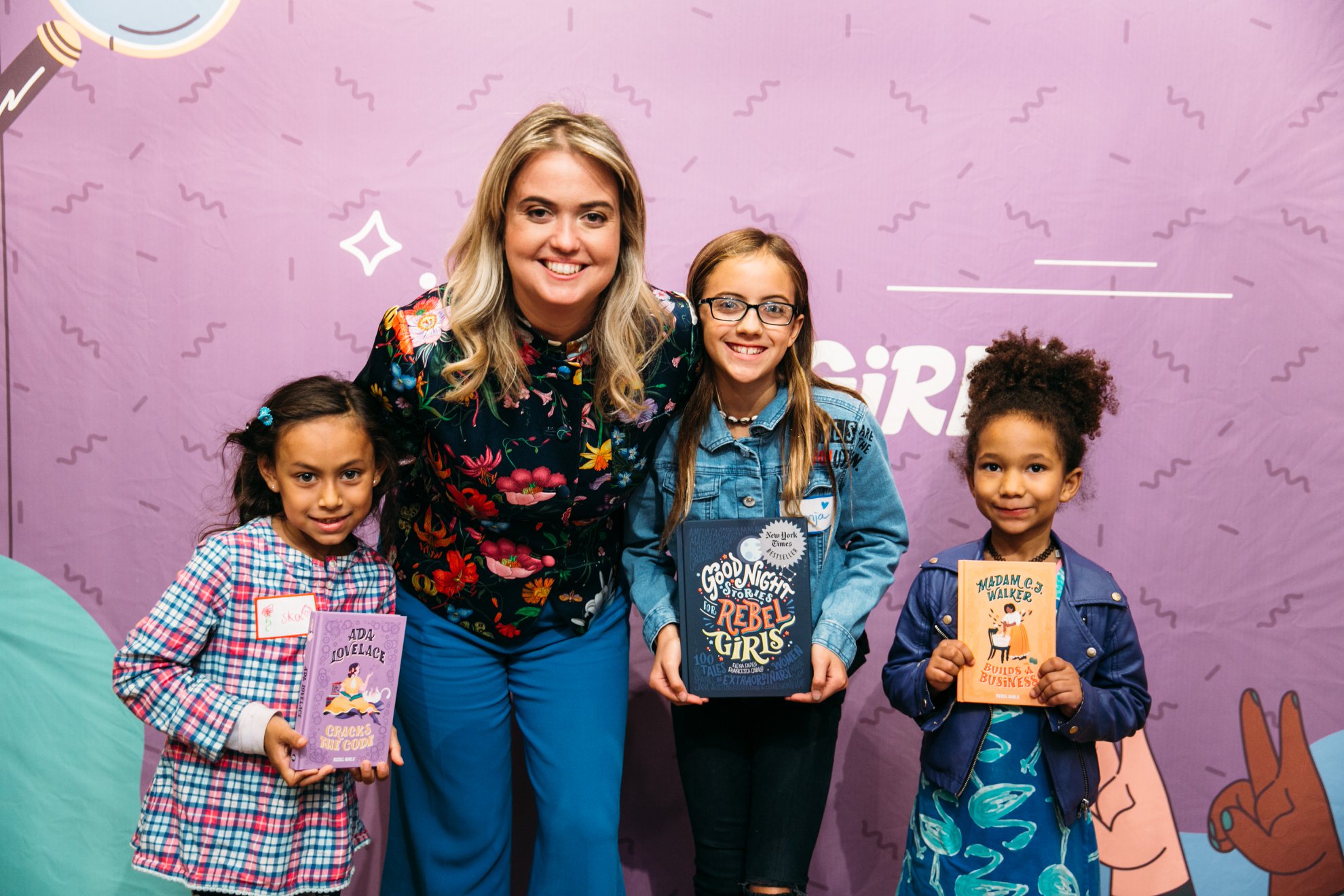
In February 2019, Favilli spoke at the Italian Cultural Institute in New York with journalist Maria Teresa Cometto. Young readers brought their books. She emphasized the route toward achievement as well as achievement itself. That makes the collection more interesting than a cabinet of medals. A life contains choices and setbacks; a child deserves to hear how someone moved through them.
The stories learn to speak
The move into audio suited something already present in the writing. Favilli and Cavallo read stories aloud to each other while making the books, testing how they would sound when a parent read them to a child. The podcast extended that practice, adding narration, music and sound. A printed biography could become a small scene constructed for the ear.
In 2018, Tarana Burke narrated Harriet Tubman’s story. Other narrators included Diana Nyad and Our Lady J. The choice of speaker added another woman’s presence to the biography. The audience heard a contemporary voice telling a historical life. For a project concerned with who gets heard, the casting carried part of the argument.
The company also found someone to help turn a book business into a broader media operation. Jes Wolfe met Favilli through a mutual connection in January 2019. On a trip to Tahoe, they skied and talked about Rebel Girls. Wolfe later became CEO. It is an appealingly ordinary setting for a consequential connection: conversation about a business, punctuated by the need to get down a mountain.
Crossing a border, keeping a name
In October 2020, Favilli published 100 Immigrant Women Who Changed the World. The subject connected to her own experience of moving to the United States. The collection put individual lives where public discussion often puts a category. Its women crossed borders for different reasons, with different ambitions and circumstances. Their shared description did not make their stories interchangeable.
The book included women such as Rihanna, Asma Khan and Madeleine Albright. Seventy female and nonbinary artists from 29 countries contributed portraits. For the audiobook, every narrator was an immigrant or the child of immigrants. Representation reached beyond the selection of subjects and into the making of the work itself.
There is another, quieter continuity in Favilli’s reading life. As a child in a small Tuscan village, she relied on local bookshops. As an author, she has valued independent shops for the chance to meet readers individually. She also likes hearing books she has already read in a new voice, naming Lab Girl and Women Who Run With the Wolves among her audiobook favorites.
A bookshelf still taking new arrivals
Favilli returned to the original collection with 22 new stories for the 2025 edition. Taylor Swift, Michelle Yeoh, Greta Thunberg and entrepreneur Melanie Perkins joined its cast. The revised collection covers more than 70 professions and over 40 countries. A book published in 2016 could hardly be expected to finish the subject. New work keeps producing new people for children to meet.
By then, the original book was available in 50 languages and in more than 110 countries. Those figures describe distribution; the individual encounter remains smaller. A reader opens a page and finds a possible occupation, a place she has never heard of, a woman whose choices ask a useful question. The format leaves room for curiosity after the reading ends.
Favilli now lives and works in Brooklyn. Her website says she is working on her first narrative nonfiction book and is represented by Curtis Brown. Another project brings her back to Tuscany: a home that also serves as an artist residency, featured in the March 2026 issue of Vogue Italia. The interest in giving other people space to make things has acquired an actual roof.
Her career has moved through newsrooms, a tablet magazine, crowdfunding, books and recorded voices. The recurring task is editorial: choose a life, find its shape, make someone want to listen. The early email promised one woman’s story a week. Years later, with a larger shelf and more readers, that is still a rather good place to begin.