Apty had already done the supposedly difficult thing: it was running in the cloud. Yet its AWS expenses were climbing, its infrastructure was difficult to untangle, and its development team was losing time. In Eficens’ account of the engagement, the problem was less about getting to the cloud than understanding what life there had become. That is a useful place to begin with DiscoverCloud.
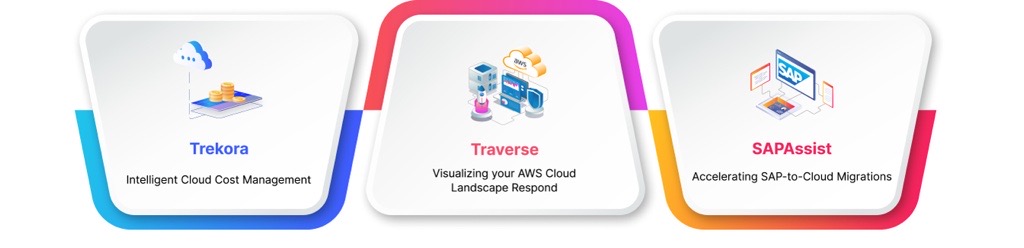
- See the bill: Trekora looks for spending and resource inefficiencies.
- See the machinery: Traverse maps AWS infrastructure and connects it to costs.
- Get help changing it: managed services bring engineers into the work.
Eficens DiscoverCloud packages its own software with cloud consulting and ongoing operations. The buyer might be a finance leader trying to understand expenditure, an architect investigating dependencies, or a technology chief whose team has too much maintenance on its plate. Its proposition depends on an ordinary organizational fact: identifying a problem and assigning someone to fix it are separate accomplishments.
The bill was only the beginning
Consider the Apty example. The digital-adoption software company was growing, but Eficens describes a combination of uncontrolled spending, architectural inefficiencies, and slower innovation. DiscoverCloud brought Trekora into the cost analysis and Traverse into the architecture review. Eficens then helped establish managed FinOps, keeping financial objectives connected to operational decisions.
Eficens’ November 2024 case study reports a 30% reduction in AWS expenses within the first quarter, a 50% improvement in application performance, and twice the feature-release cadence. Those are company-published results for one engagement. The interesting detail is their combination: the account presents cost, performance, and development speed as parts of the same engineering problem.
within the first quarter
Apty founder and CEO Krishna Dunthoori supplied a compact description of the outcome: “we are delivering better, faster, and more efficiently than ever before.” The practical lesson is to measure the application alongside the invoice. A lower bill is more persuasive when customers still get a responsive product and developers recover time.
Give the spreadsheet a map
Trekora divides optimization into three kinds of work. Commercial changes concern pricing and commitments, including Savings Plans and Reserved Instances. Architectural changes concern how compute, storage, and data transfers are arranged. Operational changes concern how resources behave over time, including scaling, idle capacity, and schedules for non-production environments. Buying a discount is only one lever.
Traverse adds a visual vocabulary. Its AWS product documentation describes automatically generated infrastructure diagrams, resource searches by name, IP address, or tag, and cost insights drawn from AWS Cost and Usage Reports. Teams can export diagrams in PNG, JSON, CSV, or Draw.io formats. A financial question can therefore be attached to a specific resource and discussed with the people responsible for it.
A recommendation still needs someone who can change the system.The operating question
For a team sharing an environment across accounts and departments, that connection matters. A resource inventory, its relationships, and its expense tell a more useful story together. DiscoverCloud’s wager is that combining these views with expert help makes the next decision easier to execute.
A service business with its own instruments
DiscoverCloud’s public portal launch was announced in September 2023. From the beginning, the announcement emphasized proprietary accelerators accompanied by expert-backed managed services. That places it between standalone cloud software and a consulting engagement: customers can use tools, while Eficens can also supply the work around them.

The parent’s leadership page names Ramu Venigandla as founder and chairman and Sanjeev Kumar as CEO. Eficens identifies itself as an AWS Advanced Tier Services Partner. DiscoverCloud’s AWS Marketplace listing covers DevOps, CloudOps, FinOps, database and application operations, and SecOps, including round-the-clock support. The breadth explains why its audience includes both financial and technical decision-makers.
An in-house team using AWS tools is an alternative. So is a specialist cost platform or another managed-services partner. DiscoverCloud’s distinction is the bundle: proprietary analysis and visualization alongside people who can help implement changes. Its appeal depends on whether a buyer needs that combination.
Free is the first conversation
The commercial arrangement deserves careful reading. The AWS Marketplace listing advertises zero-cost portal signup, while professional services use custom pricing through private offers. Traverse’s pricing documentation names account counts, managed resources, and support requirements as factors. These describe different purchases: access to a portal, use of a product, and responsibility for operating an environment.
For a prospective customer, the useful exercise is to agree on the baseline and the work. Which accounts are included? Who approves changes? How will performance be measured? What continues after the initial optimization? These are buying questions implied by the model, and their answers determine whether a promising recommendation becomes a durable saving.
The brief keeps getting bigger
The suite extends beyond cloud bills. SAPAssist assesses SAP landscapes and helps plan AWS migrations, including a path to SAP HANA at the database level that can prepare for a later S/4HANA transition. LLMx covers generative AI strategy, development, security, and governance. Its AWS materials discuss Bedrock and SageMaker, placing AI projects inside the same infrastructure conversation.
Current Eficens pages also describe DiscoverCloud as a governance portal joining FinOps, operations, and migration. Traverse now carries an AIOps pitch, including predictive anomaly detection and pre-approved automated fixes. This expands the original emphasis on seeing the environment toward operating it. The buyer should pin down the capabilities and scope of the proposed engagement.
There is a sequence here that other teams can copy: establish visibility, connect spending to architecture, make a controlled change, and review the result. It requires access to useful data and permission to act. A team unable to change its infrastructure will get less from another diagnosis. DiscoverCloud’s most concrete offer is help with that final, consequential step.