Edoardo Narduzzi had given himself a stopping point: create a thousand high-quality jobs. Then he got there earlier than expected. Retirement lost the argument. He raised the target to three thousand. For someone whose working life began with financial journalism, it was an unusually personal economic indicator: employment measured through businesses he had helped bring into being.
He has described his ventures as creating more than three thousand jobs over almost thirty years. That is his own cumulative tally, across companies. The interesting detail is the revised ambition. Reaching the number had supplied him with a reason to choose a larger one.
Today, Narduzzi is founder and Group CEO of Mashfrog and founder and executive chairman of gAIn360. Behind those titles sits a career that includes newspaper offices, government work, enterprise software, economic books and wine writing. The books and businesses have often proceeded together. He has spent much of his life explaining economic change while trying to build something within it.
Self-reported targets across his ventures. He later put the cumulative total above 3,000 jobs.
The financial desk comes first
Born in Rome in 1964, Narduzzi worked from 1990 to 1994 as head of research at Milano Finanza and head of the Rome office of ItaliaOggi. Both roles placed him close to the machinery behind a business headline: companies, financial decisions, public policy and the people responsible for them.
Between 1995 and 1997, he led the technical secretariat at the Ministries of Finance and International Trade. Work within the Telecom Italia group followed, involving technology strategy and the reorganization of IT activities. His professional record also includes Greenwich NatWest and consultancy for PIMCO in Italy. The movement between finance, institutions and technology started well before the current enthusiasm for AI.
His studies cover a similarly broad territory. His qualifications include economics, law and sociology at Sapienza, an MBA at Warwick, finance at London Business School, environmental economics at Imperial College and public policy at Harvard Kennedy School. This is a biography with room for several university libraries.
By the turn of the millennium, he was founding and leading NETikos, a business in mobile value-added services. Other ventures addressed narrower financial problems. Proxitalia dealt with shareholder voting proxies and was later acquired by Computershare; EvaBeta worked on risk-assessment technology. These were specific jobs for companies to perform, each with a customer and a practical use.
NETikos had offices in Rome, Pisa, Rio de Janeiro and Helsinki. That list makes the international thread visible early. His next roles also included the public sector: in 2005 and 2006 he was sole director of LAit, the Lazio region’s ICT company. Building and managing technology businesses had taken him into several kinds of institution, with different customers and responsibilities.
A company over dinner
The origin of Techedge has a more sociable setting than the customary garage. In a 2014 interview, Narduzzi recalled a dinner at Duke’s in Rome with his business partner Domenico Restuccia. They wanted to build an Italian company supplying enterprise solutions to large organizations. His role as co-founder and president began in January 2004.
Enterprise software concerns the activities that keep an organization functioning: managing information, coordinating processes and making different systems work together. A company entering that business has to understand its clients’ existing arrangements. The new system must eventually survive a working Tuesday, with all its unfinished business.
Techedge became an international operation, and Narduzzi remained its president until 2017. The company later listed on the Milan stock exchange. Looking back at its beginnings, the useful detail is the partnership. His account locates the idea in a conversation between two people who wanted to take Italian technical expertise into a wider market.
“Avere il mappamondo sempre tra le mani.”
Edoardo Narduzzi, 2014
“Always keep the globe in your hands.” Translation from Italian.
That was his advice when asked about building businesses: keep an international perspective. The image is wonderfully literal. A globe is difficult to consult if it remains an ornament on someone else’s desk.
- 1990Financial journalism
- 1999NETikos founder role begins
- 2004Techedge co-founder
- 2024gAIn360 founder
Selected milestones from a career spanning finance and technology.
The books never stopped
Alongside this company-building career ran a sustained attempt to describe the economy in print. His early books included Il malessere fiscale, written with Augusto Fantozzi and published by Laterza in 1996. Taxes, markets and institutions were already part of his subject matter.
With journalist Massimo Gaggi, he went on to write La fine del ceto medio e la nascita della società low cost, published by Einaudi in 2006. Its title places the middle class beside the emergence of a low-cost society. Their next collaboration, Piena disoccupazione, followed in 2007. These were books about work and economic organization, appearing during years when Narduzzi was also occupied with technology companies.
The low-cost society book reached readers in around ten languages. Its audience extended beyond the Italian setting from which Narduzzi’s newspaper career had begun. For him and Gaggi, a collaboration on the page had become another international undertaking, one carried by publishers and translations rather than local subsidiaries.
In 2010, Marsilio published his Ciascuno per sé. Vivere senza welfare. His newspaper commentary continued too, with contributions to Il Foglio, MF/Milano Finanza and ItaliaOggi. Writing remained an activity with its own output, rather than an introductory chapter closed when the entrepreneurial career began.
His compact self-description pairs “scrivere libri e creare startup” - writing books and creating startups. He also names technology, finance and wine among his principal interests. Wine economics appears in his writing for Gambero Rosso. Evidently, a bottle can offer both dinner-table pleasure and material for a financial column.
He has also described a wish to teach at an English-speaking or European business school after his entrepreneurial career. That was an earlier ambition, and it fits the range of subjects already on his reading list. There would be no shortage of case material.
The map gets larger
Mashfrog brings several of those interests into one organization. Its work spans technology, business systems and communication. It expanded into the United States, Spain, the Emirates and Serbia in 2018 and 2019, followed by a growing portfolio of proprietary products.
That geography gives some substance to Narduzzi’s globe. International work appears here as offices, local teams and business relationships. The group’s management includes executives responsible for different companies and markets, distributing the work of running the organization across a network.
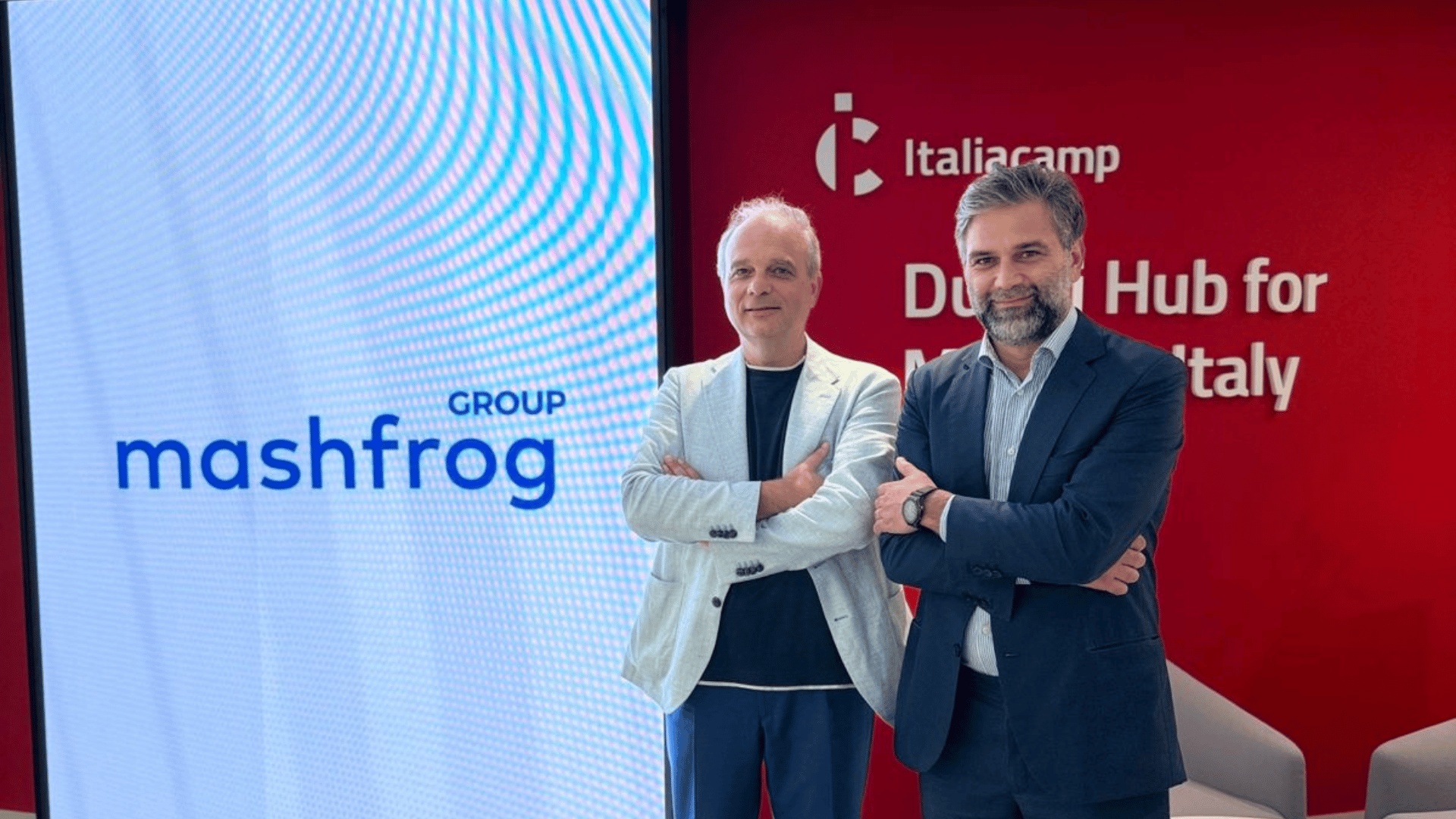
In November 2024, Mashfrog announced that its UAE operation had moved to the Dubai Hub for Made in Italy, managed by Italiacamp. The hub sits in the Convention Tower at the Dubai World Trade Centre Free Zone. The group had been operating in the Middle East since 2018. The move provided another location for the continuing business of connecting Italian capabilities with customers abroad.
His ventures also extend into hospitality technology. Yato names Narduzzi, Sandro Capocci and Matteo Colucci as founders. Its work includes integrations for hotel and restaurant systems. A hospitality business gives software a particularly immediate examination: guests arrive, payments need processing and the evening continues whether the systems cooperate or not.
The agent still has to earn its keep
In 2024, Narduzzi founded gAIn360, bringing his interests in financial services and software together again. The company offers an AI-driven wealth-management platform integrated with the Salesforce ecosystem. He served as CEO until June 2025, then became executive chairman, with responsibilities for strategic direction and product development.
The platform brings together customer relationship management, AI agents, portfolio optimization and security selection. Those functions connect the administration of a client relationship with the analysis of investments. It is another example of Narduzzi choosing a particular professional activity as the setting for a software business, following earlier ventures concerned with voting proxies and financial risk.
His public discussions of AI return repeatedly to organizational use. For a 2025 hospitality presentation, his stated approach was to test the technology in practice, integrate it into business processes and check the results. He described AI as an additional software layer that can work with systems companies already use. That is familiar territory for someone whose career includes years in enterprise technology.
In commentary published in May 2026, he anticipated a more varied AI ecosystem, requiring integration among different components. By July, discussing AI economics on Class CNBC, he was also concentrating on token consumption, deployment costs and productivity. The financial journalist’s questions remain close at hand: what must a company spend, and what does that expenditure produce?
- ConnectFit AI into existing business systems.
- MeasureUnderstand usage and operating costs.
- EvaluateCheck productivity and the return on investment.
Three recurring concerns in his 2025 and 2026 discussions of applied AI.
The corporate work continues to change shape. On October 13, 2026, gAIn360 announced that Taje Mohabir had succeeded Narduzzi as CEO and chief commercial officer of its Canadian subsidiary. The subsidiary, established that May, forms part of the company’s North American development. This is a separate role from Narduzzi’s executive chairmanship of the parent company.
Across the different chapters, certain activities keep recurring: finding partners, studying a market, building a business and writing about the forces around it. The subject matter has moved from mobile services and enterprise systems to AI agents. Narduzzi still occupies the junction between the financial discussion and the practical business.
His sense of accountability sometimes takes a theatrical form. In 2014, he imagined having to answer to Leonardo, Galileo and Michelangelo for what he had done with the inheritance they left Italy. It is a demanding appointment to put in anyone’s diary. In his telling, the defence would be to show that he had tried to compete at the frontier of innovation.
His original job target offers a fitting way to leave him. He had imagined a point at which enough would be enough. Then he reached it and changed the number. The prospective business-school lecturer has continued collecting examples.
Narduzzi in print and on screen
Follow the conversations, books and businesses behind this profile.
- Mashfrog Group: management and company history
- gAIn360: executive biography
- Edoardo Narduzzi on LinkedIn
- X: @EdoNarduzzi, credited in his published columns
- His writing and author biography
- The 2014 conversation about Techedge and ambition
- Books: the Marsilio author page
- Watch Class CNBC: AI productivity and operating costs
- Watch Class CNBC: AI infrastructure and integration
- October 2026: Canadian subsidiary leadership announcement