Sixty-two is an unusual age to begin a fashion business. In 1985, Joseph Harary put everything he had into Gina Hosiery and set to work with his son Edmond. The starting product was modest enough: hosiery. The commitment was rather less modest. A father was making a new beginning, and a son was helping build something that would outlast its first category.
There is a pleasing lack of glamour in that opening. Socks rarely receive a standing ovation. They do, however, require someone to design them, arrange their manufacture and get them into shops. A fashion business can begin with a relatively small item and still demand a large collection of practical skills. The customer sees the finished pair. The business has to see everything that precedes it.
Edmond Harary is now Gina Group’s CEO, based in New York. His career offers a way into the less visible part of fashion: the work connecting a brand’s promise with a retailer’s shelf. To understand that work, it helps to keep the original hosiery business in view. The products have multiplied. The need to make a useful proposition to a buyer has stayed.
A degree, and a business already under way
Harary attended Baruch College from 1983 to 1986. His studies covered international business and marketing. Put those dates beside the company’s beginning and an interesting overlap appears: Gina started in 1985, before his graduation. The family business and his business education were taking shape during the same period. The dates place his formal studies beside the early work of a business that would occupy much of his career.
Marketing and international business are apt subjects for a career in wholesale fashion. One concerns how a product makes sense to its audience; the other widens the frame beyond a single market. Neither subject, on its own, puts merchandise on a shelf. A business must turn the proposition into something that can be made, priced and supplied. Harary’s subsequent work sits at that meeting point.
There is also a useful distinction between founding a business and continuing to operate it. The founding date stays fixed. The product assortment does not. A company selling seasonal goods must keep making decisions after the origin story has been told. In Harary’s case, the long tenure means that the beginning and the continuing work belong in the same portrait.
The name on the label, the work behind it
A particular partnership makes his role easier to see. In May 2016, WallFlower announced that Gina Group would handle new hosiery and footwear offerings for the juniors lifestyle brand. Hosiery was scheduled for fall 2016; footwear for spring 2017. The announcement described several licensing partners working on different parts of an expanding assortment.
Harary spoke about designs that would complement WallFlower’s existing junior business. His chosen phrase, “the same aesthetic integrity,” was a compact statement of the assignment. The additional category had to make sense beside the clothing the customer already associated with the brand. A familiar label placed on an unrelated product would be a rather expensive introduction to confusion.
The distinction matters because category expansion is easy to describe and harder to make convincing. A shopper who knows a denim brand encounters a pair of shoes with the same name. The products differ, but the relationship should be intelligible. In that 2016 announcement, Gina’s job was to help carry the brand into products beyond its established clothing business.
This is one of the places where an executive’s work can be consequential without becoming a public performance. The announcement names the brand and the partners. The consumer meets the merchandise. Between those points sits the business of coordinating an extension that feels coherent. Harary appears here as a participant in that practical translation, with the hosiery company’s original competence still relevant.
The timing of the WallFlower launch is worth lingering over. The two categories were announced together, but planned for different seasons. Hosiery came first in the schedule, followed by footwear. That detail gives a category extension a calendar, rather than leaving it as an abstract promise of growth. It also keeps the history tied to an identifiable business decision.
“the same aesthetic integrity”Edmond Harary, on the WallFlower partnership, 2016
Two scales of attention
On January 12, 2015, Harary published a LinkedIn article titled “Hiring Director of Operations.” Its opening described an apparel and accessories company in Midtown Manhattan seeking an experienced operations director. It is a small public detail, but a telling one. Alongside the brand names and product categories, there was the ordinary task of finding someone to help run the machinery of the business.
A hiring notice has none of the romance of a founder’s memoir. That is part of its usefulness. It puts a specific operational need into the picture. Growing an assortment also creates work that must be assigned, supervised and completed. Whatever a company intends to become, someone still has to decide who will do tomorrow’s jobs.
The tension between a broad commercial ambition and the particulars of execution is familiar enough to anyone who has managed a project. From a distance, expansion can look like adding another line to a catalogue. Up close, it creates another set of obligations. A product needs more than permission to carry a name. It needs a credible path from the first design decision to the final purchase.
For a wholesale business, those two scales are inseparable. The large view asks where the company can go. The small view asks whether its commitments can be kept. Harary’s public career is most legible when both are held together: a long association with the company, a named licensing partnership, and the prosaic evidence of recruitment. Fashion acquires a different texture when the job advertisement joins the mood board.
Readers of a fashion story naturally gravitate toward the finished object. The operational side offers another kind of interest: how many separate responsibilities have to meet before the object can appear. In a company working across categories, the connecting work deserves attention of its own. Harary’s role is situated among those responsibilities, rather than confined to a single product or a single season’s look.
Away from the product meeting
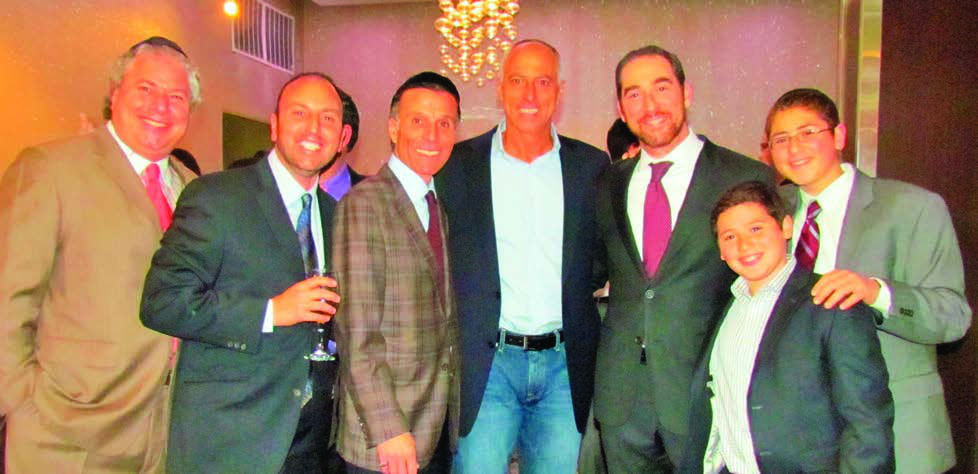
A June 2014 community photograph places Harary in a different company. He appears alongside Eddie Schweky, Joey Torgueman, Michael Fallas, Rabbi Joseph Dweck, Ezra Dweck and Isaac Dweck at a gathering marking Rabbi Dweck’s departure for London. It is a group photograph of a community occasion, rather than a corporate portrait arranged around a title.
The accompanying account records members of Congregation Shaare Shalom wishing their rabbi well. Harary’s presence belongs to that particular occasion. The picture gives the profile a second setting: people gathered around a shared institution and a departing figure. It also provides a welcome change of scale after the discussion of brands, products and schedules.
Another public connection is the Sephardic Heritage Project, which lists Edmond and Terry Harary among its donors. Its work concerns genealogy and the preservation of family history. Read beside the father-and-son business origin, that association makes an interesting pairing. One institution preserves connections to the past; the company’s founding story records a family making a new commercial start.
These details do not need to be inflated into a grand theory of his character. They are specific connections outside his executive role. A profile becomes more human when it can accommodate a community photograph and an interest in family history alongside a licensing agreement. The variety is useful precisely because each detail belongs to a different part of a life.
Forty years, and the next assortment
On August 19, 2026, Gina Group issued an announcement celebrating more than four decades in business. Its description of the company now included legwear, footwear, accessories, handbags, home and pet products. The distance from the original hosiery focus is visible in the assortment itself. The assortment provides a direct view of how the scope has changed since the company’s early focus on legwear.
The business now combines design, licensing, manufacturing and distribution. Those activities describe different parts of the same commercial journey. Design gives a product its form. Licensing connects it to a brand. Manufacturing produces it. Distribution moves it toward the places where it can be bought. An assortment can look effortless in a shop; the sequence behind it is considerably more particular.
Harary’s anniversary comments emphasized partners’ needs, consumer trends and value in the marketplace. These are business priorities expressed in the language of the people buying and selling the products. They also offer a practical way to read the company’s future. Another category has a purpose only if the resulting merchandise makes sense to a partner and to a customer.
Gina’s stated next steps include strategic partnerships, brand development and category expansion. After four decades, the work continues to involve new decisions about products and relationships. Longevity provides experience; it does not select the next assortment. That selection still has to happen in the present, with the present customer in mind.
Return, finally, to 1985. Joseph began at 62, and Edmond joined him. The origin has the appealing asymmetry of a father starting again while his son was finishing college. Decades later, the son leads a business with a wider set of products and partners. The thread connecting those moments is the continued work of putting merchandise into the world. A pair of socks was a perfectly serviceable place to begin.