A bottle of perfume is a small object with a surprisingly long journey. Someone has to make it, price it, sell it to a retailer and get it onto a shelf. Frank Fazzinga III has built his career along that journey, where a consumer’s moment of pleasure depends on a considerable amount of work the consumer will never see.
The glamorous part of beauty comes with its own vocabulary: desire, identity, discovery. Distribution has a less seductive lexicon. Inventory. Assortment. Forecasting. Yet both concern the same encounter between a product and a person. Fazzinga’s story is interesting because he has worked on the connection between them, first as an entrepreneur in fragrance and later as an executive and investor.
Two golfers, one change of plans
After graduating from Lafayette College in 2001, Fazzinga considered law school. In Manhattan, following September 11, he and former golf co-captain Andrew Mitchell discussed their options. They started Aspen Industries in February 2002, drawing on Fazzinga’s father’s fragrance experience. Getting established took more than a year.
There is a useful distinction between having a connection and having a company. A connection can open a conversation. A company must give the other person a reason to keep talking. In wholesale commerce, the next delivery matters as much as the first introduction. The business has to become dependable enough that another business can make plans around it.
“being entrepreneurial definitely takes risk and guts”Frank Fazzinga III, 2007
In April 2005, the business launched FragranceUP.com with fellow alumnus Anthony Dimarco. The online store also sold older, harder-to-find scents. Lafayette students visiting as externs packed boxes and made sales calls. Fazzinga had met his wife, Nancy Nejman, at college, too. His university connections had become part of both his working life and his family life.
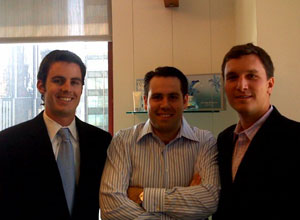
His college golf years supply another detail. The Patriot League lists Fazzinga on its men’s golf academic honor roll for 2001. That record places him within a student sporting life as well as an entrepreneurial one. It also makes the later partnership easier to picture without inventing a scene: two people who had already shared a team entered a business together. Familiarity gave the venture a history before it had a balance sheet.
The family business travels further
Grace Beauty’s family roots begin with Frank A. Fazzinga Jr. and a beauty retail store in New Jersey. Father and son went on to build a distribution and retail marketing business. Its present structure brings together two divisions: Grace Beauty, the operating business, and Grace Beauty Capital, the investment arm.
The family connection gives this career a particular shape. Fazzinga’s starting point included experience accumulated before he arrived. That is an advantage, but it also establishes a standard. A business passed between generations has to remain useful to customers whose expectations keep changing. Heritage can introduce a company; it cannot place the customer’s next order.
Grace’s stated principles include collaboration, authenticity, family, integrity and low ego. As an editorial matter, that last phrase is the most arresting. Beauty sells self-expression. Business leadership often sells the leader. A company that explicitly places attention on its partners makes a different promise: the customer’s brand gets the spotlight, while the machinery works behind it.
This is also a practical way to understand the family story. The inheritance is more than a surname attached to the door. It is a set of relationships and expectations that has to earn its keep in a different retail world.
What a retail door actually opens
Grace Beauty reports omnichannel reach across more than 30,000 retail doors, alongside ecommerce sites. That number describes the company’s reach. It is neither a count of products sold nor a guarantee that every partner appears in every location. Its significance is the range of routes available to a brand.
A company network metric, alongside ecommerce channels
The company’s distribution process moves through market assessment, retailer strategy, sales execution, supply chain management and measurement. Its retail channels include mass merchants, specialist beauty retailers and online destinations, with US and Canadian outlets represented. For a brand, choosing among those channels is part of the work, rather than a detail to settle after the product is ready.
A useful way to read the process is as a sequence of questions. Where does this product belong? What price makes sense there? How does it arrive? What happens once it does? A launch answers only some of them. The answers have to survive an actual selling cycle.
There is something pleasingly unsentimental about a process that returns to assessment. It allows the market to correct the plan. The shelf is a place where an elegant argument meets a customer who is perfectly entitled to walk past.
The names behind the operation
Fazzinga is listed as Grace Beauty’s CEO and President. Mike Pane holds the Chief Operating Officer and Chief Financial Officer roles. The team also includes separate functions for retail sales and marketing, sales and financial analytics, and inventory planning and logistics.
Those distinctions explain what an executive in this business is coordinating. Elyse Warner leads analytics and insights. Angela Fresolone directs demand and inventory planning. Geovanny Avecillas oversees warehouse and logistics work. The company also lists growth marketing and ecommerce leadership, finance and treasury roles, and sales specialists.
An organization chart can seem a dry way to tell a personal story. Here it clarifies the scale of the subject. Fazzinga’s job sits above work with very different clocks. Marketing looks toward the next opportunity. Inventory planning concerns what will be needed. A warehouse has to deal with what is physically present. Financial oversight ties the decisions together.
The interesting leadership question is how those clocks stay in time. A consumer sees one product and one price. Behind that encounter, people with different responsibilities have to agree on what should happen next. The romance of retail has a remarkably administrative underside.
An investor with an operating vocabulary
Fazzinga has served as Managing Partner of Grace Beauty Capital since 2014. Earlier, he co-founded ZIG Capital and worked there as a managing partner from 2007 to 2014. The investment work sits beside his long-running leadership of Grace Beauty.
Grace Beauty Capital’s stated interests include digital-first brands, consumer goods and services, software for retailers or consumers, and retail technology. Its criteria include differentiated products, growing markets, strong gross margins and room for improvement. It offers strategic advice, introductions, business development and help with brand awareness.
These choices bring the investor’s question closer to the operator’s. A product may be appealing; the business still needs a workable route to its audience. Margins, distribution and customer interest have to make sense together. The investment thesis suggests that knowing the route can be useful when deciding which journey to finance.
The portfolio extends beyond fragrance. It includes companies working in clothing, home essentials, footwear and retail software. Perch’s interactive displays and Pixlee’s visual marketing platform concern how products are presented and discovered. Other portfolio businesses address what people wear or bring into their homes. The connecting editorial theme is commerce: the product, the customer and the encounter between them.
A shopping trip can happen in a chat
In 2014, Grace Beauty Capital backed ShareRails, the company behind Dressli. The app let people share products in a private conversation with friends and family, then follow a purchase link to a retailer. Shopping advice became part of the mobile experience.
“We understand the important role of human interaction”Frank Fazzinga III, Dressli launch announcement, 2014
Fazzinga’s published comments connected that idea to the personal exchanges of department-store shopping. The interest is revealing without requiring a grand theory of his personality. It identifies a concrete feature of commerce that technology could carry into another setting: people often want someone else’s opinion before they buy.
A screen changes the setting of the conversation. The familiar questions remain. Does this suit me? Is it worth the price? Would you choose this one? The app’s proposition was to keep those questions close to the product. For an investor whose operating experience includes physical retail, that was a recognisable problem expressed through a new interface.
A name in the theatre’s donor list
There is a quieter connection beyond retail. The Dramatists Guild Foundation’s 2019 donor impact report names Frank Fazzinga III among its annual fund donors for the period from January 2018 through June 2019. The foundation supports writers for the theatre. The entry records a contribution, rather than a business role, and offers a small glimpse of activity outside the beauty trade. In a career described largely through companies and markets, that different kind of affiliation has its own place.
The next product still needs a plan
In a 2025 recruiting post, Fazzinga sought a product-development consultant for Otella, describing a goal of bringing four commercially viable products to market over two years. The brief included market analysis, concept development, collaboration and finding manufacturing partners. An update said the position had been filled.
The language brings the story back to the work before the shelf. A product starts as a possibility. Someone must assess the demand, refine the idea, find a manufacturer and manage its arrival in the market. The stated ambition is specific enough to have a timetable, and practical enough to require several kinds of expertise.
For Fazzinga, the career now spans the people who make products, the businesses that distribute them and the capital that helps them develop. The thread is a continuing interest in how commerce happens. A customer may spend seconds choosing a bottle. Making that choice possible occupies rather more of everyone else’s day.