Ed Harycki had a perfectly respectable ending available to him. In September 2017, PayPal completed its purchase of Swift Financial, the business lender he had founded in 2006. The company, its technology and its team were joining a payments business with millions of merchant relationships. An acquisition makes a convenient full stop. Harycki’s career proceeded to another application form.
He founded Credit Genie in 2019, moving from small-business financing toward the finances of individual consumers. The change was substantial: different customers, different products, different sums of money. Yet a recognizable problem followed him. Financial institutions have abundant ways to collect information. Whether they use it to understand the applicant is another matter.
His working history is rooted in lending rather than in a sudden discovery that banking might benefit from software. MBNA America, Barclays Capital and Accucard appear in that history. By the time Credit Genie arrived, he had already spent years dealing with the awkward space between a customer’s circumstances and a financial institution’s willingness to accommodate them.
A banker on the other side of the queue
Before Swift, Harycki headed MBNA’s business lending division. That experience matters to the story because his next company addressed small businesses seeking working capital. He knew the institutional side of the counter before setting up another counter of his own.
Swift Financial was established in Wilmington, Delaware, in 2006. Its proposition was practical: give growing businesses access to financing through loans and advances. Its brands included Swift Capital and LoanBuilder. The latter allowed businesses to explore and customize working-capital loan terms before applying. Even the name sounded as though somebody had considered letting the customer participate.
Working capital has an unromantic job. It keeps an enterprise operating while money moves through it. A lender serving that need has to understand the business’s incoming revenue, obligations and timing. The glamour, if any, tends to arrive much later, when somebody writes the acquisition announcement.
Third Point Ventures, which led Swift’s Series D in March 2016, described a platform designed to assess businesses rapidly, with decisions in minutes and funding potentially available the same day. Its portfolio account records more than $500 million supplied to small businesses nationwide. Those figures belong to Swift’s development at that time; they describe the scale of the operation Harycki was building before the sale.
- 2006Swift Financial founded
- 2017PayPal completes acquisition
- 2019Credit Genie founded
- 2022Consumer platform launch
Growth still had a telephone number
Swift Capital appeared on the Inc. 5000 at No. 64 in 2015, No. 368 in 2016 and No. 694 in 2017. Those are annual growth-list positions, rather than a league table of lending quality. They nevertheless place the business’s expansion in the years immediately before PayPal bought it.
There was another, quieter milestone in 2017. Swift Financial’s contact centers earned J.D. Power certification for their live-phone service. The evaluation considered matters such as courtesy, knowledge, prompt access to a representative and resolution of the customer’s problem. A lending platform could process data at speed and still be judged on whether someone answered a question properly.
Harycki’s response placed customer service at the foundation of the organization. That is a useful detail in a technology career. A customer calling about money has usually found a reason to stop admiring the interface. At that point, the institution becomes the person who picks up.
“Providing an exceptional customer service experience is foundational to our organization.”
Ed Harycki, Swift Financial, 2017
The same period brought experienced financial executives into Swift’s orbit. Richard Vague joined its board in 2016, alongside investors and banking veterans including Tench Coxe, David Weiden and William Zuendt. Harycki’s company was growing within a network of people familiar with credit businesses and the work of making them operate.
PayPal wanted the machinery, too
When PayPal announced its agreement to acquire Swift in August 2017, it already had a commercial relationship with the company. The attraction included Swift’s ability to use additional information in underwriting. PayPal wanted to strengthen its financing offering and reach more small and midsized businesses.
Swift had financed more than 20,000 businesses by the acquisition announcement. For PayPal, buying the company meant bringing its platform and people into an existing distribution network. For Harycki, the decision involved a choice: he and the board selected PayPal over a competing venture financing proposal that would have kept Swift independent longer.
“This is great for our people,” he said at the time. It is a compact explanation, especially in a field where transactions can acquire enough explanatory adjectives to require their own financing. The remark put the team inside the decision, alongside the business case.
The acquisition closed on September 19, 2017. Swift’s employees joined PayPal’s Business Financing Solutions unit under Darrell Esch. The next stage was integration: taking a business that had developed its own capabilities and fitting those capabilities into a larger operation. That is work beyond the signing ceremony.
Businesses financed through loans and advances.
The colleagues who came along
Two years after the acquisition, Harycki founded Credit Genie. The new company began with developers and engineers who had worked with him at PayPal. Software architects Alex Kates and Anthony Briglia were among the early builders. A founder starting again can bring an address book; here, some of the working relationships became part of the new operation.
Its early work addressed debt counseling. Credit Genie partnered with the National Foundation for Credit Counseling and built software to collect consumer financial information for participating agencies. A five-page proof of concept took under a week to build. By April 2021, the platform was serving the top five NFCC agencies.
That beginning gives the company’s story a particular shape. Before the consumer app and its public growth announcements, there was a tool for an existing professional workflow. The customer’s information had to reach a counselor in a useful form. There was administrative work to remove before there was a larger audience to attract.
Harycki also appeared on the March 2020 agenda for the Consumer Financial Protection Bureau’s debt-relief convening, listed as Creditly’s founder and CEO. The panel concerned innovation in debt relief. It places his young company in a discussion about how the industry might change, while its product work was still taking shape.
From a counselor’s desk to a phone
Credit Genie’s consumer platform launched in 2022. By October 2023, the company said it had engaged more than one million Americans. That dated milestone marked a different scale and a different relationship with the customer: an app could sit directly on the consumer’s phone.
That October, Credit Genie announced $10 million in additional financing led by Khosla Ventures, with participation from Tippet Ventures. Khosla had also backed Swift. The recurring investor is one connection between the companies, though the products and their customers had changed.
Credit Genie presented financial alerts, budgeting and credit-related tools as parts of a broader service. The premise was that a household’s cash flow could reveal useful information about its circumstances. The company’s ambition was to use that information to make financial services more accessible. An ambition deserves to be read as a direction of travel, with the products doing the work of proving it.
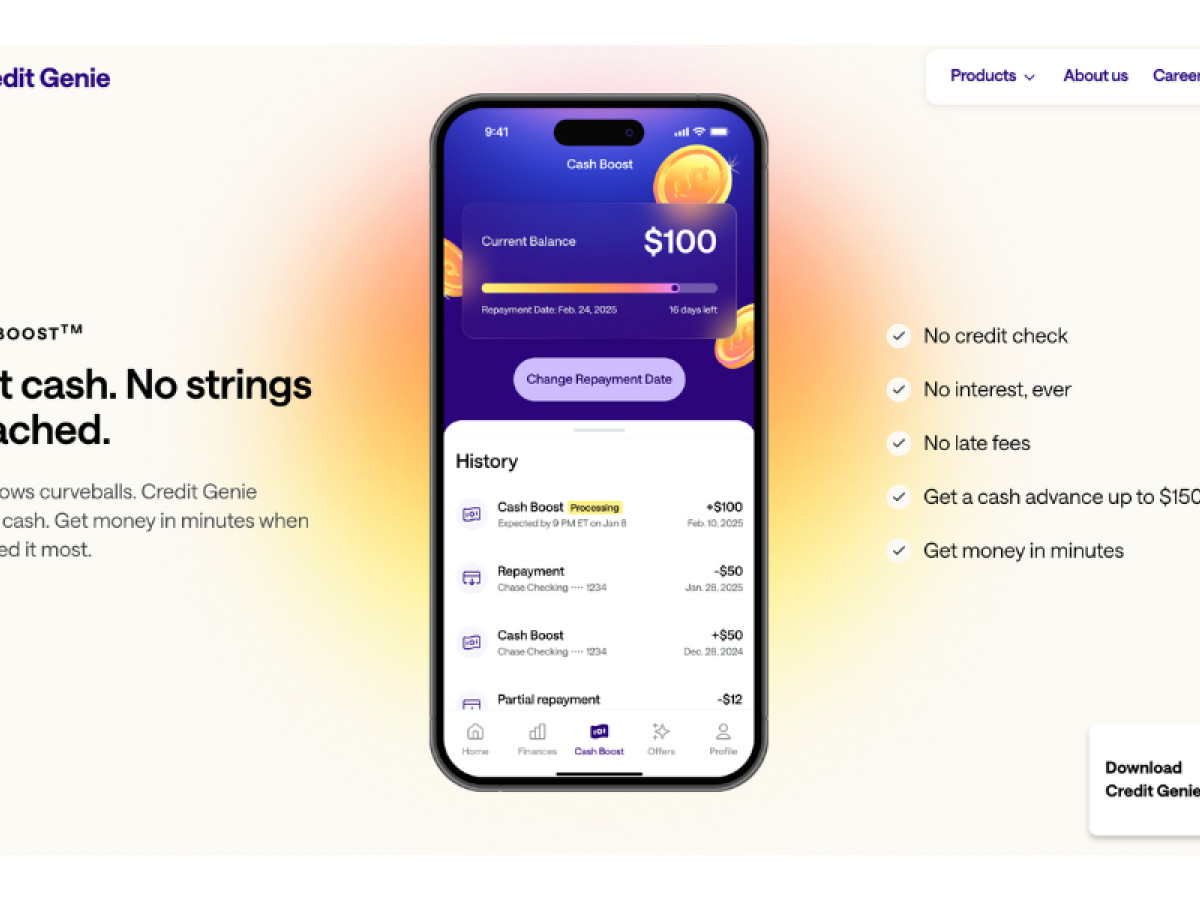
The presentation changed, too. A website redesign by Cappen, featured in September 2025, used bright colors, illustrations and a prominent mobile interface. Financial products have often dressed as though friendliness might damage the balance sheet. Credit Genie’s visual approach allowed a less formal introduction to a serious household task.
The small print is part of the product
Harycki remains identified as Credit Genie’s founder and CEO on its public About page. The current offering includes Cash Boost advances for eligible customers. The page describes amounts from $10 to $150, while making clear that few customers qualify for the maximum and some do not qualify at all.
The distinctions matter to the story of what he is building. A headline amount is a ceiling, rather than a promise. The company’s terms also distinguish access to a Cash Boost from paid membership and faster delivery options. Those choices shape the customer’s actual experience as surely as the color of the app.
Credit Genie’s mission statement emphasizes helping people gain more control over their finances. Harycki puts the founding motive plainly: “We knew there had to be a better way.” That is an aspiration with a demanding audience. People managing a tight cash-flow gap have reason to judge a service by the details.
The business and household settings remain different. Swift supplied working capital to enterprises; Credit Genie addresses personal finances. Across those settings, the recurring product questions concern information, access, timing and service. Each is easier to describe in a meeting than to get right repeatedly for customers.
The question that followed him
Harycki’s career has passed through established banking, a company built for business borrowers, an acquisition and another startup. The sequence gives Credit Genie some history behind its name. Its founder has worked with institutions that make credit decisions, people seeking financing and colleagues building the software between them.
The PayPal sale remains a significant event. So does the decision to return to building. One delivered Swift into a larger business; the other put Harycki back in charge of developing a product around a different customer’s financial circumstances.
There is a pleasing stubbornness in the question that runs through the work: how can finance make better use of what it knows about the people asking for help? The answer takes the shape of products, teams and service decisions. Harycki has kept returning to those details. The borrower, meanwhile, still has an application to finish.