A student loan can last longer than the job that made it look affordable. It can outlive a car, follow a borrower across the country and sit patiently through several changes of plan. Earnest built a business around a small rebellion against that rigidity: let people choose a monthly payment that fits their lives, then work out the loan around it.
That idea has carried the company from a venture-backed startup to a business inside Navient. Along the way came private student loans, an international lending partnership and, in 2026, a return to personal lending. There was also a $2.5 million Massachusetts settlement over alleged underwriting and consumer-protection failures. The approachable interface has a complicated business behind it.
Earnest is worth understanding because both sides matter. Repayment flexibility can be useful. A lender still has to decide who qualifies, find money to lend and handle what happens when the borrower’s life stops matching the application.
The budget came before the menu
Louis Beryl and Benjamin Hutchinson founded Earnest in 2013. Its early proposition was that a credit score could miss financially responsible people. Income, savings and the ability to meet ordinary expenses could help fill in the picture. Personal loans came first; student loan refinancing followed in January 2015, alongside a $17 million Series A led by Maveron.
The refinancing product gave that philosophy something concrete to do. Earnest’s Precision Pricing approach allowed borrowers to start with their desired payment and receive a customized rate and term. A household budget rarely arrives in tidy five-year increments. The product treated that awkwardness as a design problem.
Refinancing itself is straightforward: a new private loan pays off existing education debt, leaving a new repayment agreement. Whether the replacement is better depends on the rate, term and protections involved. A lower monthly bill can feel like a pay rise while quietly keeping the borrower in debt for longer.
The arithmetic below isolates that tradeoff. It uses an invented $40,000 balance and a constant 6% annual interest rate, not an Earnest quote. Stretch the term and the monthly payment falls. Watch what happens to the interest bill.
More time has a price tag.
Illustrative monthly amortization, fixed 6% rate, no fees or extra payments. Rounded to whole dollars. Actual loan calculations and offers differ.
A friendly interface needs serious money
By November 2015, Earnest announced $275 million in financing. The number needs unpacking: $75 million was Series B equity led by Battery Ventures, with Adams Street Partners and Maveron participating. The other $200 million was institutional lending capital from New York Life and others. One paid for building the company. The other helped fund its customers’ loans.
Beryl was appropriately restrained about the equity round. In a January 2016 interview with Caroline Fairchild, he said, “$75 million in funding is just the opportunity to build something great.” It was an opportunity with a recurring financing requirement attached.
“$75 million in funding is just the opportunity to build something great.”
Louis Beryl · January 2016
In October 2017, Navient announced a $155 million cash deal for Earnest. A subsequent filing recorded approximately $149 million for a 95% controlling interest when the transaction closed in November. The announced price and the accounting for the acquired stake describe different things.
The pairing had a practical logic: Earnest brought digital customer acquisition and underwriting; Navient brought education-finance experience and access to capital markets. S&P Global’s contemporary analysis highlighted the benefit of a larger balance sheet. Read that way, the acquisition shows the financial infrastructure required to keep an appealing product available.
The customer has to pass the test
Earnest serves several moments in a financial life. Students and families use private education loans to cover eligible costs. Borrowers with existing student debt seek refinancing. Personal-loan customers may want to consolidate other debts or pay for major expenses. These are different products, with different terms and eligibility decisions.
The company’s refinancing guidance describes a customer with reliable income, manageable everyday expenses and a positive payment history. It also considers savings habits and career potential. Broader underwriting does not mean automatic approval. The intended borrower must still look capable of repaying the loan.
There is a more consequential distinction for people with federal debt. Refinancing into an Earnest private loan permanently gives up the federal benefits attached to the old loans, including applicable income-driven repayment and forgiveness options. Someone who expects to need those protections has a different calculation from a borrower replacing an expensive private loan.
SoFi, Citizens and Sallie Mae appear in Earnest’s competitive neighborhood, although their product ranges differ. The sensible comparison is between actual offers for the same need. A brand’s advertised starting rate cannot tell a particular applicant what they will receive.
The small print gets a speaking part
Earnest’s skip-a-payment feature captures its appeal and its limits. The first request requires six months’ worth of consecutive, on-time scheduled principal-and-interest payments. After using it, another twelve months of qualifying payments are required before the next skip. Approval is necessary; an application is not permission to stop paying.
Interest keeps accruing during the break. For student loans, a skip is processed as one month of forbearance and counts toward the lifetime twelve-month allowance. That can be valuable breathing room during a difficult month, but the financial clock keeps ticking.
Costs also depend on the product. Earnest’s student-loan materials describe no origination or prepayment fees. Its newer personal loans offer an optional origination fee of 1% to 8% in exchange for a lower interest rate, where permitted. The fee comes out of the proceeds: borrowing a stated amount does not mean receiving that entire amount in cash.
A borrower comparing those personal-loan options needs to consider the cash received, monthly payments and expected payoff date together. Paying upfront for a lower rate may be less attractive if the loan will be repaid quickly. The useful number is the cost over the period the borrower actually expects to keep it.
The model faced a $2.5 million challenge
Earnest’s central claim was that better information could support better lending decisions. In July 2025, Massachusetts challenged the company’s execution of that idea. Attorney General Andrea Joy Campbell announced a $2.5 million settlement resolving allegations involving consumer protection and fair lending, including risks posed by algorithmic underwriting.
The state alleged that Earnest had not adequately addressed risks of disparate harm to Black, Hispanic and non-citizen applicants and borrowers. The settlement agreement also described alleged shortcomings in testing and governance. Earnest denied the allegations and denied violating state or federal law; the agreement was not an admission.
The company agreed to changes in its practices and compliance reporting. That distinction matters: a settlement establishes obligations, while the disputed allegations should remain identified as allegations.
For anyone copying the company’s approach, this is the demanding part. Adding information to a lending decision does not settle whether the decision is fair. The model needs scrutiny, and so do the human judgments and processes surrounding it. A promise to see the whole person creates an obligation to examine who the system might still miss.
A credit file travels. A brand lightens up.
One concrete attempt to widen access arrived in July 2023. Earnest partnered with Nova Credit to use home-country credit information for eligible international students. Credit Passport translated that history into information that could support a U.S. lending decision, addressing the problem of an established borrower appearing new to credit after crossing a border.
The launch was deliberately limited: selected graduate programs and schools, with eligible students from India, Mexico, Canada and South Korea. It offered qualifying applicants a route without a cosigner. The interesting lesson is the specificity. A missing local credit history and an absence of financial history are different problems.
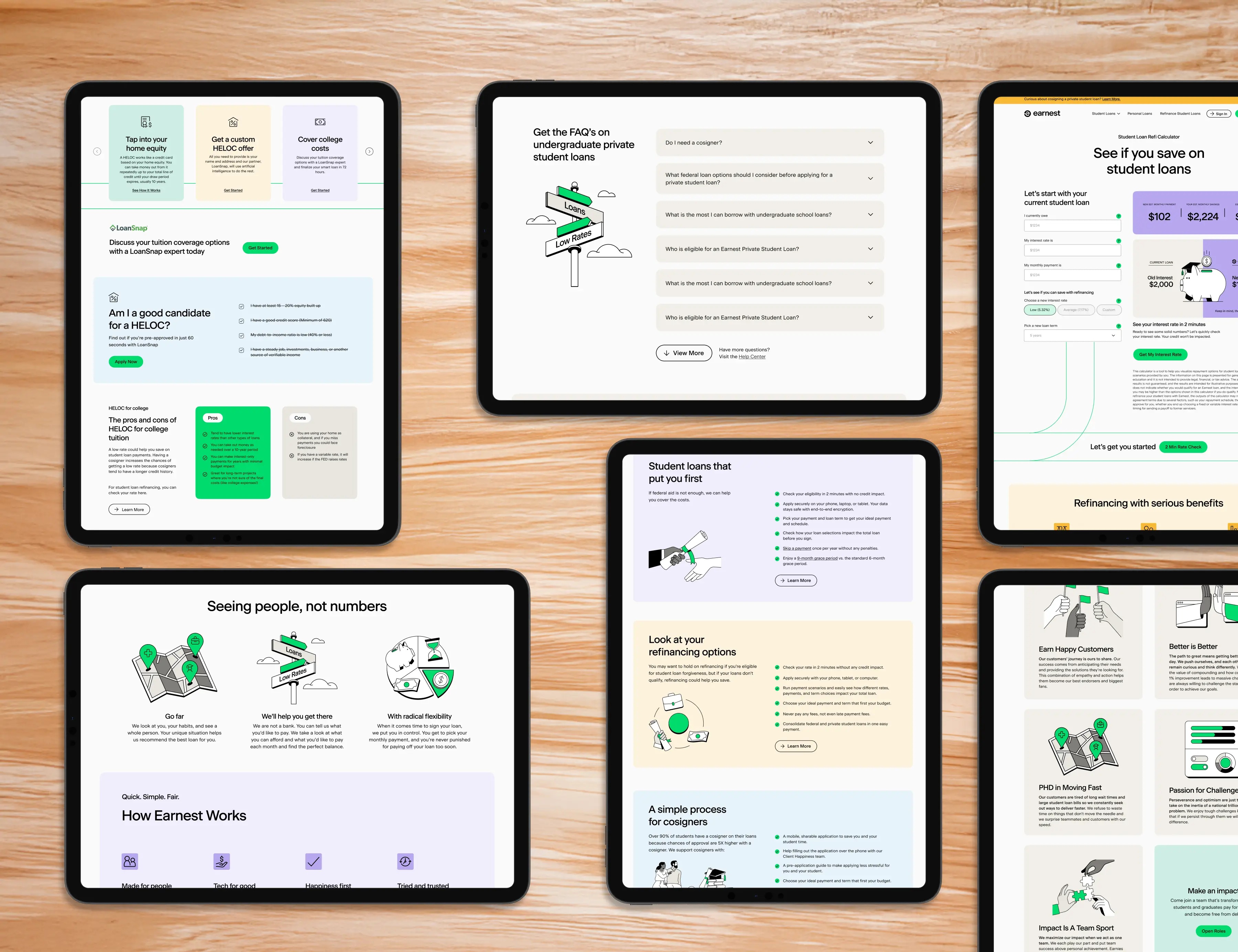
Elsewhere, Earnest worked on how lending felt. Motto’s brand case study describes stakeholder interviews, workshops and a competitive audit, followed by a refreshed identity with highlighter green, lavender, illustrations and cleaner web layouts. The exercise made a technical subject easier to approach without changing the underlying obligation to repay.

Even support has a branded name: Client Happiness. Earnest says it continues to provide servicing and works with MOHELA, its servicing partner since October 2024. The name is cheerful. The operational test is whether a borrower can get a clear answer when a payment becomes difficult.
Personal loans, take two
Earnest’s 2026 expansion has an unexpected echo. Its original personal-loan product launched in 2014 and ended in 2020, according to the Massachusetts agreement. The help center now describes a new personal-loan offering. A business that became known for student debt has returned to a broader borrowing need.
Navient’s November 2025 strategy discussion supplied the commercial reasoning: offer additional products as customers’ financial needs evolve, spreading acquisition costs across a longer relationship. Management described 2026 as a transitional period for personal lending. This was a stated plan, not evidence that every proposed expansion would succeed.
The scale is already substantial. Navient reported more than 375,000 unique Earnest customer relationships as of September 2025. Its illustrative 2025 presentation estimated $219 million in revenue, including interest and servicing income. That estimate should not be mistaken for audited standalone revenue.
What can another company borrow from this history? Start with a constraint customers can name. For Earnest, it was the payment that fits the month. Show the tradeoffs beside the choice. Find partners for capabilities the interface cannot supply. And test the promises after launch, when a borrower needs help, an underwriting decision deserves review or funding becomes harder to secure. That is where the product earns its name.
Open another tab
Explore Earnest’s website, its Help Center and blog. Follow LinkedIn, X, Instagram and Facebook, or visit its GitHub profile and YouTube channel.
More on the company: Motto’s design case study and Earnest news releases.