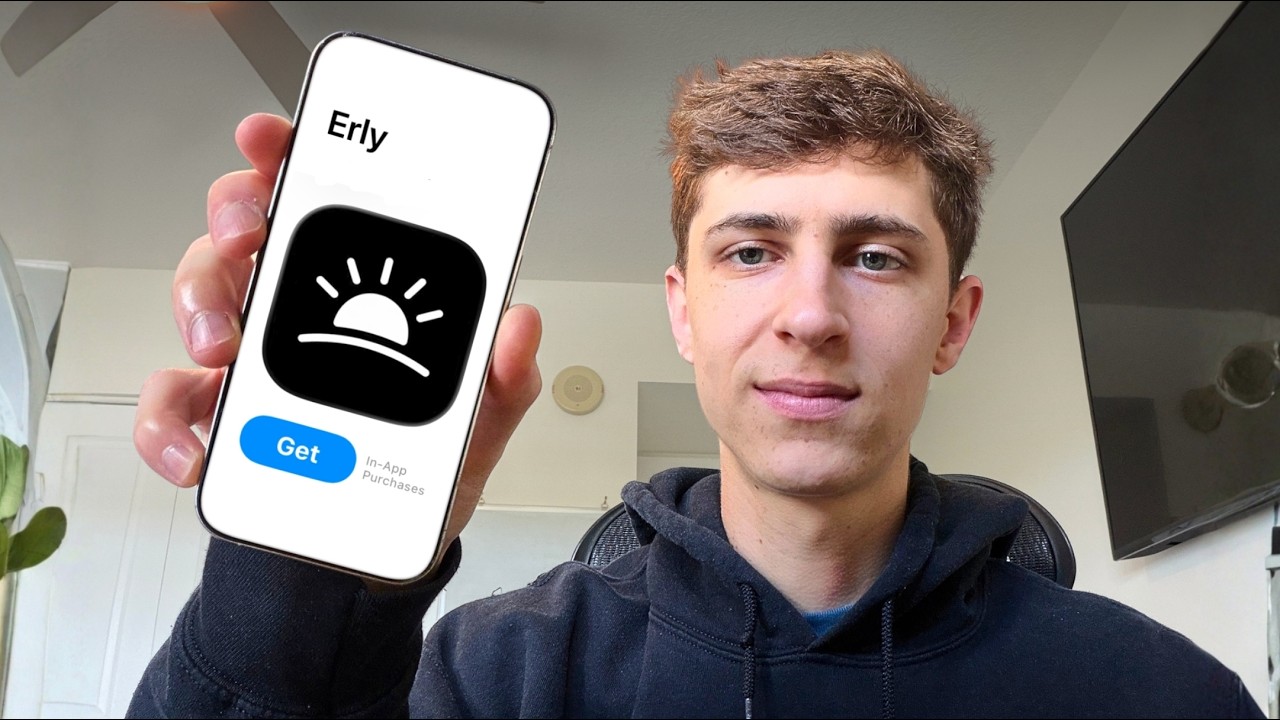
When Pat Walls sat down for the latest episode of Starter Story, he opened with an admission that borders on disbelief. “When I heard about this app idea, I could not believe my eyes,” he told viewers. “Hands down, one of the simplest ideas I’ve ever seen on this channel, and yet it makes over $50,000 a month.” The man responsible for that number is Jake, a 24-year-old developer whose entire pitch fits into a single line: push-ups that turn off your alarm.
That is not a metaphor. Jake’s app, called Early, is an iPhone alarm clock that refuses to go quiet until you physically drop to the floor and knock out a set of push-ups in front of your phone’s camera. And no, you cannot cheat — the app runs an AI analysis to confirm you actually did the reps before it flashes a green check and, at last, silences the noise. It is a deceptively small idea. It is also, by the numbers, a runaway success: more than 200,000 downloads in 2026 and revenue that crossed $50,000 a month within four months of launch.
“I launched at the end of 2025 and went from zero to $50,000 a month in 4 months,” Jake said, laying out the trajectory that makes his story catnip for aspiring founders. But the most striking thing about the conversation is not the revenue curve. It is Jake’s insistence, repeated in a dozen different ways, that building the thing was almost beside the point.
Building doesn’t really matter so much. What really matters is marketing. And so I prioritized that over everything.
From Spreadsheets to the App Store
Jake’s résumé does not scream Silicon Valley. He went to school for accounting — four years of undergrad, a fifth for his master’s — earned his CPA, and spent just over a year in public accounting at a Big Four firm. Coding was something he taught himself on the side over the last four years, in between a string of businesses that, in his own blunt telling, went nowhere. “Had some other businesses in the past, nothing really worked,” he said.
Those failures, though, were the tuition. “I realized through all these failures that marketing is the most important thing,” Jake explained. The conclusion reshaped how he approached his next attempt: build something that solved a painful problem in the simplest possible way, then throw everything at distribution using a playbook he had watched other apps prove — influencer marketing.
The origin of Early was almost embarrassingly personal. Jake, like a lot of people, struggled to get out of bed. His fix was analog and slightly ridiculous: every night he texted a friend a promise. “Hey, I’m going to send you a video of me doing push-ups by 6:00 a.m. tomorrow.” The accountability worked. And somewhere in that nightly ritual, an app was hiding.
The MVP that had no alarm
Here is the wrinkle that makes the story more instructive than a typical overnight-success tale: the first version of Early was not an alarm app at all. The minimum viable product was a bare accountability tool — set a wake-up goal the night before, log that you hit it. No alarm feature whatsoever. Jake built it in about three weeks and pushed it live. “It took about 19 days from my first commit to live on the App Store,” he said. “It actually went out without the alarm feature, funny enough.”
Then came the pivot, and a stroke of timing he freely credits to luck. Jake took an entire day to walk and think about direction, and landed on adding a real alarm. The reason he could was that Apple had just shipped iOS 26, which exposed the AlarmKit API — a way to hook an app directly into the iPhone’s native alarm system. Until then, Jake noted, alarm apps on the store were “gimmicky and not reliable because they used different app sounds and workarounds to make the quote-unquote alarm.” A missed alarm is a fatal flaw for an alarm clock. AlarmKit fixed it. The alarm feature went live roughly 19 days after the original launch.
The Framework: Painful, Simple, Viral
Asked how someone else might find an idea like this, Jake offered a framework tight enough to fit on an index card. “Solve a painful problem in a simple way and it should be inherently viral,” he said. “If it’s not inherently viral, the idea itself, then add some sort of novel aspect to it to make it inherently viral.” The push-ups, in other words, were not just a feature — they were the marketing baked into the product.
His test for whether a problem is painful enough is refreshingly human. “If it’s something that’s going through your head at least once a day, it’s probably a really painful problem,” he said. In college, he and his roommate talked every single night about going to sleep early and waking up early. And the anecdotal validation kept coming: whenever Jake shows the app to someone, the reaction is almost always “Oh, I need this” or “my friend needs this” or “my girlfriend needs this.” Someone in the room always needs it.
If it’s painful, people will pay. And if it’s simple, it’s easy to show the value in content very quickly.
Walls, who has interviewed a long line of successful founders, backed the point. Across the fastest-growing apps he has profiled, one pattern recurs: simplicity. “Sometimes it’s just one main killer feature,” he said. Simple products are easier to explain, easier to film, and easier to grow — which is exactly why they win on distribution.
How He Actually Grew It
There are, Jake acknowledges, a thousand alarm apps on the App Store, with more arriving every day. Standing out came down to a single channel executed relentlessly: influencer marketing on TikTok and Instagram. Early on, that meant grinding — sending a flood of DMs and getting very few replies. But the targeting was smart. He hunted for creators already making “day in the life” or lifestyle content, the kind of video where an alarm going off in the morning fits naturally.
That natural fit was the whole sell. “They could continue making their existing videos, except they would get paid for it,” Jake said. Traditional influencer ads feel like ads, which means creators demand more money and viewers tune out. But drop a push-up alarm into a college student’s morning routine and it reads as a genuine, intriguing moment, not a pitch. A typical winning video, Jake described, was pure POV: a student wakes up, the alarm goes off, the push-ups happen, the app analyzes, a green check appears — alarm turned off. Subtle, natural, and almost guaranteed to generate the comment every founder wants: what’s the app name? Jake or the creator answers below and pins it. “Early on the App Store.”
The economics of a viral clip
On the money, Jake was unusually candid. Deals are typically structured as two to four videos a month with a view guarantee — meaning he pays for views he actually receives, at roughly $2 to $3 CPM. That, he argues, makes the downside low: you can cap your spend and see returns within about a day, the time it takes a video to hit peak views. The upside, meanwhile, is governed by the power law. “A lot of videos will sort of do okay,” he said. “Every once in a while you get a big 1 million view, 2 million, 5 million view video, and that’s where you really make money.”
Attribution, he admits, is a mess. Influencer marketing is “extremely difficult” to measure precisely, so Jake keeps it crude on purpose: track views, watch for spikes. When a jump in video views lines up with a jump in downloads and conversions, he can be reasonably sure which clip drove it. Beyond that, he treats the whole machine as a black box.
I view it as sort of like a black box. Put in 5K and you get out 10. That worked.
You will lose money on some creators, he concedes, and often you will never know which ones. “It’s just inevitable.” The point is not perfect measurement; it is a positive average return, repeated.
The Stack Behind a One-Man Show
For a solo founder — Jake says he now has some help, calling it “inevitable” — the toolset is lean. The app runs on Firebase for database, authentication, and cloud functions; Superwall handles the paywall and subscriptions; OpenAI powers the AI; and Mixpanel covers in-app analytics. For building the app itself, he named Claude Code as “the absolute best tool.” On the marketing side, he leans on Grow for influencer tracking and payments, SideShift for UGC creator sourcing, Instantly for mass outreach emails, Cal for booking, and Agree for contracts. Then the unglamorous backbone: QuickBooks for accounting, 1Password for passwords — “on a personal note, absolute life changer” — and, inevitably, Google Sheets running everything.
The pricing is standard App Store fare: a free trial, then $29.99 a year or $9.99 a month. Nothing exotic. The magic is entirely in the top of the funnel.
“Focus on Top of Funnel Only”
Pressed for the one piece of advice he would give his younger self — or anyone watching who wants to follow his path — Jake did not hesitate. “Focus on top of funnel only. That is the most valuable skill right now is marketing.” His reasoning is a clear-eyed read on the AI era: building an app has never been easier, so building is no longer the bottleneck. Getting anyone to notice it is.
He preaches ruthless scope discipline for solo builders: limit what you make, solve one painful problem simply, and pour the rest of your energy into marketing. Then, in a moment of accidental comedy that could not have been scripted better, his own app went off mid-sentence. “Oops, I should have turned off the alarm,” he said — a live demo of the very problem he built a business on.
The Producer’s Read: Watch the APIs
In the closing debrief, Starter Story producer Gus pulled out a takeaway aimed squarely at idea-hunters. The thing that unlocked Early was a platform change — Apple exposing AlarmKit — and those changes reliably spawn waves of new apps. “Every time there’s a new improvement to the API,” Gus said, “there are thousands of business ideas that become easier to build, but there’s a short window of time to do it.” He rattled off precedents: programmatic widgets, screen-time controls that birthed a flood of screen-blocking apps, new camera capabilities. The opportunity, in other words, often hides in the changelog — and it does not stay open long.
Walls closed on the theme that has become the channel’s refrain. “Distribution, specifically video, organic video content creation… is the number one skill you can have right now,” he said. Building is getting easier every day. Putting yourself out there is not only hard but scary, which is exactly why it stops so many people — and exactly why it remains the edge. Or, as Gus put it after watching a 24-year-old ex-accountant out-market an entire category: “Marketing is like the hardest thing, but the most important thing.”
Early is, at bottom, an alarm clock. It has one killer feature and a price most people wouldn’t blink at. What it also has — a painful problem, a viral hook, a relentless distribution engine, and a founder who understood that the code was never the hard part — is a $50,000-a-month business. The rest of us are still hitting snooze.