An early Figma user decided to throw a party inside a design file. Invitations went out. People arrived as cursors. The team behind the software spent the next 48 hours trying to keep this peculiar gathering from bringing the file down. Some visitors had come to make fun of the idea. Then they began making things together.
Dylan Field remembers the episode with the satisfaction of someone whose demonstration has briefly escaped its enclosure. Here was the argument for Figma, happening without a pitch deck: a shared place could change what people made, and how they felt about making it. Of course, the place had to stay open. Hospitality is more complicated when your guests can crash the building.
Field, Figma’s co-founder and CEO, has spent much of his working life inviting people into unfinished work. The invitation sounds harmless. It can touch a nerve. A designer’s private file contains discarded ideas, unexplained decisions, and the occasional layer name best left between its author and the machine.
There is a parallel in Field’s own career. While he was building a product that let people work together, he was learning how to give his colleagues the freedom to do it.
A boy with two kinds of stage
Growing up in Sonoma County, California, Field had an early career in acting. In one production of Peter Pan, he fell asleep onstage. The engagement nevertheless supplied something useful: experience with theatrical flying. That helped him land a Windows XP commercial. An imperfect performance had produced a surprisingly practical qualification.
At Brown University, he studied computer science and mathematics. In 2012, a Thiel Fellowship offered $100,000 and a condition: leave school for two years. Brown announced that he would take a leave to develop ideas for improving creative tools on computers. The ambition was broad. The eventual product still needed discovering.
There was also an unusual answer in his fellowship application: “Chocolate is repulsive.” Field had chosen a matter on which disagreement was readily available. He later described enjoying the joke of being contrary about something other than the grand theories on which Silicon Valley usually conducts its disagreements.
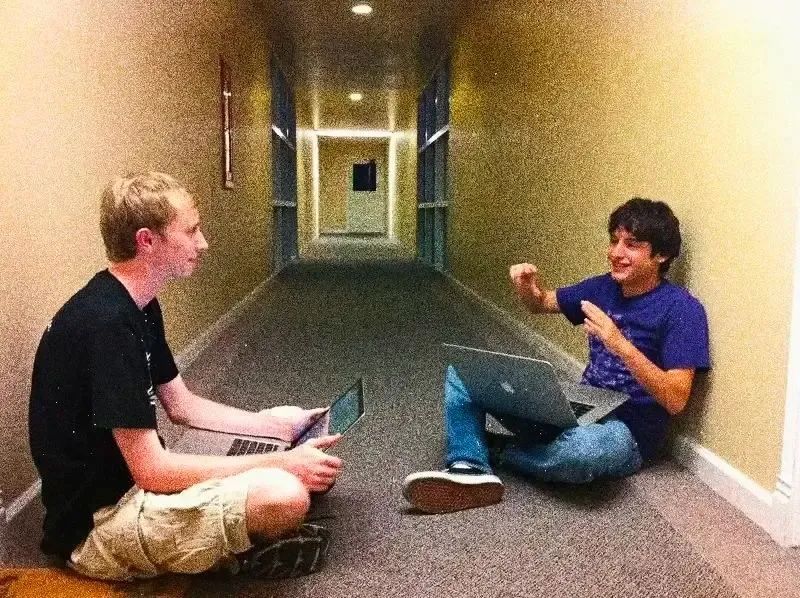
His partnership with Evan Wallace supplied a more consequential opening. Wallace’s experiments showed that WebGL, a browser graphics technology, could support creative software. Field’s 2015 launch account places an early demonstration in Brown’s computer science lab in April 2011. The two kept discussing what it could make possible.
The distinction matters. They had found a technology worth exploring before they had settled every question about the business. Figma’s familiar shape emerged through work, rather than arriving fully labeled in a moment of revelation. Field and Wallace started the company in 2012. They would spend years earning the apparent simplicity of its premise.
The browser had to earn its invitation
In December 2015, Field announced Figma’s preview after three years of work. His description of the problem was concrete: designers dealt with engineers, marketers, and other designers, yet the tools for sharing, commenting, and storing work remained fragmented. Sending a link offered a way around the procession of attachments and competing versions.
Wallace described the technical burden as building a browser inside a browser. Professional graphics software had to draw reliably, handle typography, and respond quickly. A tool that hesitates while someone draws makes the problem visible at the tip of their cursor. Elegance in the sales pitch could not compensate for clumsiness in the hand.
- 2012Company founded
- 2015Invite-only preview
- 2016Public access + multiplayer
- 2017First paid product
Different milestones, spread across five calendar years.
The preview did not yet include simultaneous multiplayer editing. That arrived with public access in September 2016. Looking back, it is easy to compress these steps into a single launch. Living through them meant separate technical tests, separate invitations, and more waiting. Charging customers followed in 2017.
Even a working product had to contend with the habits around it. In 2020, Field acknowledged that he had initially underestimated designers’ resistance. Opening the file could invite micromanagement and tighter deadlines. A person proud of their craft might reasonably wonder whether greater visibility would mean spending the afternoon defending every unfinished thought.
“The browser is natively multiplayer.”
Dylan Field
That later recognition makes his argument more interesting. He had come to see the browser as an environment that changed access and authority. Removing a technical barrier exposed a social negotiation. Who could enter? Who could comment? Who would decide? Figma could supply the canvas; each team still had to work out the manners.
The CEO learns to move his cursor
Inside Figma, Field faced his own version of the control problem. He had become a CEO with little management experience. “I was an intern before that,” he said. Optimism about an approaching release kept colliding with the distance still to travel. His involvement in product details left colleagues with too little autonomy.
He also recalled an early office where conversation had practically disappeared. Looking around, he wondered why people would stay if working there could not be enjoyable. Giving the team permission to have fun became part of the correction. A collaboration company needed an atmosphere in which people wanted to participate.
Senior team members eventually pressed him to get help. Sho Kuwamoto, an experienced product leader who joined in 2015, helped Field establish direction without trying to resolve every detail himself. The work required a different kind of contribution from the founder: give people enough context to make decisions, then let them explore.
For a founder, a small correction can feel like proof of care. For the person receiving the fifth correction, the meaning may be rather different. Field’s experience makes the costs legible. A company can hire people for their judgment and organize the day so they scarcely get to exercise it.
Colleagues also describe the patient work behind his relationships. Amanda Kleha recalled his habit of following up with designers after a demo, returning months later with improvements and writing thank-you notes. Danny Rimer, the Index investor and board member, emphasized his willingness to change. Neither habit produces an especially cinematic scene. Both require doing something after the interesting meeting has ended.
People were already using it wrong
Users had ideas of their own about the shared canvas. They used Figma for games, icebreakers, meal planning, and brainstorming. These activities stretched the original purpose of an interface design tool. They also revealed an appetite for a place where people could simply gather around an idea.
Figma introduced FigJam in April 2021 as a separate online whiteboard. Its lighter environment made room for people who did not need the full design editor. Field’s Config announcements that year placed it alongside other ways to contribute, including branching and audio. Participation had become a product question with several answers.
There is a useful restraint in that sequence: observe a behavior before deciding it deserves its own tool. A company may explain what its product is for; users retain the privilege of being inconveniently imaginative. The early design party had already suggested as much. An invitation to collaborate can become an invitation to play.
A sale, an unsale, and a bell
In September 2022, Adobe agreed to acquire Figma for approximately $20 billion. By December 2023, the companies had concluded that there was no clear route to the necessary European and UK regulatory approvals. They terminated the agreement. Adobe paid the agreed $1 billion termination fee. Figma continued independently.
The size of those figures can obscure an ordinary fact about the job: a proposed transaction does not finish the product. Field still had a company to run and customers with work to do. Figma’s expansion continued. In May 2025, for example, Figma Sites offered a route from designing a website to building and publishing it.
On July 31, 2025, Figma began trading on the New York Stock Exchange under FIG, following an offering priced at $33 a share. Outside the exchange, the company put its invitation into physical space. A banner declared that design belonged in everyone’s business, and a public gathering brought the community to the occasion.
Field’s founder letter asked potential shareholders for patience. He favored a long horizon, expected mistakes, and warned that investment in AI could weigh on efficiency for several years. The request resembled an old part of the Figma story: judging the work would require looking beyond the nearest announcement.
More tools, more decisions
By Config 2026, Field was presenting another expansion of the canvas: code layers, motion, shaders, generative plugins, and Weave tools. The June announcements described more ways for people to develop an idea within the same environment. The product was reaching further into creation as the boundaries between design and code shifted.
In August, Figma reported roughly $370 million in second-quarter revenue, up 48 percent year over year. Those numbers measure the business’s progress. The continuing product question is more personal: what does a designer contribute when software can generate more of the material around them?
Field’s answer gives greater weight to craft, context, and judgment. Easier production means more things can get made. Someone still has to decide whether the thing makes sense, whether it serves the person using it, and whether the team should keep going. A faster route to an answer makes the choice of question consequential.
That belief connects his current ambitions to the original shared file. More people can enter; more possibilities become visible; decisions remain. Field has learned something about the temptation to make all of them himself. His company keeps making the room larger. The guests, as that first design party demonstrated, will decide what happens inside.