The spreadsheet was doing a job nobody particularly wanted. At Zemanta, Dusan Omercevic had to keep track of the software subscriptions his colleagues used. He put them in Excel. Then, in his spare time, he began automating the task. A small piece of office housekeeping was acquiring the outline of a company.
There is something pleasingly unromantic about that beginning. Software subscriptions arrive with promises of speed and convenience. Keeping track of them requires the less glamorous business of remembering what you bought. Omercevic had encountered the gap from inside a software company, where buying useful tools was rather easier than maintaining a complete account of them.
Cleanshelf grew out of that problem. In March 2021, LeanIX acquired it, bringing a 40-person team into its business. Omercevic went on to lead product work for its SaaS management offering. He had helped turn an internal administrative nuisance into something another software company wanted to own.
By 2026, he was building again. His current company, *codeplain, tackles a different accumulation: the code produced by AI. The connection between the two ventures is an editorial observation, rather than a declared master plan. Both ask how people can retain a useful understanding of software when producing or acquiring more of it becomes easy.
when software multiplies?From subscription bills to specifications.
Learning to see, then learning to sell
Omercevic's technical background includes a master's degree in computer vision from the University of Ljubljana. Before Cleanshelf, he held senior product and engineering positions at Zemanta and Najdi.si. These were jobs inside the machinery of software businesses, with the responsibility of turning technical work into something people could use.
His research also concerned how computers connect what they see with useful information. He coauthored “Hyperlinking reality via camera phones” with Aleš Leonardis, published in Machine Vision and Applications in 2011. The title now has a period charm: a camera phone still sounded like a distinct category of object. The problem of making an interface understand context has aged rather better.
Building Cleanshelf required a second education. A technically useful tool needed buyers, a sales process and an American presence. Omercevic partnered with Brian Flynn and FounderPartners while the business was still small. The partnership brought practical work on incorporation, customer discovery and the commercial operation, alongside investment.
The division of labour mattered. Ljubljana provided the engineering base; San Francisco brought proximity to a large software market. Omercevic had to operate across those worlds. An elegant product demonstration could open a door, but somebody still had to work out which door to knock on, and what conversation should follow.
The six o’clock flight
Dawn Capital's Mina Mutafchieva first spoke with Cleanshelf on December 18, before a January product demonstration sharpened her interest. She later boarded a six o'clock flight from Copenhagen to Ljubljana to meet Omercevic and the team. It is a useful scene in a business story: an investor rearranging a trip because a demonstration had made the problem tangible.
Her account of Omercevic combined ambition with an ability to listen. She described a founder who recognised his own blind spots. That assessment belongs to an investor who chose to back him, but it offers a more specific portrait than the usual catalogue of entrepreneurial virtues. He could understand the product deeply and still accept that other people understood parts of the business better.
In March 2020, Cleanshelf announced an $8 million Series A led by Dawn Capital, with LAUNCHub participating. Its customers included Hilton, Looker and CoStar Group. The service connected subscription information with financial, HR and single sign-on systems. For a buyer, the attraction was concrete: a way to see what the organisation was paying for and who was using it.
A subscription is a remarkably polite way for a cost to avoid attention. It arrives in instalments, renews itself and rarely interrupts a meeting to explain its continued existence. Cleanshelf made those recurring commitments easier to inspect. Renewals, access and overlapping tools became matters a business could address together.
A founder changes the sales machinery
Inside Cleanshelf, commercial progress involved changes less photogenic than a funding announcement. Farlan Dowell, its sales leader, described reorganising a team whose representatives had been responsible for both prospecting and closing deals. Specialisation gave those different jobs clearer owners.
Omercevic put the lesson plainly: “lead generation is fundamentally different from the closing process.” For a technical founder, that is a revealing admission. The organisation around a product needs design as surely as the product does. Expertise in one part of the system does not make every other part self-explanatory.
Dowell's account also described refining the ideal customer profile, building outbound lead generation and changing the discovery process. These were deliberate operating choices. They give the Cleanshelf story texture: people revised roles and routines until a useful product had a more repeatable route to customers.
On March 24, 2021, LeanIX announced that Cleanshelf was joining it. The team was spread across San Francisco, Denver and Ljubljana. The acquisition connected Cleanshelf's subscription discovery and management technology with LeanIX's work on enterprise application landscapes. Omercevic became vice president of product for SaaS Intelligence, carrying his product responsibilities into the larger organisation.
When the specification becomes the thing you keep
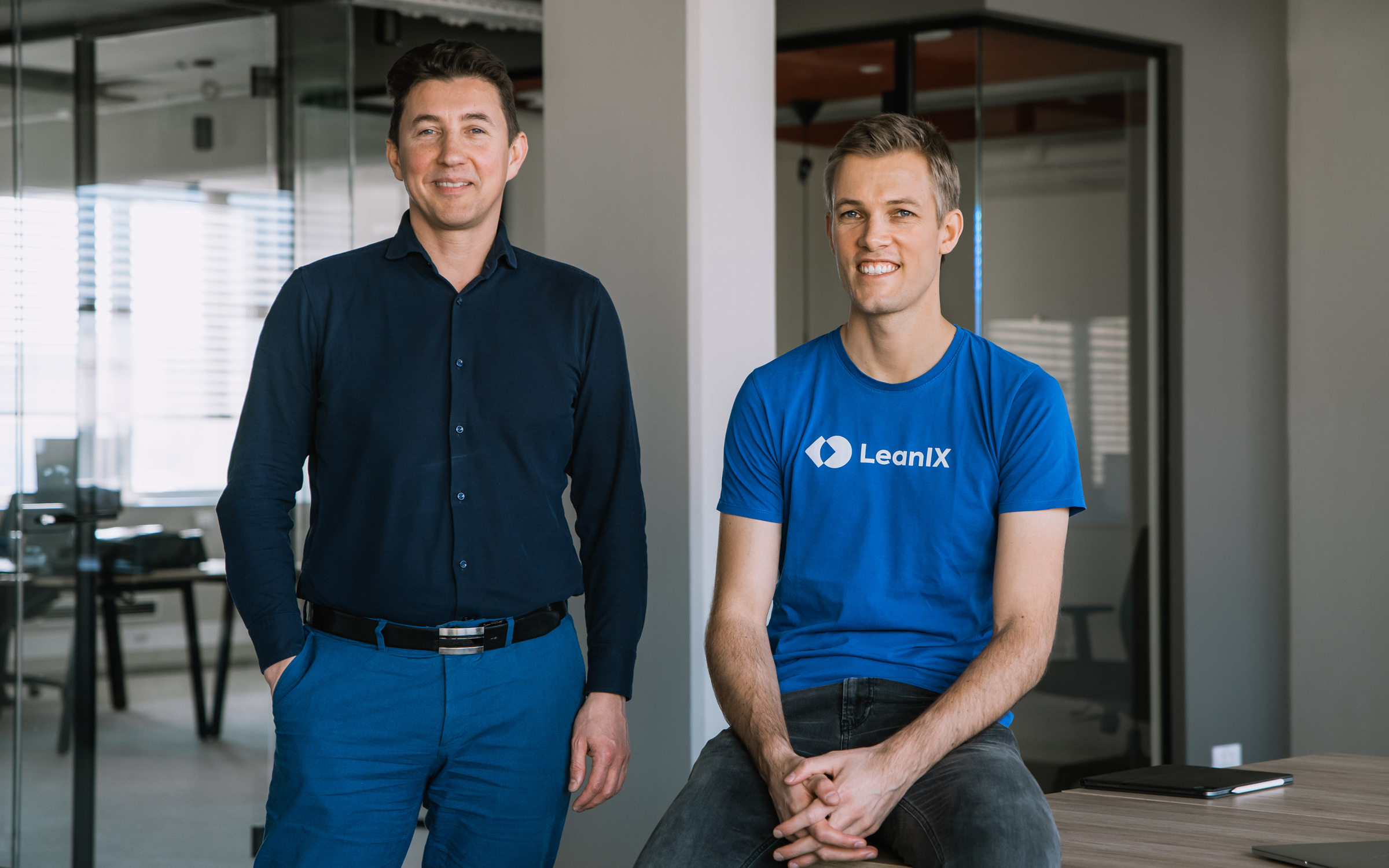
His next venture moves closer to the act of building software itself. At *codeplain, Omercevic is CEO, working alongside CTO Predrag Radenkovic and head of AI Vitjan Zavrtanik. The company develops software from specifications written in ***plain, a structured language intended to preserve what engineers want a system to do.
In a February 2026 essay, Omercevic described a familiar difficulty: maintaining code requires someone to reconstruct the understanding that went into writing it. An implementation contains decisions, but the reasoning behind them can be hard to recover. His proposed answer is to retain a clearer expression of that intent and use it to generate the implementation.
This is a specific bet about where engineering effort belongs. If requirements change, teams would update the specification and regenerate software. The specification becomes the durable working document. Generated code becomes something that can be replaced. The approach still asks engineers to make decisions precisely; moving the words to a different file does not make ambiguity disappear.
Omercevic has written directly about that objection. His January 2026 essay on the :Concept: notation argues that important meanings should be defined explicitly, rather than assembled from scattered prompts. When a team uses the word “task,” for example, the system needs a consistent definition of what that object contains and permits. Ordinary vocabulary can conceal a surprising amount of unfinished design.
His earlier “Beyond Vibe Coding” essay acknowledged that some algorithms are more efficiently expressed in code. It also described specifications as text files that can use version control, templates and existing development tools. The proposal draws on engineering habits already in place, while changing the material those habits organise.
- 01 / IntentDescribe the behaviourEngineers write structured specifications.
- 02 / ImplementationGenerate the softwareAI produces code from the specification.
- 03 / ChangeRevise, then regenerateKeep the intent as the lasting reference.
A second company, familiar company
In May 2026, Omercevic presented *codeplain's first platform version at ***plain dev day. His talk covered feedback from design partners, including DevRev, Incode and HYCU, as well as the specification language and the agent used to render code. He also discussed limitations: more complex specifications, rendering speed and helping developers debug their descriptions.
Those details matter because an idea about software development eventually has to survive somebody else's project. A language needs people who can learn it. A generation system needs understandable failures. A promising demonstration must become a workflow that another team can use without its creator standing beside them.
In July 2026, Silicon Gardens announced its participation in *codeplain's $3 million seed round, led by GapMinder VC. The relationship had travelled in both directions: Silicon Gardens had backed Cleanshelf, Omercevic became an investor after his exit, and the fund then backed his new company. Its announcement named a ten-person team and customers HYCU and DevRev.
“lead generation is fundamentally different from the closing process.”
Dusan Omercevic, on his Cleanshelf sales lesson
The disco has acquired a compiler
Omercevic's writing provides a less formal view of the same interests. In July 2026, he compared the discos of his youth with the hackathons attracting younger builders. His company had organised an event in Ljubljana and sponsored another in London. He saw places where people could meet, learn and make things together.
The Ljubljana event brought together 30 people who produced 12 projects. For Omercevic, the result was also an argument for infrastructure: rooms, organisers and shared interests give a technical community somewhere to form. His essay called for a place where Slovenia's AI generation could grow, recalling the role Kiberpipa had played for an earlier internet generation.
Elsewhere, his curiosity follows technology out into the street. In an essay about riding in San Francisco's driverless taxis, he lingered on the passenger experience: ordering the car, finding it, getting inside and becoming accustomed to the empty driver's seat. A computer-vision graduate was examining an automated system from the back seat.
The recurring interest is in what people can actually do with technology once it leaves the demonstration. At Cleanshelf, that meant making a company's collection of subscriptions intelligible. At *codeplain, it means asking engineers to write down the understanding they would otherwise bury in implementation. In Ljubljana, it can mean finding a room for 30 people on a Saturday. Omercevic's next software argument is still being tested. He has given it a language, a company and some working company to keep.
Follow the work
Read Omercevic’s essays, explore his technical writing or watch him explain the approach.