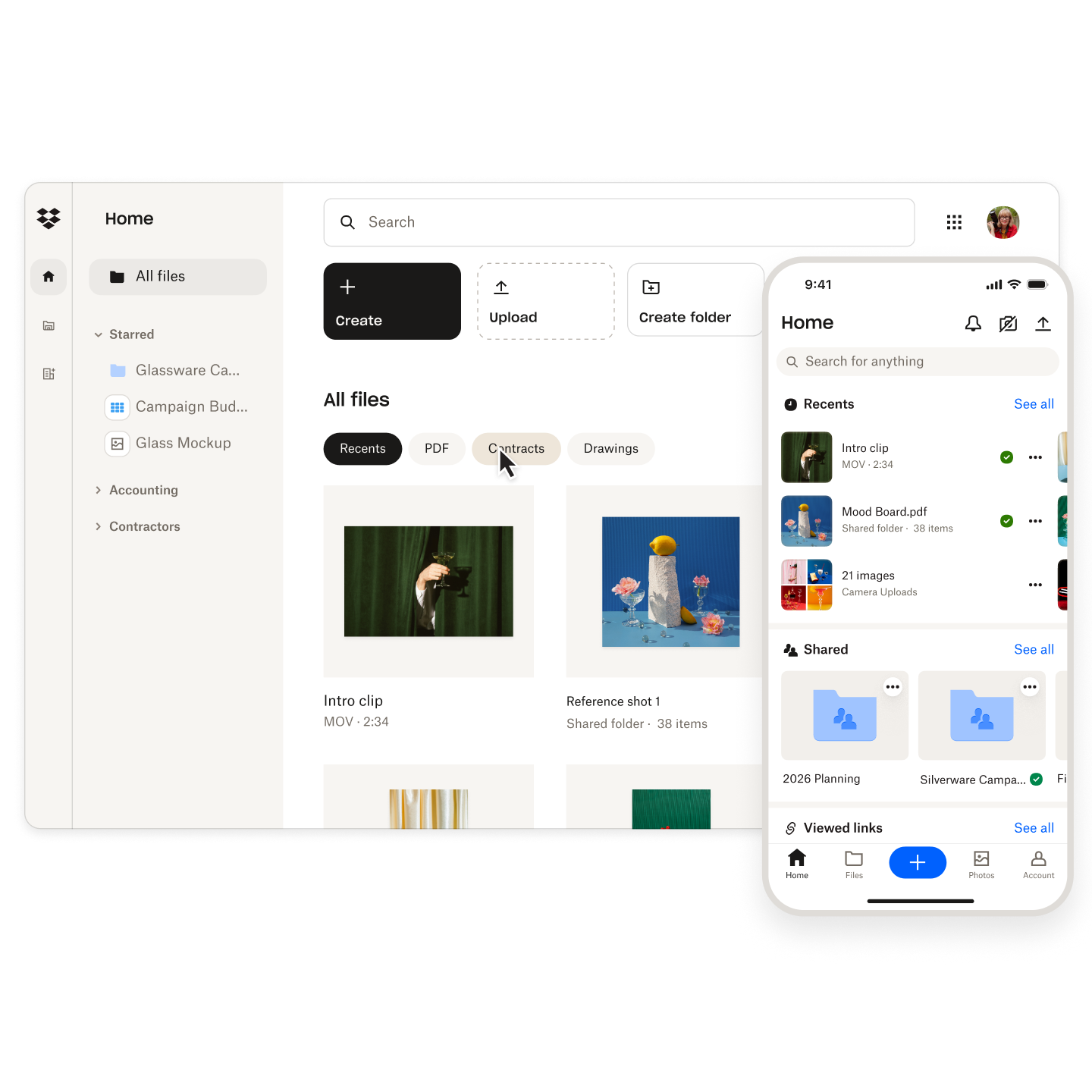
Somewhere right now, a freelance editor is dropping a 4GB video into a shared folder, and a colleague three time zones away watches it appear without a single email, attachment, or "did you get my file?" The folder is blue. Nobody thinks about it. That invisibility is the whole point - and it is exactly what Dropbox spent nearly two decades engineering.
Dropbox is, depending on who you ask, a cloud-storage utility, a collaboration platform, or a verb. "Put it in my Dropbox" is a sentence roughly 700 million registered accounts understand without translation. About 18 million of those accounts pay, which is how a company that gives away its first few gigabytes funds a business pulling in around $2.5 billion a year on the Nasdaq under the ticker DBX. Not bad for software whose proudest feature is that you forget it exists.
A file in two places at once
Before Dropbox, keeping the same document current across a laptop, a desktop, and a phone was a small daily humiliation. You emailed files to yourself. You carried USB drives that you then left on buses. You ended up with report_final_FINAL_v3.doc and no idea which machine held the real one. The problem was not storage - hard drives were cheap. The problem was truth: which copy is the one that counts?
Plenty of companies had tried to answer this. Most produced sync tools that worked beautifully in a demo and fell apart the moment a real person used two computers and a flaky Wi-Fi connection. The graveyard was crowded. The skeptics were right to be skeptical.
A USB drive, forgotten, on a bus
The origin story is almost too tidy to be real, which is why people keep repeating it. In 2007, MIT graduate Drew Houston boarded a bus from Boston to New York, opened his laptop to work, and realized he had left his USB flash drive behind - again. Instead of cursing and moving on, he started writing code that would make his files simply follow him. By the end of the ride he had the beginnings of Dropbox.
He pulled in Arash Ferdowsi, who dropped out of MIT to co-found the company. They went through Y Combinator in 2007, and rather than write a business plan, Houston made a short screencast demo full of in-jokes for the technically literate. It hit the front page of tech forums overnight and stacked up a waitlist of tens of thousands. The pitch was the product working - nothing more.
Not everyone was convinced. Steve Jobs, the story goes, tried to buy Dropbox, and when Houston declined, reportedly dismissed it as "a feature, not a product." It is one of the more famous misreads in tech. Dropbox went on to build a multibillion-dollar business out of that supposed feature - though, to be fair to Jobs, the "feature vs. product" question would haunt the company for years.
How a folder became a company
Milestones, lightly dramatized, fully sourced
More than a blue box
For most of its life Dropbox was one thing: a folder on your computer that quietly lived in the cloud too. Drag a file in, and it was everywhere - synced, versioned, recoverable, shareable with a link. That simplicity was the moat. It also became the ceiling, because a folder is hard to charge more and more money for once everyone has one.
So Dropbox spent the last several years turning the box into a toolbox. The pieces fit together more than the casual user realizes:
Dropbox
The core: file storage and sync, version history, sharing links, offline access. The thing everyone means.
Dash
AI-powered universal search across Dropbox and third-party apps - semantic search, chat, and "stacks" to organize.
Dropbox Sign
Legally binding e-signatures and document workflows (formerly HelloSign, acquired 2019).
DocSend
Secure document sharing with analytics - the quiet favorite for pitch decks and sales collateral.
Replay
Frame-accurate video and media review, so creative feedback stops living in scattered email threads.
Transfer & Capture
Send giant files with delivery confirmation; record quick screen messages instead of booking a meeting.
Pictured: the family that grew up around one folder. Most users meet two of these and never realize the other four exist.
The numbers behind the calm
Scale is the easy part of the Dropbox story. Roughly 700 million people have registered an account. Around 18 million pay for one. Behind them sits "Magic Pocket," the custom storage infrastructure Dropbox built to move the bulk of user data off public cloud and onto its own machines - a rare and expensive piece of engineering that most of its rivals never attempted.
Revenue: the plateau that funds the pivot
Approximate annual revenue, USD billions
Figures are approximate and rounded from public reporting. Note the flat top - growth has stalled near $2.5B, which is precisely the problem Dash is meant to solve.
That flat top is the central tension of Dropbox today. The core business is healthy, profitable, and not growing much. In a world where Google Drive and Microsoft OneDrive bundle storage into products people already pay for, "the best standalone folder" is a harder thing to sell every year. The skeptics, again, have a point.
Dropbox's answer is Dash. The pitch: your work no longer lives in one folder - it is scattered across Slack, Google Workspace, email, design tools, and a dozen other apps. Dash is an AI layer that searches all of it at once, answers questions, and organizes the chaos into shareable "stacks." It is, in a sense, the original Dropbox bet pointed at a new problem. In 2007 the question was "which copy is the truth?" In 2026 it is "where, across forty apps, is the thing I need right now?"
Designing a calmer way to work
Dropbox has long described its mission as designing "a more enlightened way of working." Underneath the corporate phrasing is a consistent idea: people should spend their attention on the work, not on managing where the work lives. The company leaned into this with "Virtual First," dropping the traditional office-default model and recasting its spaces as collaboration studios rather than daily desks.
In May 2026 the company turned a page. Drew Houston announced he was stepping down as CEO after 19 years, moving to Executive Chairman, with longtime product leader Ashraf Alkarmi taking the top job. Houston signaled his next act would be entrepreneurial, with AI in the crosshairs - which is a very Drew Houston way to leave a company he is betting on AI to revive.
Why It Matters TomorrowThe next invisible thing
Here is the honest version. Dropbox could ride its profitable plateau for years - 18 million paying customers do not vanish overnight, and free cash flow north of a billion dollars buys a lot of patience. Or Dash could do for scattered work what sync did for scattered files: make a daily friction disappear so completely that people forget it was ever a problem. Both outcomes are plausible. Only one of them is interesting.
Return to that freelance editor and the 4GB video. The file appears across three machines, no email required, and nobody marvels at it because the marvel became ordinary. That is what Dropbox does best - it takes something that should be hard and makes it boring. The whole company is a bet that there is a second hard-thing-made-boring waiting in your scattered workday, and that finding it is worth one more chapter.