The first draft of Ivybrook Academy lived on an airline napkin. Drew and Jennifer McWilliams were on their honeymoon, turning over a question that was at once intimate and commercial: what kind of school would they want to build? Jennifer was a first-grade teacher. She had watched children arrive in her classroom without the preparation she believed they deserved, while the pressure of testing narrowed what happened once they got there. Drew had business instincts, a career in residential real estate, and the restless conviction that he should own something himself. Somewhere above the clouds, those two frustrations became a sketch.
Napkins are generous to founders. They never ask about zoning, enrollment, payroll, curriculum writing, or whether a concept can survive contact with Tuesday morning. The McWilliamses spent the next two years answering those questions. Jennifer stepped away from teaching to develop the educational program. Drew's real-estate work helped finance the idea and gave him a practical feel for the physical side of a school: the site, the building, the local market, the rooms in which a philosophy must eventually stand up.
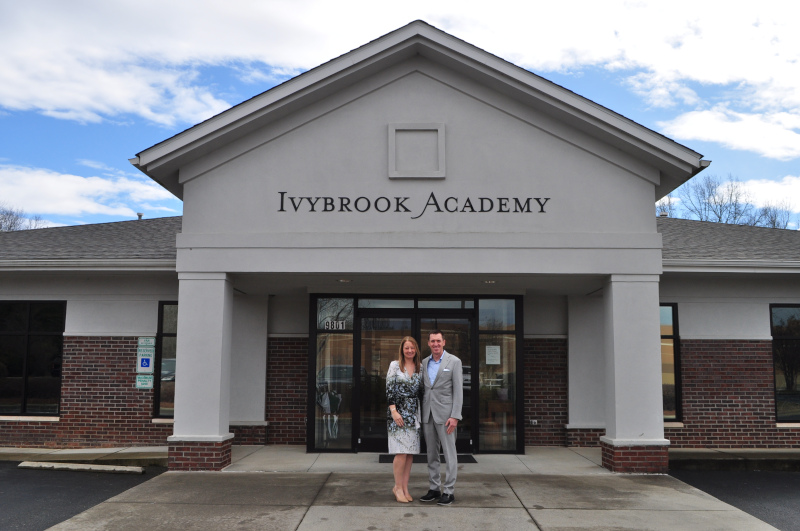
In 2007, they opened the first Ivybrook Academy in Weddington, North Carolina. Drew has said the campus was in the black on its first day. That is a lovely sentence, but its more interesting implication is that the idea had found a waiting audience. Families were not merely looking for a place to leave children while adults worked. Ivybrook offered a private, half-day preschool with a blended educational approach: Montessori for independence, Reggio Emilia for child-led inquiry, collaborative work for learning with peers, and a discovery program for art, music, movement, and books.
insight
discipline
focus
A constraint with good manners
The half-day schedule is the business's most visible limitation and its clearest statement of taste. A full-day childcare center sells coverage as well as education. Ivybrook chose a shorter window and made that window more deliberate. The classrooms are prepared around the idea that children are capable investigators. Teachers observe their interests, then shape learning experiences around what emerges. The environment is expected to participate, almost like another teacher, rather than behave as cheerful storage for plastic things.
For an operator, the temptation is obvious: extend the hours, serve more needs, catch more revenue. But additions can make a proposition harder to read. Drew's role became partly an exercise in protecting the shape of Jennifer's original insight while giving it repeatable business systems. The school would not win by doing everything. It would win by being unusually clear about the few hours it did own.
“The brilliance of Ivybrook - the creation - all the kudos go to my wife.”Drew McWilliams
It is a revealing bit of founderly credit. Drew does not cast himself as the source of the curriculum. His contribution sits elsewhere: strategic direction, business planning, real estate, franchise support, and the willingness to turn a local success into an organization that could travel. In durable partnerships, modesty can be a form of precision. Everyone knows which problem is theirs.
The recession test
The first campus opened just before the financial crisis began rearranging the country's confidence. Between 2008 and 2010, caution became the respectable business strategy. The McWilliamses chose a different experiment. In 2011, they opened a second Ivybrook in Fort Mill, South Carolina. Drew later called it their best decision. The second school succeeded quickly, too.
The significance was larger than a second address. One successful location can be dismissed as a neighborhood fluke, a founder's charisma, or good timing. Two begin to suggest a system. The Fort Mill campus showed that the concept could cross a state line and still make sense to families. It also joined Drew's property knowledge to Jennifer's curriculum in a way that would later matter enormously. Preschool happens in classrooms, but expansion happens through leases, construction, traffic patterns, parking, capital, and the stubborn geography of where families actually live.
Still, franchising was not the plan. For roughly a decade, the couple operated their two schools. The pressure to expand came from an unusually useful constituency: former customers. Charlotte's banking economy moved families around the country, and parents who relocated began asking the McWilliamses to follow them. The sharpest signal came from the former president of an Ivybrook parent-teacher association. After moving to Des Moines, she worried that her third child would miss the experience her older two had received. Drew recalls that she called Jennifer every day for 30 days.
This is market research with a pulse. A survey measures stated preference. A parent repeatedly asking you to open in another state is closer to an advance order. Her persistence pushed the couple to consider franchising, a mechanism Drew readily admits he did not yet understand.
A beginner on purpose
“You don't know what you don't know” is a shopworn phrase until someone builds a practice around it. Drew sought out franchise advisers, including SMB Franchise Advisors founder Steve Beagelman, assembled experienced counsel, and later earned the Certified Franchise Executive credential from the International Franchise Association in 2023. He has advised aspiring franchisors to create advisory boards and learn from people who have already made the trip.
His most transferable idea may be how he frames the people buying into the network. He prefers “franchise owner” to “franchisee.” Vocabulary alone proves nothing, but his selection process gives the phrase some weight. Candidates interview Ivybrook as Ivybrook interviews them. A franchise agreement can bind the parties for 15 years, and Drew compares that compact to a marriage. Nobody sensible chooses one from a glossy brochure.
“I'll take someone that has drive and no experience all day because they're going to be able to figure it out.”Drew McWilliams on selecting franchise owners
The line contains both generosity and a test. Experience is welcome, but it cannot substitute for active ownership. Ivybrook is not pitched as an autopilot asset. The operator must recruit teachers, earn trust from families, understand a local community, and carry a defined educational culture into daily practice. Drew looks for motion, not merely mileage.
Write before scaling
Jennifer develops the curriculum while Drew's real-estate career helps provide the economic runway.
Prove it twice
Weddington establishes demand; Fort Mill tests whether the model can leave its first neighborhood.
Learn the mechanism
The company builds franchise support, owner selection, training, and business-planning systems.
Protect the premise
As the network grows, leadership continues arguing publicly for the half-day distinction.
Scale without beige wallpaper
The paradox of franchising an emergent curriculum is almost comic. A franchise depends on consistency; an emergent classroom depends on attention to the particular child in front of you. Standardize too loosely and the brand dissolves. Standardize too tightly and the educational philosophy becomes theater.
Ivybrook's answer is to standardize the conditions for individual learning rather than every outcome. Its four-part curricular foundation gives teachers a shared grammar. Training and operational systems give owners a common backbone. Inside that frame, observation still matters. A child's curiosity can redirect the day. The system repeats the method, not a script.
There are signs that relationships have become part of that infrastructure. Drew has noted that two senior vice presidents began at Ivybrook as part-time teachers and moved through the organization. He has described the moment when the first franchise owner returned to buy another unit as one of his greatest highs. In July 2026, the company's annual conference in Colorado Springs centered its program on relationships and brought owners, school leaders, staff, and partners into the same room.
By then, Ivybrook reported more than 70 locations open or in development, with 40 additional locations awarded across 22 states. Numbers at that scale invite trumpet music. The quieter fact is more useful: a company born from dissatisfaction with standardized schooling grew by creating a standard for protecting individual attention.
The afternoon remains tempting
Every growing company eventually meets the revenue hiding just outside its premise. For Ivybrook, that revenue lives after lunch. Some campuses have added afternoon sessions, and the company has discussed how the same footprint might responsibly serve a second group. Leadership presents it as a local strategic choice, not a universal command. That distinction is small enough to miss and important enough to govern the next chapter.
Drew's own career has widened around the school. He co-founded Catapult Industries, a software business, and has worked at the meeting point of franchising and real estate through Franchise Realty Partners. Yet the Ivybrook story remains unusually coherent. An educator saw children arriving unprepared. A real-estate professional wanted to build. They made a school whose short day forced a sharp promise, then learned how to let other owners carry that promise into new communities.
The napkin was not a business plan. It was better: a compact between two different kinds of expertise. Nearly two decades later, the useful lesson is not to start sketching on airline stationery. It is to notice the constraint that makes an idea legible, find the partner whose competence completes yours, and resist improving the concept until nobody can remember why it mattered.