A meeting has an invisible seating plan, even when everyone has the same chair. The most senior person offers an opinion. Everyone else now has two things to consider: the investment and the opinion. Drew Johnson has described a small intervention at Gauge Capital. Junior associates give their ratings and ideas first. The partners wait. It is a procedural detail with a larger question behind it: how much of what an investor hears is an independent judgment, and how much is an echo?
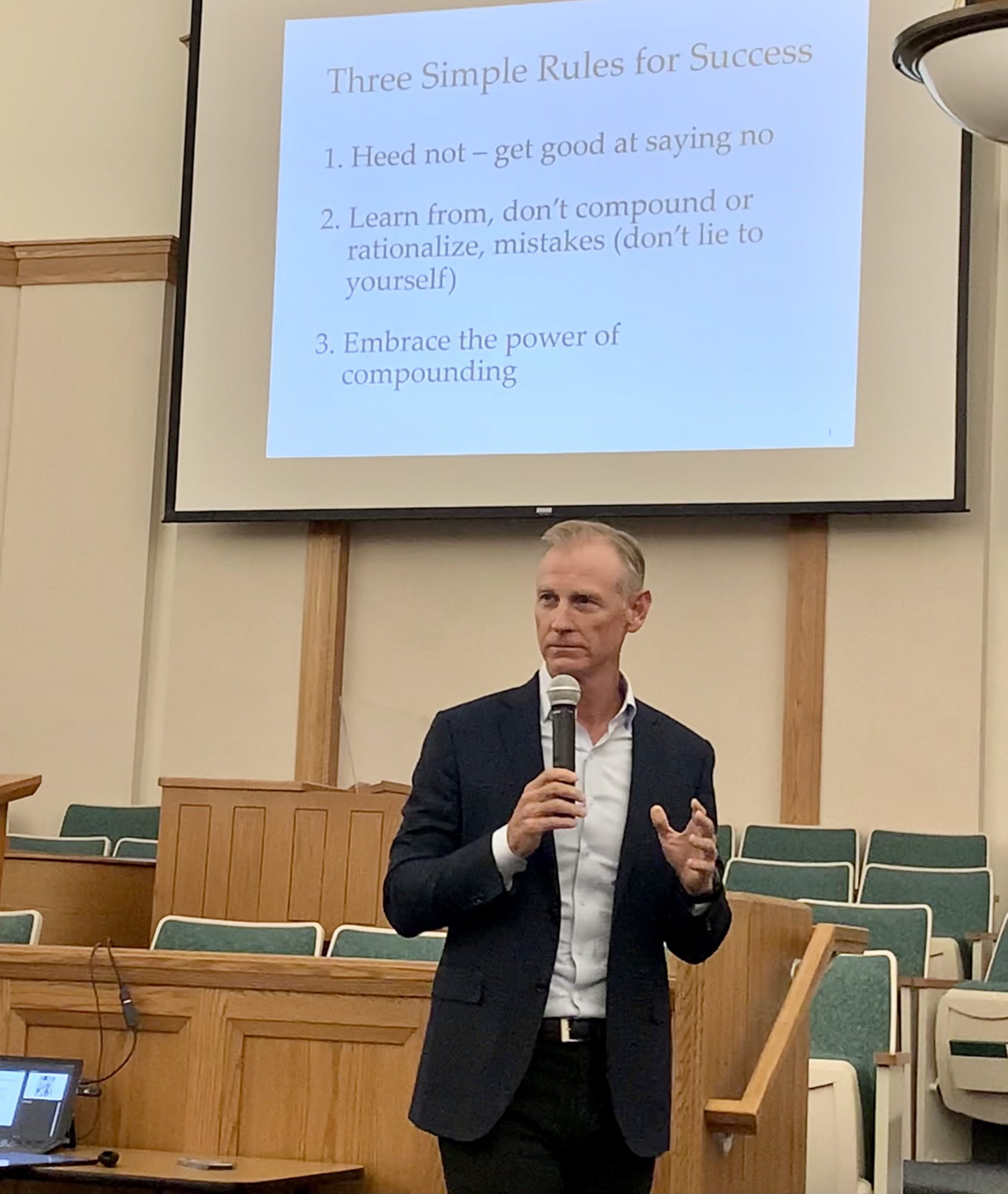
Johnson discussed that practice at a DFW Leadership Series event in 2022. He also described asking job candidates for an example of resisting the crowd. These are useful details in a career usually expressed through titles and transactions. They show a stated preference taking a practical form. Before asking a person to think independently, arrange the conversation so that independence has a chance.
A profession that arrived by telephone
Johnson’s own working life began with an unfamiliar possibility. As he prepared to graduate from Brigham Young University, he was interviewing with investment banks and applying to law school. Consulting had not entered his plans. Then McKinsey contacted him. His economics department chair had supplied his name when the firm asked about promising students.
He investigated the opportunity and joined McKinsey, working in Los Angeles and Seoul before entering Harvard Business School in 1995. His route into private equity came afterward, in Dallas, at Cardinal Investment Company. He later recalled the vocabulary shift with a joke: “When I left business school, ‘PE’ still meant physical education, not private equity.” Finance had acquired another acronym; his career had acquired another direction.
At CIC Partners, which he co-founded and helped lead, Johnson spent 16 years. Gauge followed, co-founded with Tom McKelvey. The progression matters because Johnson had already helped build an investment organization before starting another. Founding a firm and evaluating someone else’s business became overlapping parts of his professional experience.
Behind the products on the shelf
Consider the consumer businesses around Johnson. They take private equity out of its natural habitat of financial abbreviations and put it near things people buy. Hair extensions. Nuts and dried fruit. Restaurant meals. Sports equipment. Each category brings a different customer, a different distribution system, and a different set of people who know how the business works.
In 2016, Gauge invested in Beauty Industry Group, a Salt Lake City company selling professionally installed hair extensions and other beauty products. At the time, its distribution included direct consumer sales and more than 40 independent distributors across the United States and Canada. Johnson joined the board alongside McKelvey and James Jackson, working with executives Derrick Porter and Logan Woolley.
Johnson’s stated investment rationale emphasized loyal customers and room for further adoption. That is a specific way to look at a product category: the relationship with the customer is already working, while the business may have more people to reach. A distributor network and direct sales offer different routes to that expansion. The investment places a financial partner beside the people who understand those routes.
American Nuts offered another version of the question. Gauge completed a majority recapitalization in 2018, and the executive management team retained significant ownership. The Sylmar, California business sourced nuts, seeds, and dried fruit and supplied roasting, seasoning, and packaging services. Its customers included retail and foodservice businesses.
A bag on a shelf can make that work look deceptively simple. Behind it sit purchasing decisions, processing capabilities, and relationships with customers who need a particular product in a particular form. Johnson pointed to the management team’s sourcing, sales, and operating capabilities. He joined its Board of Managers with Whitney Bowman and Sam Banon.
The retained ownership is a detail worth pausing over. Management continued to have a financial stake after Gauge bought its majority position. The arrangement gave the people running the business a continuing share in its future. Ownership, in this instance, was part of the working relationship rather than merely the subject of the transaction.
A restaurant plan needs a restaurateur
In December 2019, Gauge announced the creation of Chaac Foods with restaurant operator Luis Ibarguengoytia. Its initial investment was a Pizza Hut franchisee with 32 stores in the Midwest. Johnson joined the board with Banon and Tristan Loiselle. His comments singled out Ibarguengoytia’s experience and access to restaurant talent.
That emphasis places a person at the center of the expansion plan. A restaurant brand may be recognizable enough to require no introduction, but recognition does not operate a location. The management partnership was an explicit part of the investment from the beginning. Gauge supplied a financial framework around an operator’s experience and the people he could bring to the task.
By May 2021, Chaac’s next chapter included an agreement with Bojangles. The arrangement called for acquiring 40 existing corporate-owned locations and opening 40 new restaurants over seven years. Planned openings covered Georgia, Tennessee, and the Orlando area. At that point, Chaac operated 135 Pizza Huts along with restaurants under several other brands in nine states.
to acquire
planned
Acquisition and development: two different ways to add restaurants. The new-store program was a seven-year plan, not a count of completed openings.
The distinction between existing locations and planned openings gives the story its useful texture. Buying operations and developing new ones are separate tasks. One brings a business already trading; the other requires time before it can contribute. The numbers belong to an agreement. The operating work stretches beyond the date on the announcement.
The people behind the people
An investor who talks about management teams also has to build a team of his own. In September 2022, Gauge hired Charlotte Bonfield as vice president of talent and Shannon Block as vice president of capital markets. The two positions addressed different requirements: recruiting people and arranging financing.
Bonfield’s role put dedicated attention on talent acquisition. Block arrived from Francisco Partners, with earlier experience at KKR Credit and Prudential Private Capital. Johnson described their functional expertise as a way to support portfolio companies while helping Gauge grow. There is a practical organizational choice here: give recurring demands to people whose working lives center on those demands.
The point becomes clearer when placed beside the restaurant and consumer investments. A company’s expansion may need a new executive, a stronger management structure, or financing suited to its plans. Those requirements will not all be solved by the same person. An investment firm can make itself more useful by building access to the appropriate expertise before the next request arrives.
In March 2023, Gauge added Reilly McAllister as a vice president to co-lead investing in its Food and Consumer Group. Her previous consumer investment roles included Swander Pace Capital and H.I.G. Growth Partners. Johnson highlighted her experience in food, beverages, and consumer packaged goods. The hire added sector experience alongside the functional resources.
A volleyball is also a business decision
Johnson’s current board work includes RIP-IT, a sports equipment business. In January 2024, RIP-IT announced its acquisition of Tachikara USA, the volleyball equipment brand. The announced combination connected RIP-IT’s footwear and equipment work with Tachikara’s volleyball products.
Johnson’s comments emphasized building on Tachikara’s legacy. McAllister linked it to Ringor, an earlier footwear acquisition, and described a broader product offering for female athletes. This was a growth plan expressed through things a customer could actually use: footwear and a ball, brought into the same business family.
That is one appeal of following an investor through specific transactions. An acquisition stops being an arrow on a slide and becomes a question about what the combined company can offer. The businesses carry their own histories into the arrangement. The ambition is expressed at product level, where it eventually has to meet the buyer’s judgment.
A quarter of the capital, alongside everyone else
Gauge’s fourth fund closed in March 2024 with approximately $1.4 billion in commitments. The Gauge team was its largest investor and supplied more than 25% of the committed capital. The figure describes the team collectively. It does not identify Johnson’s individual contribution or personal wealth.
Approximate total commitments
Shared exposure gives the partnership language a measurable component. The people deploying the money have their own capital committed to the fund. It does not settle every question about how an investment will proceed, but it answers an initial one about whether the team is participating financially alongside its outside backers.
In October 2025, Gauge was included in Inc.’s Founder-Friendly Investors list for a sixth consecutive year. Johnson’s comments emphasized supporting founders’ ambitions while preserving their culture and values. McKelvey pointed to management retaining meaningful investment proceeds in the businesses and to the team’s fund commitment. Again, ownership was part of the explanation.
In April 2026, Gauge announced that it placed No. 15 in the 2025 HEC Paris-Dow Jones Lower MidMarket Buyout Performance Ranking. The evaluation covered 695 firms and 1,439 funds raised between 2012 and 2021. Johnson and McKelvey commented jointly, crediting the team and the outcomes for investors, portfolio businesses, and employees.
“strategy is the art of sacrifice.”
Drew Johnson · 2022 leadership remarks
In that earlier talk, Johnson urged listeners to learn from mistakes and improve patiently. The advice fits the meeting practice: allow an answer to arrive before a senior opinion can alter it. A decision process needs information it has not already supplied to itself.
Johnson’s career offers several scales on which to see that work. There is the fund, with its commitments and collective exposure. There is the company, with its management and products. And there is the conversation, where a junior colleague gets a first turn. The last is the smallest unit. It is also where a different decision can begin.