In 1999, Douglas Abrams visited Singapore on a business trip for J.P. Morgan. It was his first visit to Asia. During that trip, he decided he wanted to move there. A year later, he did. Some business travel produces a conference badge and a pile of receipts. This trip produced a different career, in a different part of the world.
Abrams had spent 14 years managing information technology at the bank. Singapore offered something he wanted to pursue: the growth of Asian markets, particularly the possibilities for young companies. Looking back in 2013, he described opportunity as his reason for coming. His account was refreshingly free of a grand conversion scene. He saw a promising place to work and chose to make it home.
The move is the hinge of his story, but the sequence after it is more revealing. He became a founding partner of Parallax Capital Management in 2000. He began teaching at the National University of Singapore in 2001. Expara followed in 2003. Investment and education were already running alongside each other before the firm had a name. The classroom was there almost from the start.
- 1999First visit to Asia
- 2000Moves to Singapore
- 2001Starts teaching at NUS
- 2003Founds Expara
The banker had been watching the machinery
Abrams studied communications at the University of Pennsylvania’s Annenberg School and earned an MBA at Wharton. His banking work placed him where technology met the business of finance. From 1991 to 1997, he was vice president and manager of investment banking technology at J.P. Morgan; from 1997 to 1999, he was Global Markets Head of Internet Marketing.
Those titles locate him in a particular moment. The internet was entering established businesses, and somebody had to work out what to do with it. His later career would keep returning to that problem: how organizations respond when technology changes the terms of competition. The setting changed from a bank to young companies and lecture rooms. The question travelled well.
There is also a small, pleasingly concrete detail from his banking years. He owned a NeXT workstation and an Apple Newton while at J.P. Morgan. In his later writing, he remembered liking both products despite their commercial difficulties. It is an investor’s useful distinction: admiring a piece of technology and judging its business prospects are separate exercises. Even an appealing machine needs someone willing to buy it.
A classroom with money on the table
At NUS, Abrams taught New Venture Creation and technopreneurship. He also taught venture capital at Sasin in Bangkok from 2007, and entrepreneurship and venture capital at RMIT in Vietnam between 2016 and 2019. These were recurring academic commitments across countries, alongside the work of building and investing through funds.
One Hong Kong University workshop makes his method tangible. Student teams were asked to act as venture capital funds: identify opportunities, evaluate real startup companies and decide about investment. Revenue projections, valuation and fundraising belonged inside the same exercise. Students had to put numbers beside their enthusiasm. A promising pitch could no longer survive entirely on adjectives.
The arrangement asks founders to examine a company from the other side of the table. An investor has to decide how much an uncertain future is worth today. A founder has to explain why that uncertainty deserves someone else’s money. Making a student inhabit both positions is a practical way to expose the gaps between a business idea, a financial model and an investable proposition.
His Hong Kong workshops also reached participants preparing applications for university startup support and incubation. In 2019, the financial modelling and venture capital sessions were prerequisites for applicants to two HKU programs. That places his teaching at a consequential point: before aspiring founders enter a process that may give their companies resources to grow.
The cheque book catches up
Expara’s investment history developed in stages. In 2007, Abrams launched Expara IDM Ventures through a public-private partnership linked to Singapore’s National Research Foundation. A second IDM fund followed in 2012. Extream Ventures, launched in 2008, added an early-stage fund to the picture. These vehicles gave the educational work a companion: actual investment decisions with actual consequences.
The regional footprint expanded too. Expara Ventures Thailand began in 2011, followed by Malaysia in 2013. Singapore remained his base, while the work increasingly crossed borders. His earlier assessment of Singapore’s small domestic market was straightforward: a successful local startup should be thinking about regional or global customers from the beginning. The more immediate difficulty, he argued, was finding specialist talent.
The scale is different now. Expara reports five venture capital funds, investments in 92 startups and 23 exits. Its training and mentoring count exceeds 32,000 entrepreneurs and investors. These are the firm’s reported totals, with different measures describing different activities. A person attending a program and a company receiving equity investment represent very different kinds of engagement.
That distinction helps explain the organization Abrams has built. Its work includes capital, acceleration, advisory services and education. A founder can encounter the firm in a classroom or a program before an investment is ever discussed. The model gives Expara several ways to work with a young business, and gives Abrams several places to test whether the lessons he teaches survive contact with a company.
The inconvenient answer is “now”
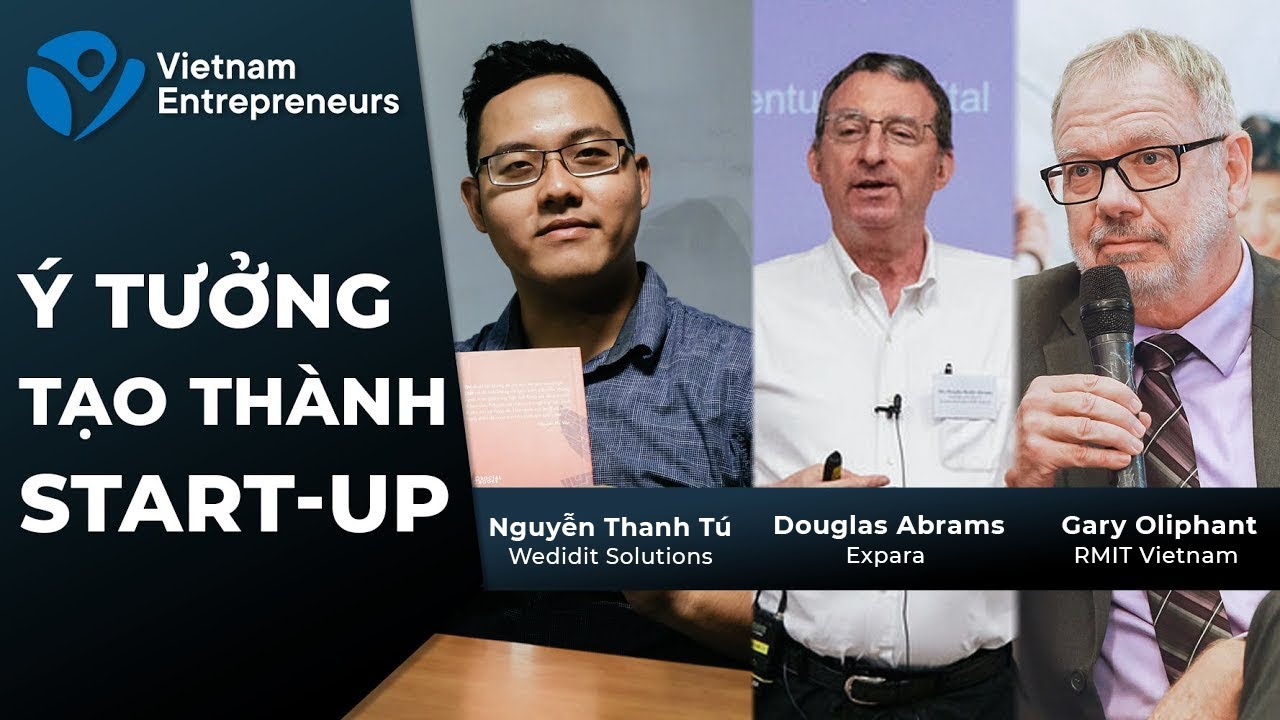
In 2018, Abrams appeared in a startup discussion at RMIT Vietnam with entrepreneurship academic Gary Oliphant and graduate founder Nguyen Thanh Tu. Quoc Khanh moderated. The questions were recognizable to anyone who has watched a first business take shape: what if the product arrives too early, what if someone copies the idea, and when should the founder seek outside money?
Abrams’s answer on fundraising was immediate: now. He qualified it with the terms of the deal. Raising on favorable terms before cash becomes urgent preserves negotiating room. Waiting until the need is pressing can leave a founder with fewer choices. The instruction is memorable because it refuses the comforting idea that fundraising can be neatly scheduled for a quieter week.
His point about market timing had a similar edge. A founder is unlikely to land on the single perfect moment. Being early may be necessary, but arriving far ahead of demand creates its own problems. Beneath the brisk delivery is a recurring concern: how to make a decision when waiting for certainty would itself be a decision, with a cost attached.
“The worst time to raise is when you need the money.”
Douglas Abrams · RMIT startup discussion, 2018
A ski slope turns up in the investment lesson
His personal website is called No Fear Career. The writing moves beyond deal mechanics into the habits that affect professional choices. A February 2025 essay recalls ski vacations before his move to Southeast Asia. He remembered watching people come down long slopes with their skis still in a snowplow, working hard to avoid a fall and missing the ease that practice might eventually bring.
It is a useful personal detail because it shows how he explains a difficult idea. He starts with a scene a reader can picture: an awkward descent, effort without much pleasure, other skiers passing. The lesson he draws concerns the cost of refusing the mistakes involved in getting better. He turns a holiday observation into a question about a career.
An April 2025 essay, “Let’s Fail,” takes the argument further. Abrams presents repeated attempts and errors as part of innovation. He challenges the habit of treating every unsuccessful attempt as evidence that the attempt should never have been made. His language can be deliberately provocative. A classroom accustomed to protecting its grades is being asked to reconsider what counts as progress.
The title alone supplies a glimpse of his teaching temperament. Most professional invitations promise success. Abrams invites the reader to contemplate the less flattering part of the process. The joke has a serious purpose: if an entrepreneur’s acceptable outcomes exclude every failed experiment, the space available for experimentation becomes rather small.
The reading list has a raised eyebrow
There is a second clue to his outlook in Expara’s public reading list. It includes books about the creation of the Federal Reserve, venture capital, technology companies and financial misconduct. Among the titles are Roger Lowenstein’s America’s Bank, John Carreyrou’s Bad Blood, Gillian Tett’s Fool’s Gold and Nick Bilton’s Hatching Twitter.
It makes for a less restful bookshelf than a row of success manuals. There are institutions being assembled, companies being contested and people behaving badly around money. That range suits the questions Abrams teaches: how capital moves, what incentives encourage and what can go wrong when a persuasive account outruns the underlying business. The reading list leaves plenty of room for an investor’s raised eyebrow.
His own late-2024 essays use everyday examples to discuss investment choices. One asks why people rarely find a large banknote lying in the street; another examines lottery tickets and expected value. These are teaching devices for making an abstract subject discussable. The reader is invited to work through a choice rather than admire a technical vocabulary.
Still making room for the next class
The institutional work reaches beyond Expara. Abrams served as a director of the Business Angel Network of Southeast Asia from 2002 to 2018 and was its chairman. He also served on Singapore’s Media Development Authority board in 2009-2010. These roles put him among the networks and public institutions around young companies, as well as inside the companies’ funding conversations.
A more recent education project carries the pattern into secondary schooling. Abrams is also co-founder and CEO of Nebula Institute. The school describes a four-year program combining IGCSE and A Level qualifications with a structured entrepreneurship pathway, connected to Expara’s venture education. The proposition extends his longstanding interest in learning through venture creation to an earlier stage of education.
The original move to Singapore was a bet on where opportunity would grow. The career that followed suggests another question has occupied just as much of his attention: who will be prepared to act when it does? Funds can supply money. Workshops can supply a place to argue over the numbers. Neither removes the uncertainty that makes starting a company uncomfortable.
Abrams has spent years bringing those activities into the same orbit. His story contains banking technology, investment funds, university courses and an unexpectedly instructive ski slope. Across them runs a consistent invitation: examine the risk carefully, then decide whether to try. The first business trip ended long ago. He is still working on what came after it.