At nine, Doug Monro had already found a business model: make a school newspaper and sell it to the other pupils for 10p. It was a small circulation operation, with an unusually captive readership. Years later, the boy charging for copies would build a company around helping people search other people’s advertisements. The newspaper business had changed considerably. His interest in getting something into people’s hands had survived.
Monro grew up in West London and went to Cambridge to study English. He acted, directed plays and took his poetry seriously enough to remember the pretension with affection. “I thought I was a proper poet,” he recalled in 2011. There is something cheering about that admission from a future chief executive. Before the job titles and financial models, there was a student enjoying words, performance and the possibility of an audience.
A poet with an accountant’s qualification
His subsequent qualifications complicate any tidy account of a humanities graduate wandering into business. Monro earned an MBA at Northwestern’s Kellogg School of Management and qualified as an accountant. His early employers included Unilever and Bain. By 2004 he had reached eBay, taking the UK strategy job he later described as the role he had wanted. This was an education in businesses where the useful thing is often the connection: a buyer finding a seller, a listing finding its reader.
When eBay acquired Gumtree in 2005, Monro’s career moved closer to the machinery of those connections. He became Gumtree’s managing director. At Zoopla, which he joined as chief operating officer in 2008, he worked on a different kind of search: homes. The team grew from five to 75 during his tenure, and the property site reached five million monthly visitors.
These were operating jobs inside young internet businesses, involving teams, products and expansion. They gave him experience of the distance between an attractive idea and a service that people return to. They also meant that when he eventually started Adzuna, he arrived with a working knowledge of online classifieds. The first-time founder had already spent years around the trade.
- 2004eBay
UK strategy - 2005 onwardGumtree
Managing director - 2008Zoopla
Chief operating officer - 2011Adzuna
Co-founder
The useful thing about a familiar face
At Gumtree, Monro met Andrew Hunter. Their acquaintance dated to 2005; their shared business took several more years. Hunter went on to Qype, while Monro worked at Zoopla. They stayed in touch. The early Adzuna origin story involved an envelope in a central London pub in 2010, that economical substitute for a conference room which British business folklore keeps reliably supplied.
In 2026 Monro added another detail. He and Hunter had first talked about starting a company together on a trip to Hamburg to watch Fulham lose the Europa League final. Football supplied the disappointment; the conversation supplied a more durable possibility. It is an origin with room for both a pub envelope and a journey abroad: deciding to work together and deciding exactly what to build need not happen in the same sitting.
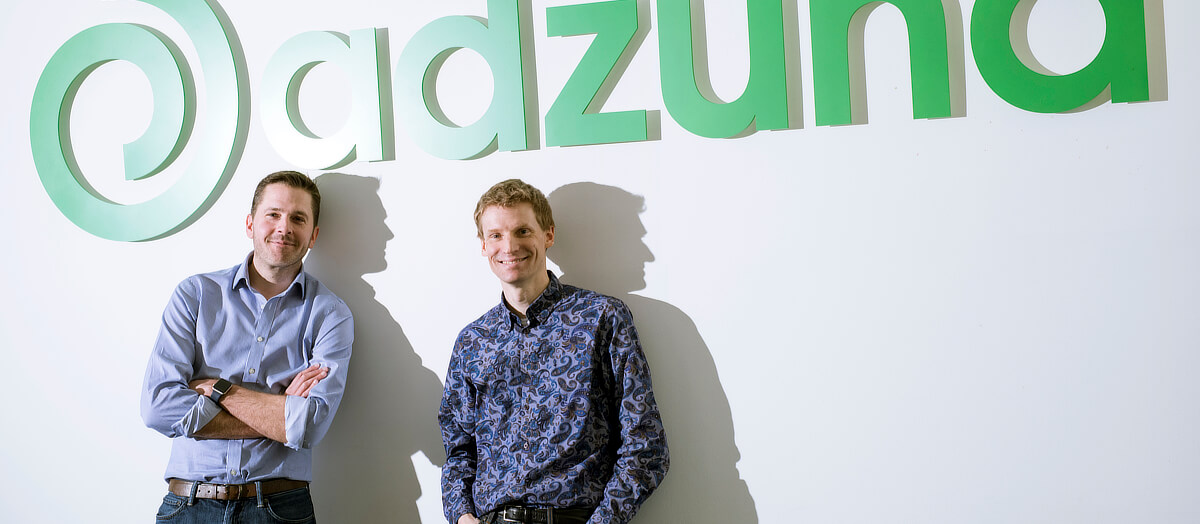
The opportunity was scattered job advertisements. A vacancy might sit on an employer’s website, a recruitment agency’s page or a job board. Candidates had to travel between them. Monro and Hunter proposed gathering the listings into a searchable place. Each put £10,000 into the venture. A £300,000 seed investment from Passion Capital and angels followed. Adzuna launched in 2011, with an April beta and a public launch in July.
Everywhere was rather a lot to start with
The early proposition extended beyond jobs to property and cars. The experience of the founders made that breadth understandable. It also made for an ambitious to-do list. Finding and organising advertisements across three markets was a substantial undertaking for a young team with limited resources. Monro later acknowledged that they had spread themselves too widely and would have been better served by establishing one area first.
There was a more immediate practical difficulty, too. Neither founder presented himself as a technologist, and recruiting the right founding developer took time. A search business needs people who can make the search work. The founders described their anxiety about having to fall back on expensive contractors. Credentials and contacts were useful; they could not write the entire product into existence.
Monro’s account of strategy is refreshingly short on ceremonial paperwork. The original business plan occupied three pages in a Word document. He described an early emphasis on the product, search visibility, partnerships and publicity built around data. Paid traffic and monetisation came later. The business subsequently charged advertisers for sponsored jobs on a pay-per-click basis. His recurring counsel was to choose a narrower starting point and earn the right to expand.
“Pick a niche”
Doug Monro, on advice to smaller businesses
When the crowd needed a telephone call
In 2015 Adzuna raised £2 million through crowdfunding. Monro’s account of the campaign contains the sort of detail that rarely survives into a funding announcement. For eight weeks, the work consumed evenings and weekends. At roughly halfway to the target, progress slowed enough to alarm the founders. Promises fell away. The expected crowd had apparently found something else to do.
They returned to their contacts and worked through possible introductions. One welcome enquiry came through the website from someone Monro knew as “Harry’s mum”, who wanted to make a substantial investment. Around three-quarters of the money ultimately came from people the company itself brought to the platform. The crowd required considerable personal assembly.
That episode is a useful companion to the familiar pub-envelope origin. An idea can fit on an envelope; a financing campaign can occupy most waking hours. Monro wrote about both the excitement and the drudgery, and about reconsidering his earlier low opinion of crowdfunding. His willingness to publish the uncomfortable middle of the story makes the eventual total more interesting. The cheque has a history.
A public campaign, built through many private conversations.
A search box with a second audience
Gathering job advertisements produced something useful beyond individual search results: a view of hiring activity. By 2012 Adzuna was providing job and property data to the Number 10 Dashboard. The company that wanted to reduce the work of searching was also supplying information to people trying to understand the economy. A collection of listings could become an instrument for watching change.
The Office for National Statistics later used Adzuna data to produce weekly online job-advert indices. Those measures offered timely breakdowns by category and region. There were limits: an advertisement might cover several openings, remain online after a job was filled, or duplicate another listing. Work advertised by word of mouth would escape the system. A useful indicator still needs careful interpretation.
That contribution belongs to Adzuna’s record rather than an indefinite present-tense claim. The ONS has since replaced its previous real-time Adzuna estimates with a Textkernel series. Separately, in 2018, Adzuna won the contract to operate the government’s Find a Job service. For Monro, public employment infrastructure became another setting in which the company’s search experience could be put to work.
The next problem begins after “search”
Adzuna’s later products followed candidates further through the process. Salary estimation and CV valuation addressed the awkward question of what work might pay. Interview preparation addressed what happens when an employer responds. In April 2025 the company launched ApplyIQ in the UK and US, adding an agent that could match candidates to vacancies and submit applications.
The design included limits. At launch, Adzuna said the tool averaged five applications per user each week, preserved the candidate’s original CV, and allowed only two applications to the same employer within 60 days. Those are company-described product controls, rather than guarantees of a job offer. Their purpose was to avoid turning automation into another source of unsuitable applications.
For a founder who began by bringing advertisements together, this introduces a different responsibility. Finding more listings is only one part of the candidate’s problem. Deciding which deserve attention, and which applications an employer should receive, requires judgement. Monro has argued publicly for AI that improves recruitment quality. The appeal is easy to understand. Nobody looking for work needs a faster way to waste an afternoon.
A change of pace, uphill
Outside the business, Monro cycles and runs. He has written about riding up Bealach na Bà and Alpe d’Huez, and about preferring running challenges more recently. His recollection of appearing on camera for a company webinar is rather less athletic: he admitted disliking watching himself and credited the team with pushing him to try it. Even a chief executive can require encouragement before pressing record.
In a testimonial for Ride25, he described the cycling trips as a welcome escape from startup pressures. That is a modest but useful glimpse of life beyond the company: long rides, fundraising and a reason to spend time away from a screen.
Hamburg, again
Expansion also came through acquisitions. Getwork brought an established US job-search business into Adzuna in 2022. Seiza followed in November 2024, adding social recruitment advertising and candidate engagement, particularly for frontline roles. In March 2026 Adzuna acquired the jobs businesses of Trovit and Mitula, bringing their users into its platform. The sequence broadened both its audience and the ways employers could reach candidates.
Then came Joblift’s assets in July 2026. The German brand would continue locally, with its sales and customer-success teams joining the wider organisation. In several other countries the business would be combined into Adzuna. Monro emphasised the local relationships Joblift had built alongside the technology and reach Adzuna could supply. Buying a platform also meant taking responsibility for the connections around it.
The Hamburg sales office gave him a reason to remember the Fulham trip with Hunter. Sixteen years after a losing football final, their business had a new foothold in the same city. In his announcement, Monro even found room for a Messi pun. International expansion apparently leaves some capacity for dad jokes.
His ambitions now include applying private-sector technology to Britain’s public jobs and careers service. In November 2025 Adzuna published a proposal projecting fiscal savings and more people entering work; those were the company’s estimates of a possible reform. The direction is consistent with his long-running interest in making job search more useful. The schoolboy who sold a paper for 10p has spent much of his adult career working on what happens when information reaches the right reader.