Alex Chesterman had a job waiting at Goldman Sachs. Then someone offered him three months in Florida. He chose Florida. For a recent economics graduate, this was an unconventional use of his degree; for the restaurant industry, it was a useful recruitment strategy. The bank would have to manage without him.
The invitation came from Robert Earl, a friend of his father, who offered a management programme at Hard Rock Cafe. Chesterman went on to work at Planet Hollywood, where he became executive vice president before returning to Britain. His early career involved opening restaurants, rather than websites. Customers, staff, premises and an evening's takings were the business.
That beginning matters because Chesterman's later reputation arrived wrapped in technology. The career underneath it is more varied. He has sold breakfast, helped deliver films, opened up property information and tried to change how people buy used cars. He has repeatedly entered industries where he had no specialist background. The customer’s irritation was usually his point of entry.
In 2012, he put his ambition plainly: “I love developing an idea from nothing.” There is an appealing contradiction in that description. His ideas often had an identifiable ancestor. He was perfectly happy to name it. Originality, in his account, did not require pretending that America had never existed.
Breakfast before broadband
Back in London, he founded Bagelmania. America had supplied a breakfast habit as well as a career, and he saw an opportunity to bring that habit home. The chain grew to nine shops. Finding good premises, however, meant competing with other businesses that also wanted busy London locations. A bagel could be excellent and still lose an argument with the rent.
He sold the outlets during 2003 and 2004. By then a different American example had caught his attention: Netflix, still sending DVDs through the post. In 2003, Chesterman and William Reeve started ScreenSelect. The service offered a way around the limited choice and return journeys associated with renting a film from a shop.
ScreenSelect merged with LoveFilm in 2006. That detail sometimes gets ironed out of the familiar shorthand in which Chesterman simply founded LoveFilm. The route involved a predecessor business, a partner and consolidation. It is a useful early glimpse of how he worked: start with a proposition customers understand, then combine businesses when scale makes the proposition stronger.
Amazon acquired LoveFilm in 2011. Physical DVDs now look like objects from a particularly recent archaeological dig, but the convenience they represented was real. Ordering from home changed the transaction before streaming changed the product. Chesterman had helped build a business around that intermediate step, when a letterbox could do some of the work of a high-street shop.
“I love developing an idea from nothing.”
Alex Chesterman, 2012
Give the house hunter the numbers
Zoopla followed a similar pattern, with a different kind of customer uncertainty. Founded in 2007 by Chesterman and Simon Kain and launched in 2008, it borrowed inspiration from the American property site Zillow. Britain already had property portals. Another collection of photographs and asking prices would have needed a good explanation for its existence.
Chesterman's explanation was information. House hunters could search listings, but they also wanted to research homes and understand values. Zoopla brought property data into that same journey. A home could be investigated as well as admired. For a country capable of turning a neighbour's asking price into dinner-table conversation, this was a practical service with a considerable entertainment side.
The early operation was small. Recruiter Tony Willis remembered meeting Chesterman in an Acton kebab shop in 2007, while Zoopla occupied a serviced office and Kain wrote its original code. Doug Monro joined from Gumtree as chief operating officer. The polished consumer brand began with familiar startup ingredients: a modest office, technical work and people being persuaded to join.
Chesterman also pursued combinations. Zoopla's 2012 merger with the Digital Property Group brought together businesses including PrimeLocation and FindaProperty. There was a commercial reason to unite audiences and listings: estate agents paid to reach house hunters. Being useful to the visitor helped make the service useful to the paying customer.
By its June 2014 flotation, Zoopla Property Group was drawing more than 40 million monthly visits across its websites and apps. Its larger rival, Rightmove, attracted about twice that number. Most revenue came from estate-agent subscriptions. The numbers locate Zoopla accurately: a substantial challenger with an established business model, still facing a larger competitor.
Shares were priced at 220p, valuing the group at about £919 million. The flotation allowed existing shareholders to sell some of their holdings; it was not a round of fresh capital for the business. Four years later, Silver Lake bought ZPG for £2.2 billion. The larger group had grown beyond the original home-search site into comparison services, software and data.
Zoopla Property Group’s flotation valuation
Silver Lake’s acquisition price for ZPG
Cazoo’s announced SPAC transaction valuation
The transporter changes the equation
Chesterman founded Cazoo in 2018, and it began trading in December 2019. The American reference this time was Carvana. Used cars offered another sizeable purchase surrounded by uncertainty. Cazoo's proposition was to make buying one online feel straightforward: fixed prices, home delivery and a seven-day returns policy.
The appeal is easy to describe. A customer could choose a vehicle without negotiating in a showroom and have time to decide whether to keep it. Chesterman's objection to the traditional transaction concerned the experience of buying as much as the car itself. He had already invested in businesses including Carwow and Motorway, so his financial interests in the sector preceded Cazoo's launch.
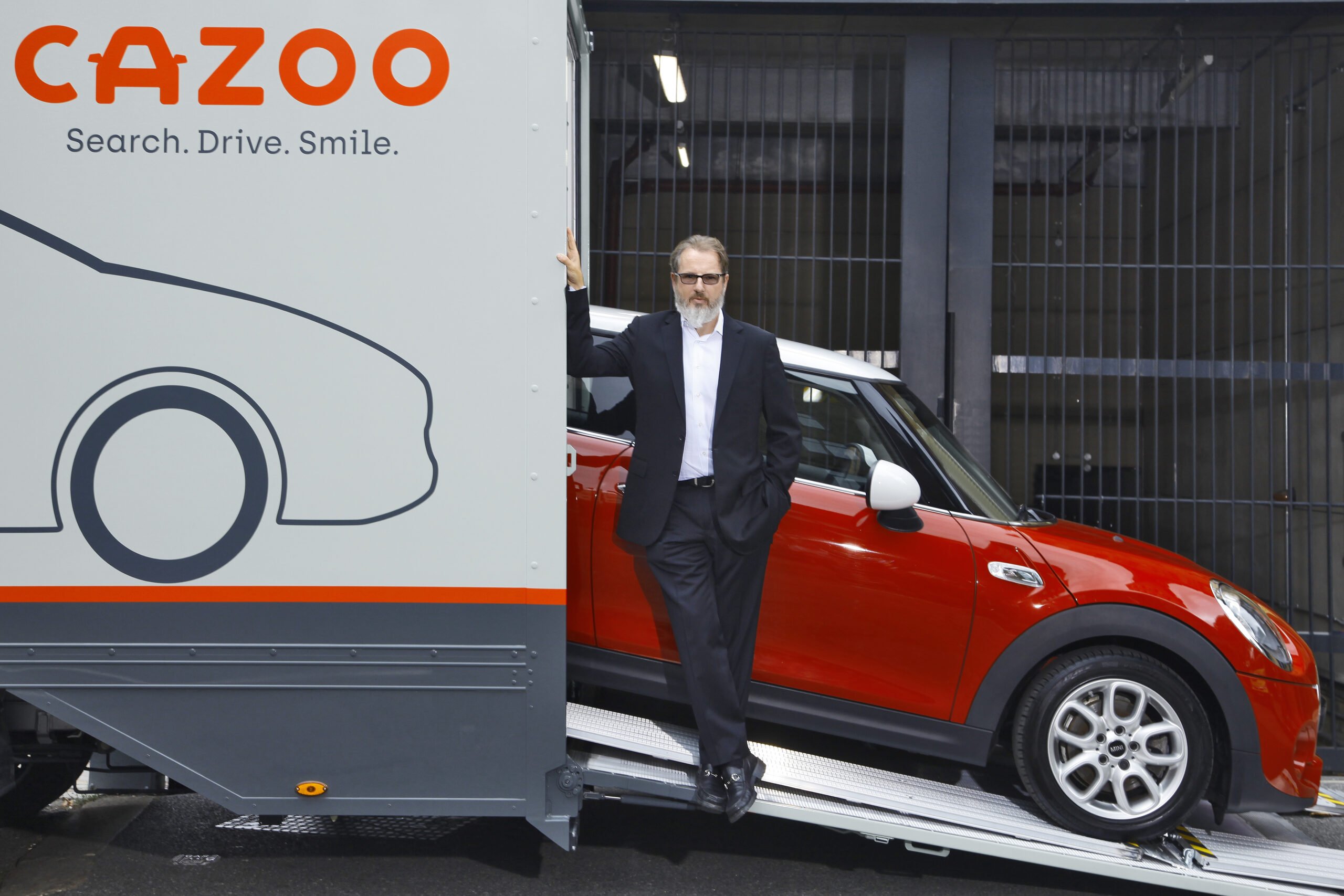
But the transporter in Cazoo's publicity photographs contains a business distinction that a browser window can obscure. A property portal introduces an audience to listings. A retailer buying and selling cars must also deal with stock, preparation and delivery. Software can help organise those jobs. The vehicles still need somewhere to stand and someone to inspect them.
Chesterman recruited for those demands. Alongside executives from digital businesses, Cazoo hired people with experience at Tesla, Auto Trader and Manheim. The team combined consumer technology with automotive operations. It was an acknowledgement, in appointments rather than slogans, that selling a car involved expertise beyond building the page on which it appeared.
In March 2021, Cazoo announced a US stock-market transaction through a special-purpose acquisition company, or SPAC, at a valuation of $7 billion. It subsequently listed in August. Chesterman argued that American investors were more receptive to businesses spending in the short term for future growth. After taking Zoopla public in London, he was choosing a different market for this venture.
Cazoo expanded into continental Europe, then reversed course in 2022 to concentrate on Britain. Its annual report set out the retreat and restructuring. Growth had become a question of how much the company could afford. Geography, staffing and the cost of each sale were now central to the plan.
Property information
+ audience
+ agent subscriptions
Vehicle stock
+ preparation
+ delivery and returns
A familiar name, an unfamiliar ending
The leadership transition was announced in January 2023. Paul Whitehead took over as chief executive on 1 April, while Chesterman became executive chairman. That distinction matters: an announcement date and the day a new executive takes charge are different points in a company's life. Chesterman remained involved after handing over the CEO role.
He left the board in December 2023 as Cazoo completed a debt restructuring. Holders of $630 million of convertible notes exchanged them for new debt and shares representing approximately 92% of the company. Existing equity holders were heavily diluted. The business had sold almost 150,000 cars online, yet its financing required a fundamental reset.
On 21 May 2024, Cazoo entered administration. It had cut 728 jobs since the beginning of March; administrators initially retained 208 employees while seeking buyers. These figures belong alongside the launch valuation. They describe the consequences for people whose employment depended on the enterprise, rather than treating the outcome as an abstract reversal on a share chart.
The Cazoo name later continued under new ownership. That continuing brand should not be confused with the original retail business surviving intact, or with Chesterman still running it. His career now includes both the sale of ZPG and the failure of the company he founded next. Neither outcome makes the other disappear.
Back to the people who start things
Zoopla's corporate story also continued without him. In September 2023, the property division adopted the Houseful name, reflecting a business encompassing consumer brands, software and data. Chesterman is its predecessor's co-founder and original chief executive. That is a historical connection, rather than a current claim to be running Houseful.
His other continuing connection is to founders. His investment record includes Graze, Secret Escapes, Carwow and Thirdfort. In January 2026 he was among the investors backing beer brand BRULO. In May, Atheni disclosed a £350,000 raise with Chesterman among its angel backers. Different businesses, once again, linked by the work of getting a proposition into customers' hands.
Atheni co-founder Louise Ballard described contacting him after their paths had crossed twenty years earlier in DVDs by post. The detail gives an investment announcement some human scale. A relationship formed around one obsolete delivery format could still be useful when a new company was building tools to help people use artificial intelligence at work.
In April 2026, Chesterman appeared at the Goodlord Leaders Forum, whose speakers included his former ScreenSelect partner William Reeve. The pair's careers had moved on from film rentals; the conversation was again taking place around property and entrepreneurship. The network accumulated across these businesses has lasted longer than any particular technology used to distribute a film.
Chesterman received an OBE for services to digital entrepreneurship in 2016. The honour recognises a career with visible achievements. The more revealing picture includes its untidy parts: shops sold off, companies merged, a successful flotation, another company's administration. His method produced different results because each new business came with its own demands. The American example could suggest where to begin. The British business still had to work.
Follow the conversation
Interviews, company history and the later chapters.
- Alex Chesterman on Twitter/X (historically attributed account)
- Jazz Shapers: hear Chesterman describe his approach
- Riding Unicorns: career and angel investing
- The 2020 conversation about his move into cars
- Goodlord Leaders Forum: 2026 highlights
- Houseful: the property business descended from Zoopla
- Cazoo’s May 2024 administration
- BRULO’s January 2026 funding
- Atheni co-founder Louise Ballard on reconnecting