Somewhere between an advertiser approving a campaign and a person noticing it, the internet becomes slippery. A video may play in a tab nobody is watching. A television impression may come from a device that does not exist. A perfectly legitimate ad may land beside content a brand would rather not finance. The dashboard still records delivery. The invoice still arrives. DoubleVerify exists for the argument that follows.
The New York company is an independent meter inside an ecosystem whose buyers, sellers and platforms all have their own meters. Its software checks whether digital ads are fraud-free, viewable, geographically correct and aligned with a brand's tolerance for surrounding content. It measures attention, reports the findings in DV Pinnacle, and increasingly uses the same signals to change how campaigns are bought. The service runs across websites, apps, social feeds, commerce media and streaming television.
That sounds like plumbing because it is plumbing - lucrative, computationally intense plumbing. DoubleVerify processed 9.5 trillion billable media transactions in 2025. Averaged across the year, that is roughly 300,000 checks every second. Revenue reached $748.3 million, up 14 percent, while adjusted EBITDA was $245.6 million. The scale explains why a company largely invisible to ordinary internet users sits in the critical path of major advertising budgets.
The receipt for an impression
Digital advertising sells an abstraction called an impression. DoubleVerify breaks it back into testable facts. Was the traffic human? Did enough of the creative appear on screen for long enough to count as viewable? What words, images or program surrounded it? Did the placement match the advertiser's rules? Each answer handles a different kind of waste.
Fraud is the most adversarial. Botnets mimic people, apps pretend to be other apps, and streaming devices can be spoofed because connected-TV inventory commands attractive prices. DoubleVerify says its systems identify more than two million bot and malware devices daily. Its Fraud Lab looks for patterns that fixed filters miss. A collaboration with Roku, for example, pairs DV monitoring with Roku's advertising watermark so a claimed Roku impression can carry evidence that it came from genuine device traffic.
Brand suitability is less binary. A children's cereal and a horror film do not share the same tolerance for content. DoubleVerify's tiers and custom profiles let an advertiser set risk levels across categories instead of accepting a single universal blacklist. Contextual tools classify the subject of a page or program, while viewability and attention products ask whether the creative had a meaningful opportunity to register.
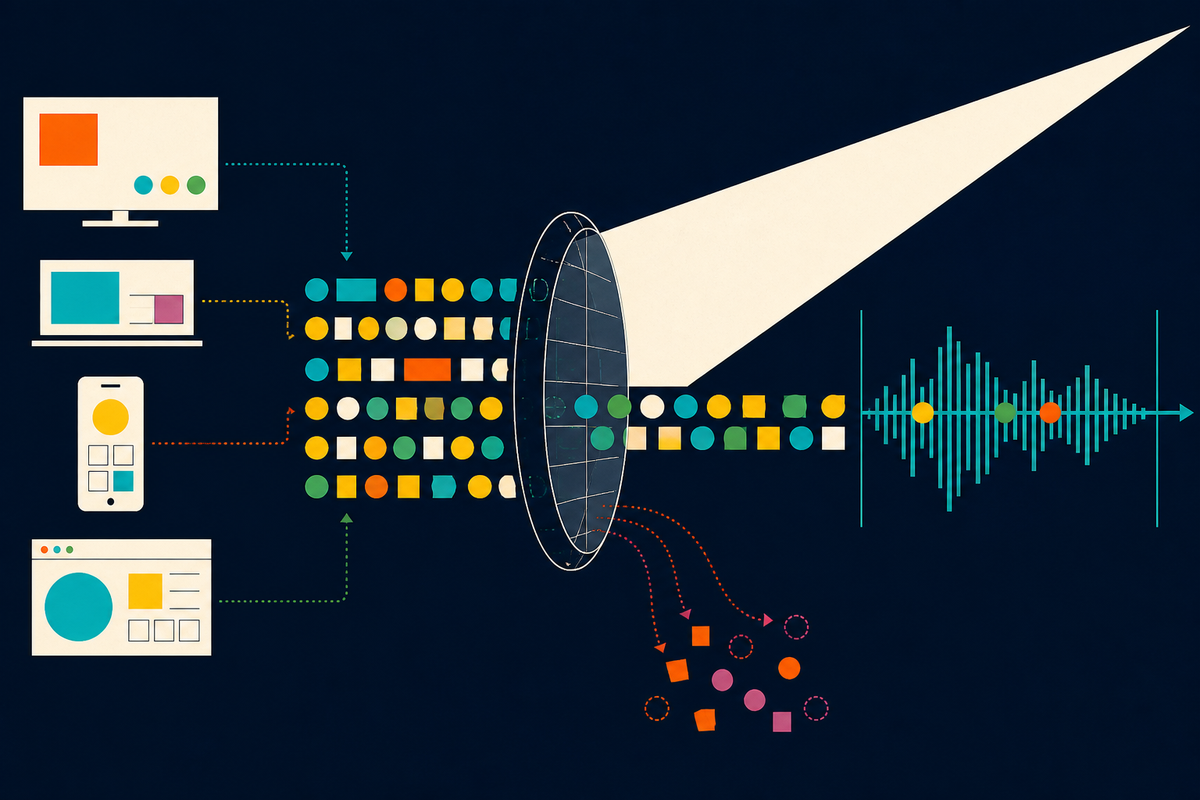
The product is not simply a fraud score. It is a common version of events for people spending, selling and carrying the same advertising dollar.YesPress analysis
From checking the buy to steering it
The company's original job ended with a report: this happened, this failed, this money was exposed. Its newer products move earlier and later in the workflow. Pre-bid controls try to avoid a bad impression before the auction. DV Scibids AI adjusts bids toward a campaign's performance goal. Rockerbox connects advertising activity to conversions through attribution, incrementality tests and marketing-mix modeling. Together they stretch DoubleVerify from quality control into decision software.
One data loop, four commercial jobs
There is a neat product strategy here. Verification creates a large, impression-level dataset. That data improves classification and benchmarking. Better signals make optimization more useful. Outcome measurement then gives the optimizer a target more meaningful than a proxy such as viewability. In a published campaign example tied to the Rockerbox acquisition, the combination of Rockerbox conversion data and Scibids optimization reduced cost per acquisition by 39 percent in one live campaign and 20 percent in another.
DV Neura, introduced in June 2026, gives this shift an AI umbrella. The engine is meant to power classification and dynamic decisioning across the portfolio. The interesting part is not that an ad-tech company uses AI. It is that DoubleVerify can feed models with years of its own measurements rather than depend only on generic content signals.
Who pays, and why they stay
DoubleVerify serves three connected constituencies. Advertisers and agencies buy Activation services for programmatic and social campaigns and Measurement services for media purchased directly from publishers and platforms. Publishers and marketplaces buy Supply-Side tools to diagnose their inventory, reduce invalid traffic, meet buyers' standards and package quality more convincingly.
The economic engine is usage-based. A central metric is the measured transaction fee - a fixed charge per thousand media transactions measured. More client campaigns and broader channel coverage produce more measured volume. New products raise the value of the relationship. In 2025, Activation supplied $427.3 million of revenue, Measurement $249.7 million and Supply-Side $71.3 million. Gross revenue retention remained above 95 percent in the fourth quarter, evidence that the measurement layer is sticky once it sits inside campaign operations.
Public case studies make the work less abstract. Lexus and agency Team One used Authentic Brand Suitability to centralize settings and reported a 3.5-times improvement in the efficiency of driving site traffic. A publisher collaboration involving The Arena Group lowered one insurance brand's block rate by 92 percent, illustrating the two-sided value: fewer suitable impressions thrown away for the buyer, more sellable inventory for the publisher. Named enterprise wins in late 2025 included Financial Times, Lionsgate UK and McCormick.
The cross-platform advantage - and its limit
DoubleVerify's closest broad competitor is Integral Ad Science. HUMAN Security overlaps in fraud prevention; Zefr in contextual suitability; Comscore and Nielsen in adjacent measurement. Large platforms also provide their own analytics. DoubleVerify's differentiation comes from combining several quality disciplines and presenting them across many environments in one system. Its social integrations span Meta, TikTok, YouTube, LinkedIn, Pinterest, Reddit, Snapchat, Twitch and X.
Independence, however, is not omniscience. In closed platforms, outside measurement depends on the access and data those platforms permit. Content classification also contains judgment. A safety system can protect a brand while mistakenly starving legitimate news of advertising revenue. Researchers have found inconsistent news classifications among major providers, a reminder that an apparently simple label can carry economic consequences for publishers. Accreditation by the Media Rating Council helps standardize processes and metrics, but it does not eliminate every disagreement about context.
The challenge is expanding as low-cost generative content floods parts of the web. DoubleVerify now markets protection against poor-quality AI material and measures emerging AI-driven traffic. This is familiar territory in a new costume: machines producing plausible activity, advertisers trying to distinguish value from volume, and publishers arguing over which signals deserve trust.
Television changes the address
Streaming TV is the company's sharpest market expansion. The screen looks familiar, but the supply chain resembles programmatic advertising: apps, resellers, auctions and incomplete information. An advertiser may know the app carrying an ad but not the specific program. DoubleVerify's Authentic Streaming TV combines verification, suitability and optimization, while its Certified Transparent Streaming program lets publishers contribute aggregated show-level information through controlled data infrastructure.
Spectrum Reach became the first participant in that program in March 2026, supplying program data across local news, sports and other streaming inventory. IMDb metadata enriches classification. A separate Do Not Air feature automates exclusions that were once moved around by spreadsheet and email. The details are prosaic, which is precisely the opportunity: a manual exception list is a software product waiting to happen.
DoubleVerify began as the inspector at the end of the line. Its ambition now is to shape the route before the impression leaves.On the company's move from verification to optimization
A measurement company meets a measurement company
DoubleVerify was founded in 2008 by Oren Netzer and Alex Liverant, raised early backing from Blumberg Capital and First Round Capital, and later took growth money from JMI Equity and IVP. Providence Equity Partners acquired a majority stake in 2017. Four years later, DoubleVerify listed on the New York Stock Exchange in an IPO that raised $360 million and valued the business at roughly $4.5 billion.
Its portfolio grew through acquisitions: contextual specialist Leiki; publisher analytics company Ad-Juster; video technology developer Zentrick; social-video specialist OpenSlate; European verifier Meetrics; AI optimizer Scibids; and, in 2025, Rockerbox. The sequence traces the company's widening definition of effectiveness, from whether an ad was properly delivered to whether the spending changed an outcome.
On August 7, 2026, Nielsen agreed to acquire DoubleVerify for approximately $2.15 billion in cash, or $13.60 per share. The transaction is pending. Strategically, the pairing is legible: Nielsen is associated with measuring audiences; DoubleVerify measures the condition and performance of digital advertising delivered to those audiences. Together they would cover more of the question a marketer actually asks - not merely who was there, but what reached them and whether it mattered.
For DoubleVerify, the most durable insight remains the first one. Digital media generates abundant numbers but scarce agreement. The company found a place where skepticism could be packaged, metered and sold. Now, as ads move into streaming programs and AI agents enter the buying loop, there are more claims to inspect than ever.