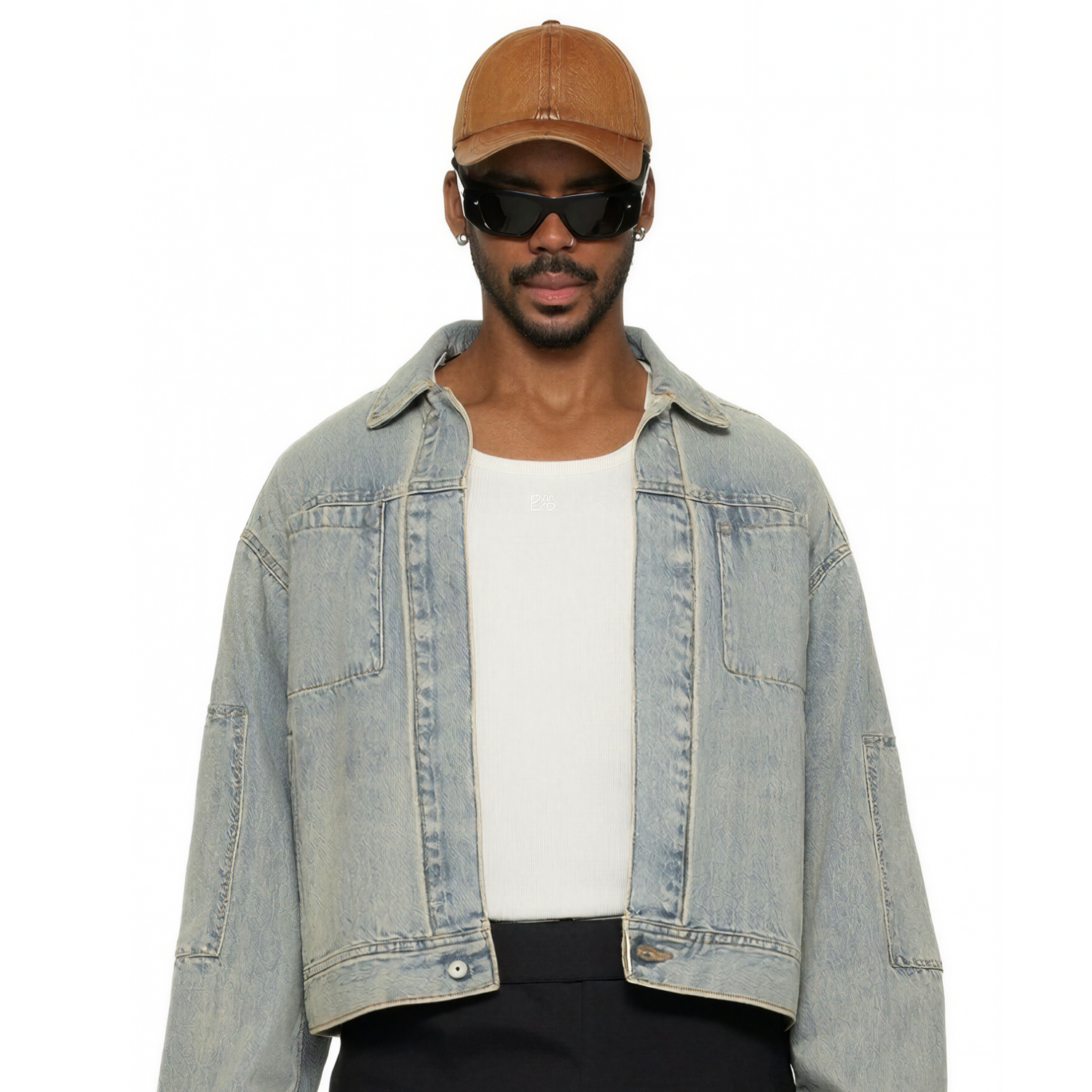
A man, a co-founder, and the avatar in between
Most founders name the company first and themselves never. Dorian Dargan did the opposite. Doji is Dorian plus Jim - a portmanteau of two people who met on Twitter over a shared weakness for clothes, and decided the future of shopping was a photorealistic copy of yourself.
Open the app and the pitch is almost absurd in its simplicity. Upload six selfies and two full-body shots. Wait about half an hour. Then meet a version of yourself that can wear anything on the internet - a runway jacket, a thrifted tee, a pair of jeans linked from a store you have never heard of - rendered convincingly enough that you flinch a little at how much it looks like you.
That flinch is the whole product. Dargan, the co-founder and CEO, has built his career on it. Before Doji, he worked at Apple on visionOS, the operating system behind the Vision Pro, and at Meta on games and experiences for the Oculus Quest, where he spent years designing avatars - those small, uncanny stand-ins for the self. He learned, headset by headset, exactly how it feels when a digital body does or does not feel like home.
We saw Lensa and thought - what if we could do this for fashion, but in a photo-realistic way?
Dorian Dargan, to TechCrunchThe spark was Lensa, the avatar app that briefly turned everyone’s social feeds into glossy, stylized self-portraits. Dargan watched people fall for those images - genuinely, helplessly attached to a prettier render of themselves. He didn’t see a gimmick. He saw a hunger. The stylized version was fun, but it wasn’t you. What if the avatar was photoreal, wore real clothes, and could actually help you decide what to buy?
His co-founder, Jim Winkens, brought the other half of the answer. Winkens was a researcher at DeepMind and worked on a generative-AI consumer product at Google - exactly the kind of person who can turn a diffusion model from a research toy into something that renders fabric falling over a shoulder. The two had been trading side projects since around 2022. When the idea finally clicked, the name wrote itself: Dorian, Jim, Doji.
The $14 million half-week
Doji launched on the App Store in 2025. Within days - before most people had even finished uploading their selfies - the company announced a $14 million seed round led by Thrive Capital, with participation from Seven Seven Six, the firm founded by Reddit’s Alexis Ohanian. It is the kind of timeline that reads like a typo. It wasn’t. The investors weren’t betting on an app they could play with for a month. They were betting on a decade of practice.
Because that is the part the funding number hides. Long before fashion AI, Dargan helped scale the live-streaming startup YouNow to 40 million users - a crash course in what makes ordinary people perform, share, and come back. He founded a stealth crypto startup and, when it didn’t work, shut it down and said so plainly. He studied at MIT, earning dual degrees in economics and urban planning - not computer science, which tells you something about how he thinks. He designs like a city planner: systems, flows, the way a person moves through a space and feels about it on the way out.
It is worth sitting with that resume for a second, because it isn’t a random walk. YouNow taught him how strangers behave when a camera is on them and an audience is watching - the psychology of performance at the scale of millions. Meta taught him the avatar: how a digital body earns trust or loses it in a fraction of a second. Apple taught him polish, the visionOS standard where a render either feels real or feels like a toy and there is nothing in between. The crypto detour taught him to kill something he loved and keep moving. Stack those lessons and Doji stops looking like a leap. It looks like the only thing he could have built.
Taste as a moat
Plenty of teams have tried virtual try-on. Most of it looked like a clothes-shaped sticker slapped onto a photo. Dargan is blunt about why he thinks it failed, and the answer isn’t only technical.
People who explored this before either didn’t have the technology chops to make it good, or the taste to understand what actually makes a person feel good about an image of themselves.
Dorian DarganTaste is doing a lot of work in that sentence, and he means it to. The hard part of Doji isn’t rendering a jacket. It’s rendering a jacket on you in a way that makes you want to keep looking - flattering without lying, accurate without being cruel. That is an aesthetic judgment as much as an engineering one, and it’s the seam where his years at Apple and Meta meet his years staring at avatars.
It also explains the app’s insistence on fun. Doji is, in his words, “designed to encourage play.” You aren’t just checking whether something fits. You’re dressing up a character who happens to be you, trying on a self you might want to become. Shopping forgot how to be that. Dargan is betting that the most personal way to shop online starts with falling a little in love with the image looking back.
The sacred process
There is a streak in Dargan that doesn’t fit the usual founder mold. On his personal site, in all capitals, he declares that “the sacred power of the creative process must be cultivated, actively engaged with, and protected.” He talks about creativity as therapeutic, generative, a way of aligning people with their authentic voices - language closer to a meditation teacher than a CEO pitching a Series A. He keeps an Are.na, the quiet corner of the internet where designers collect images like pressed flowers. His display name on X is a single glyph: .
It would be easy to read that as branding. It plays better as a thesis. A company built on photoreal self-image is, whether it admits it or not, in the identity business. The avatar isn’t a mannequin. It’s a small, editable theory of who you are. Dargan seems to be one of the few people in the category who finds that genuinely sacred rather than merely lucrative - and that conviction is the thing the $14 million is actually buying.
It is a quietly radical position for a fashion-tech founder. The industry usually sells aspiration by showing you someone else - a model you are not, in a body you do not have. Doji inverts that. The figure in the clothes is you, or a negotiated version of you, and the question shifts from “do I want to look like them” to “do I want to look like this.” That is a more honest question, and a stranger one. Dargan appears genuinely interested in the answer, not just the conversion rate that follows it.
What comes next
The roadmap is unglamorous in the best way. Fit prediction, so the avatar doesn’t just show a garment but tells you whether it will actually work on your body. In-app purchasing, so the loop closes inside Doji instead of bouncing you out to a checkout page across the web. Better models, funded by the round. The ambition is to be the layer between you and every store on the internet - the mirror you consult before you spend.
Whether Doji becomes that mirror or a beautiful footnote, the bet is coherent in a way few AI startups manage. Dargan didn’t pivot into avatars when the models got good. He spent ten years learning how digital bodies make people feel, then waited for the technology to catch up to the feeling. The diffusion models arrived. So did he - on time, with taste, and a company named after himself.
Reporting drawn from public sources including TechCrunch, the Ron Brown Scholar Program, People of Color in Tech, UrbanGeekz, Crunchbase, and Dorian Dargan’s personal website. Quotes reproduced as published. Where the public record is silent, this profile stays silent too.