A car can leave the dealership before its paperwork is finished. That small fact explains a surprising amount about the business of selling cars. The buyer has the keys. The finance office has the signatures. Somewhere behind them, a title clerk still has to make the transaction acceptable to a state that may be hundreds of miles away. A wrong fee or an incomplete form can send the work back around.
- The job: calculate fees, prepare forms, and move vehicle title applications toward filing.
- The reach: DLR50 supports out-of-state deals across all 50 states and D.C.
- The bet: fewer mistakes at the desk mean fewer callbacks after delivery.
DLRdmv has made that unfinished business its specialty. Founded in 2016 by Johnson Berry and Jeremie Wells, the Dallas company supplies title and registration technology to dealers and other automotive businesses. In 2026, it reported serving more than 5,000 dealerships. Its users include the people whose work rarely appears in the advertisement: title clerks, finance managers, and staff trying to close the loop on a sale.
The trouble starts with a second keyboard
Consider the problem described in DLRdmv’s May 2026 announcement with TALON Powersports Solutions. A finance manager enters a deal into TALONes, TALON’s dealer management system. Without an integration, the information has to be entered again for titling. A vehicle identification number, a lienholder, an address: each becomes another opportunity to introduce a discrepancy. The error may surface only when the application is rejected.
The new connection lets the manager enter a deal number and pull the existing record into DLRdmv. That record feeds fee calculations, forms, and the title clerk’s review. The improvement is easy to underestimate because it looks so ordinary. Software has removed a handoff at which a correct record could become an incorrect copy.
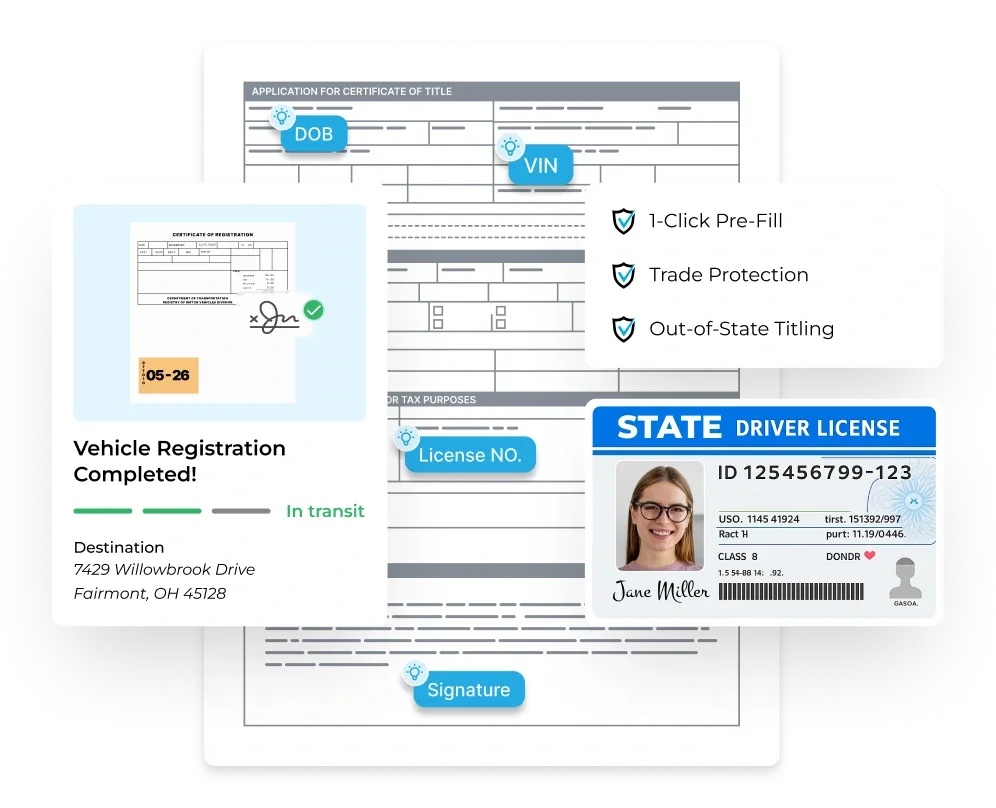
This is a business selling fewer reasons to do the same job twice. AccuFee calculates taxes and registration charges. Trade Protector checks vehicle records for potential title problems. DLRsign handles electronic signatures in supported workflows. These tools address different moments when a deal can accumulate a small defect that becomes somebody else’s urgent problem.
An earlier example makes the role of permissions clearer. On June 2, 2020, Sarasota Ford used DLRsign to send a buyer documents including the title application, odometer disclosure, and contract for electronic signature. The signed documents flowed into DLRdmv’s electronic filing system for submission to Florida. DLRdmv described it as the country’s first fully digital vehicle purchase. Crucially, Florida had approved electronic signatures on the relevant DMV forms. Product design and state acceptance had to meet before the transaction could happen.
Fifty states, one impatient buyer
The company’s expansion followed a recognizable complaint. Dealers using its in-state products wanted help with out-of-state transactions, too. DLR50 initially launched in 2021 for Florida and Georgia dealerships. By February 2024, when DLRdmv announced nationwide availability, the product already served more than 1,500 dealerships in 18 states. It had grown outward from an existing customer problem.
- 01Import
the deal - 02Calculate
& prepare - 03Review
& correct - 04Choose
filing path
The important detail is the filing network. DLR50 combines the software with access to agencies that process transactions in particular states. Dealers can choose between managing a deal themselves and using integrated agency partners. The product therefore packages both instructions and access to people who carry them out. A screen alone cannot finish every state’s paperwork.
Its current offering also includes prefilled forms, signature prompts, status tracking, and eQA corrections before a packet is mailed. The company says AccuFee covers more than 13,000 local jurisdictions. That number helps explain the appeal: a nationwide retailer must understand local obligations even when the customer’s address is unfamiliar.
The scanner is part of the strategy
National coverage can obscure the specificity of the work. DLRdmv’s Wisconsin product lets a clerk scan documents directly into a deal and replace one bad page without rescanning the entire packet. It supports issuing standard plates and ordering specialty plates. Packers plates appear in the product description, a cheerful reminder that regulatory software eventually meets somebody’s very particular preferences.
Minnesota has its own details. TitleIQ retrieves previous title and registration information. Inventory Safe-Lock lets staff correct a transaction without releasing its assigned plate back into available inventory. Documents can go to the dealer’s preferred Deputy Registrar. The workflow accommodates an existing local relationship, giving the dealership a reason to adopt the software without reorganizing every part of its routine.
Florida’s version includes toll clearance and temporary-tag aging alerts. Georgia’s includes checks against state ownership records. The distinctions matter. Nationwide out-of-state processing and a direct in-state electronic filing product are different services. In its August 2026 announcement, DLRdmv listed five licensed in-state markets: Florida, Georgia, Minnesota, Wisconsin, and California.
There is also a service operation around the software. DLRdmv advertises dedicated account managers, on-site onboarding, and 24/7 support. Its stated expertise includes former regulators, title clerks, and dealership veterans. That staffing makes sense for a product whose users may need an answer while a customer is sitting across the desk.
The people with the problem buy a seat
In August 2026, DLRdmv announced a strategic investment from FM Capital, following an Apax Digital Funds investment in 2025. FM Capital’s investor network includes more than 50 dealer groups, fleet operators, and remarketing companies. The stated benefit extends to the product roadmap: operators who experience the paperwork have a channel to influence what gets built.
“For ten years, we’ve built DLRdmv by listening to dealers.”
JOHNSON BERRY · CO-FOUNDER & CEO · AUGUST 2026
DLRdmv competes in an established category. Dealertrack offers in-state registration and out-of-state RegUSA services. Dealers can also retain manual processes and local agencies. DLRdmv’s case rests on connecting fee accuracy, document preparation, filing choices, and support within the dealership’s existing systems.
For a buyer, the sensible comparison includes the service charge, staff time spent correcting rejected work, mailing costs, and the effect of delays on funding. A useful demo would follow an actual awkward deal, including its correction. Ask who notices a missing item, who contacts the buyer, and where the completed filing becomes visible. Those questions test the entire service a dealership will depend on when a transaction needs attention. State inspections, required documents, and government processing still set limits. Importing bad data will not make it good.
The lesson other businesses can borrow is concrete: find the point where information gets copied or an error becomes expensive, then move the check earlier. DLRdmv’s story gives the title office its due. A customer remembers being asked to sign again. Preventing that call is a product worth understanding.