The oddest thing about the six-figure Hollywood gift bag is not that it contains a holiday, a cosmetic procedure and a jar of something promising radiance. It is that the recipient may do absolutely nothing with any of them. No contractual smile. No required Instagram post. No endorsement. A brand pays a fee, supplies the goods and accepts the possibility that its carefully chosen present will disappear into a famous person’s hallway cupboard.
This sounds less like advertising than a wager. Distinctive Assets has made it a business for 27 years. The Los Angeles agency sits between consumer brands that need a story and entertainment figures whose attention can become one. Its gift bags and backstage lounges are the visible part. Underneath is a compact machine made of product curation, event production, public relations and access.
The first pitch got a laugh
Lash Fary began Distinctive Assets in 1999 as a private showroom for television costume designers. The showroom was practical: put useful products where influential professionals could discover them. Then Fary applied the same thought to celebrity gifting. In a 2003 interview, he remembered the response from brands: give merchandise to celebrities - and pay a fee as well? People laughed.
The timing helped. Entertainment coverage was becoming a continuous appetite, and a gift bag came with a ready-made question: what is inside? The list could hold a serious skincare company beside a whimsical snack, an island holiday beside a children’s game. Each item borrowed interest from the whole. A product that would never earn a standalone story could appear in dozens of roundups because the package itself was peculiar enough to print.
Pay a campaign fee, provide inventory and bring a product with a clean, tellable hook.
A performer, presenter or nominee can discover it, use it, redeem it - or leave it alone.
The aggregate bag becomes annual entertainment news, distributing every included name.
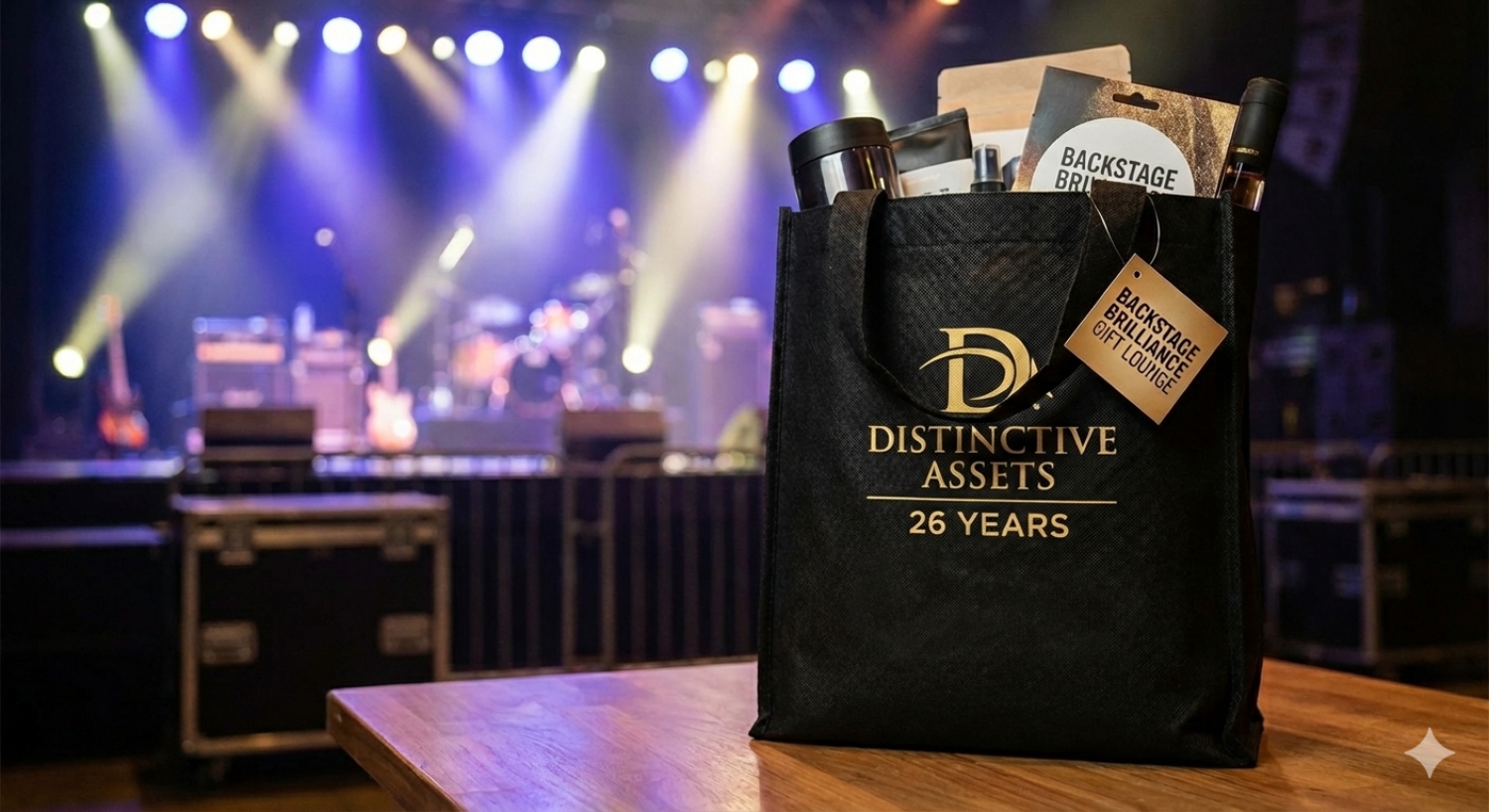
The company’s longest official relationship began with the Recording Academy around 2000. By 2026, Distinctive Assets was producing the official Grammy Gift Lounge and presenter and performer bags for a 26th year. This is the controlled version of the format: an authorized backstage space, assembled during rehearsals, where talent can move quickly and privacy matters. Fary has said that artists trust the lounge because a no-photo promise remains a no-photo promise.
Official in one room, independent in another
The famous nominee bag works differently. Distinctive Assets independently delivers its “Everyone Wins” package to a small set of acting and directing nominees. It is not an Academy program and does not arrive at the ceremony. That distinction became painfully important in 2016, when the Academy sued over trademark use and the impression of affiliation.
The dispute settled quickly, but it changed the language. Distinctive Assets agreed not to use Academy trademarks in bag names, taglines, descriptions or hashtags, and to use clearer disclaimers. The bag survived. The ambiguity did not. What failed first was not the gifting mechanism; it was loose brand architecture around somebody else’s event.
The correction reveals the company’s unusual market position. It is neither a traditional advertising agency nor a talent-booking marketplace. A paid celebrity campaign purchases defined deliverables. Distinctive Assets sells a curated introduction and the publicity environment surrounding it. Its alternatives include gifting-suite producers such as Backstage Creations and GBK Brand Bar, along with PR firms, influencer agencies and direct endorsement deals. Its advantage is a calendar of durable entertainment rituals and the operational trust to get near them.
What the brand actually buys
Published prices vary because the campaigns vary. A 2022 guide put participation at roughly $500 to $50,000. A 2018 profile reported a $4,000 minimum for the nominee bag. Product must usually be supplied on top. The fee buys curation, handling, access, campaign association and a chance to appear in the coverage orbit. It does not buy a celebrity’s affection.
The headline value of the bag is even slipperier. A $25,000 genealogy experience or a $65,000 holiday counts at face value, although it costs nothing if nobody redeems it. Fary once said fewer than ten percent of recipients redeemed offered trips in a given year. In 2022, he explained that a prior bag’s $75,000 digital-consulting certificate had not been redeemed at all. The arithmetic makes excellent copy; it is not the same thing as cash expenditure.
This is why the model suits some companies and punishes others. A hotel can offer unused capacity. A software consultant can issue a certificate. A beauty brand with healthy margins can place samples. A company with fragile inventory, thin margins or a product that needs a long technical explanation may find the economics disagreeable. The format also falters when the brand needs measurable conversions, controlled messaging or a guaranteed post. Earned attention is the upside and the risk.
Buy this for association, product discovery and potential earned media. If your plan requires a named celebrity to publish a specific message, buy a contracted endorsement instead.
When the room changed
In January 2025, fires devastated parts of Los Angeles just before the Grammys. A luxury gifting ritual suddenly looked wrong for the moment. Fary looked at the products already gathered and saw care packages. Distinctive Assets redirected planned celebrity gifts toward affected residents and connected the effort with Bright Harbor recovery services. The broader Grammy week was also reshaped around relief.
The decision matters because it shows what the company is really expert at: not bags, but context. A gift is a social signal before it is an object. Give it to the wrong person at the wrong moment and generosity becomes tone-deaf theater. Change the recipient and the same inventory says something useful.
That sensitivity also appears in smaller details. At a Grammy lounge, Adele reportedly wanted games for her child. The practical toy beat the luxury pitch. Distinctive Assets says it looks for gifts that are fun, indulgent, functional or surprising, without making price the only filter. The best item is the one that produces a human reaction. Sometimes that is jewelry. Sometimes it is Toilet Trouble by Hasbro.
The part worth copying
Most companies cannot stand backstage at the Grammys. They can still borrow the mechanism. Distinctive Assets created leverage by choosing a very small audience with an unusually large wake, packaging many products into one newsworthy object and repeating the ritual until the calendar did part of the marketing.
- Choose the amplifier, not merely the buyer. Find the few people, institutions or communities whose discovery carries naturally into a larger market.
- Make the package the story. A collection with contrast, humor and utility travels farther than a row of interchangeable samples.
- Remove friction. Respect time, privacy and logistics. Access is valuable only when the experience does not exhaust the person granting it.
- Price for uncertainty. Treat organic use as a welcome outcome, never as the spreadsheet’s guaranteed assumption.
- Know when to redirect. Context can turn a clever promotion into an embarrassment. The 2025 care-package pivot is the better model.
The enduring trick is almost embarrassingly simple. Famous people still enjoy gifts. Readers still enjoy looking inside bags they will never receive. Brands still need a way into the conversation. Distinctive Assets has spent a quarter-century standing where those three appetites cross, carefully labeling the luggage.