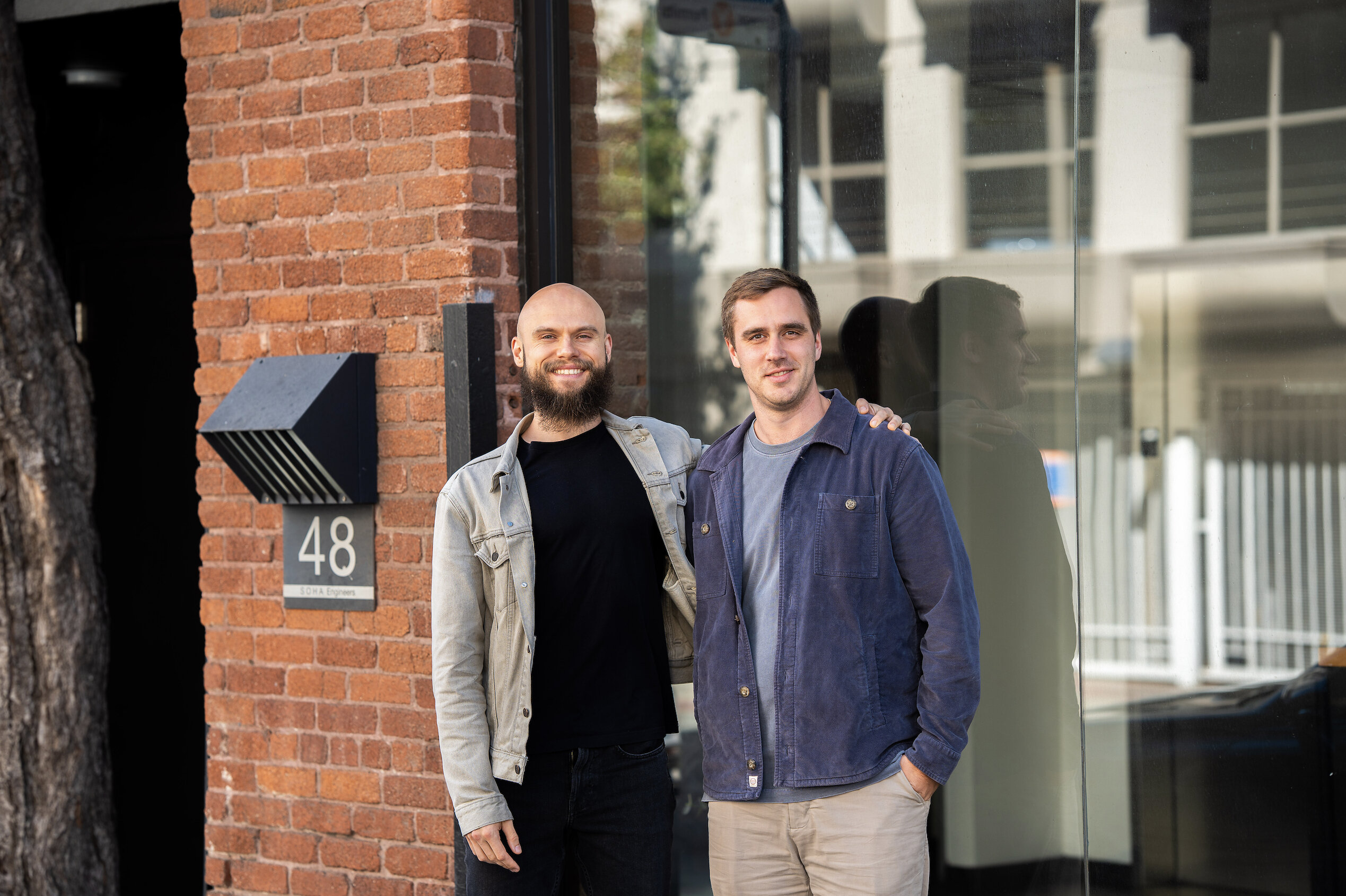
Dima Goncharov and Colin Elsinga had known each other since middle school before they became the sort of people who have to explain their company in a sentence. That earlier relationship is a useful place to begin. By the time they left their engineering jobs in 2021, they had more than fifteen years of friendship behind them. The startup would require a new vocabulary. The partnership already had a history.
Today Goncharov is co-founder and CEO of Metriport, an open-source data infrastructure company based in San Francisco. In August 2026, it announced $26 million in new funding. Those are the neat facts, suitable for a business card and a financing table. The less tidy story includes a practical computing education, aerospace work, an app built by two people, and a decision to change direction after getting into Y Combinator.
There is a revealing tension running through it. Goncharov wanted the freedom to build something of his own. The company he and Elsinga developed makes an argument for giving customers more freedom, too: access to the code beneath the service they buy.
A practical education, then a very personal question
Goncharov graduated from the British Columbia Institute of Technology’s Computer Systems Technology program in 2015, with distinction. The two-year diploma appealed to him because it offered a direct route into work. His account of choosing software is wonderfully concrete: a modest computer could become the means to build games, work with AI, or contribute to satellites. The appeal lay in the range of things a person could make.
His early career took him to MDA and then Amazon Web Services. Aerospace systems and highly available cloud database services were substantial engineering jobs. They also remained jobs working for somebody else. In recalling the drive to his first job, he described realizing how much of his working life an employer would determine. The question was personal: how much control did he want over his own time?
At BCIT, instructor Jason Wilder had encouraged him to think about entrepreneurship. The idea stayed with him after graduation. Goncharov’s advice to others later carried the same practical impatience: “Just shortcut yourself to where you want to be.” It is a brisk sentence. His route still included several years of paid engineering before the leap.
The friend who was there before the pitch
The early Metriport was a consumer app. Goncharov and Elsinga began in Vancouver, building a tool for personal data tracking. A February 2022 account described the app as publicly launched the previous month and bootstrapped to that point. Before venture funding became part of the story, there was the ordinary task of getting something useful onto somebody’s phone.
Their first public product description had the texture of developers explaining software they had wanted to use themselves. They objected to rigid settings, limited customization and aggressive paywalls. They wanted people to choose what they tracked and how they saw it. Even the ability to alter a chart’s colors mattered. A software product can reveal its assumptions in a surprisingly small control.
Privacy was another early concern. Their launch description specified local storage by default, optional encrypted backups, and the ability to export or delete data. Those were promises about the original app, rather than a description of every later Metriport product. But they establish something specific about the beginning: user control appeared in the product brief before open source became the company’s business proposition.
The two founders also brought different professional histories to the same project. Goncharov’s experience included aerospace and cloud systems. Elsinga had worked on consumer software. One became CEO, the other COO. Their longstanding friendship gave the collaboration a past; their engineering backgrounds gave it a way to get started.
Permission to change their minds
Metriport joined Y Combinator’s Summer 2022 batch. The original app had brought the founders that far. During the program, the business changed toward an open-source API and infrastructure for other companies. An investor’s September 2022 account places the pivot midway through the batch, a useful reminder that the finished company description was still being worked out while the founders were building it.
That sequence matters. They had already made a product and found a route into an accelerator. Continuing with the original plan would have been easy to explain. Changing it meant accepting that work already completed might point toward a different business. A launch is a milestone; it need not become a set of handcuffs.
Elsinga later described conversations with dozens of companies as part of finding the new direction. He also recalled the time and engineering effort required to build integrations. His account brings the pivot down from the abstract language of startup strategy to the length of an engineering calendar. Connecting systems takes work. Repeating that work at every company creates a possible business for somebody willing to do it centrally.
The financing and hiring followed. Metriport secured a $2.4 million seed round after YC. In December 2022, the founders hired their founding engineering team and shared their fundraising news. Elsinga would later name hiring those engineers among his favorite company memories. The detail is pleasingly occupational: the reward for building a company was getting more people to build with.
An escape hatch, written into the software
Open source can sound like a matter of taste among programmers. Metriport’s founders make a more commercial argument. Customers relying on software should be able to examine it and retain access to the machinery if the vendor goes away. In a joint interview, they used the phrase “immortal code.” It is an ambitious name for a sensible contingency plan.
The promise is about continuity and visibility. Someone still has to understand the software, run it and maintain it. Making code available does not abolish those jobs. It changes who can take responsibility for them. A customer has another option besides waiting for a supplier to answer. For a company buying infrastructure, that option belongs in the conversation alongside price and features.
Goncharov’s public GitHub profile points directly to Metriport’s repository. There, the company’s software exists as files and packages a developer can inspect, alongside documentation and contribution instructions. The repository includes licensing information for its open-source and enterprise portions. The company’s position is therefore open to a more demanding kind of attention than a product slogan usually receives.
The founders have also argued that outside scrutiny can help identify security problems. That remains an argument for inspection, rather than a guarantee that public software contains no mistakes. The distinction gives their position substance. Trust in infrastructure has to survive an inconvenient question. Publishing the implementation gives customers somewhere concrete to begin asking it.
“Immortal code”
Goncharov and Elsinga’s joint description of the continuity argument for open source, July 2023
There is humor in their public appearances, too. In the same joint interview, they named Y Combinator’s Dalton & Michael video series as a favorite. Asked how they unwind, the pair gave a joking answer about always working. The exchange supplies a little air around the API discussion. Even infrastructure founders can occasionally leave the infrastructure alone long enough to make a joke.
The capital arrives; the work remains
On August 27, 2026, Metriport announced the $26 million financing led by TJ Parker at Matrix, with ARTIS and Y Combinator participating. The company put its total funding at $28.4 million. These are company financing figures. They describe resources available to the business, with the new money intended to support expansion of the platform and its AI and machine-learning capabilities.
New company funding
$28.4 million reported total fundingThe company’s public roster of investors and advisers also includes Patrick and John Collison, Nicolas Dessaigne, Rich Aberman and David Lieb. Their presence places Metriport within a wider network of founders and software businesses. The everyday test remains closer to the workbench: whether the product is useful enough for another company to depend on it.
Metriport’s stated operating principles emphasize engineering, ownership, openness and long-term thinking. It describes a small team with substantial autonomy and little bureaucracy. Those are commitments the company has chosen to make publicly. They fit the problem of building infrastructure, where the less glamorous work continues long after a launch announcement has disappeared from somebody’s feed.
Goncharov now leads the company from San Francisco. His professional identity still carries the engineer alongside the executive: the aerospace and cloud background, the GitHub profile, the interest in making the implementation visible. His story has moved from employment to founding, and from a consumer app to infrastructure. Its most interesting question has stayed close to the software: how much control should the person depending on it have?
For Goncharov and Elsinga, the answer has taken the form of a company whose customers can look inside. A friendship helped them begin. A willingness to revise the first idea helped them continue. The code gives everyone else something more useful than a promise to examine.
Keep following the build
Metriport · Dima on LinkedIn · Dima on X · Dima on GitHub
Explore the company’s code · The YC company profile · The early investor account · The August 2026 funding news