In Bogotá, Diego Rosón went to collect his motorcycle and found himself greeting it almost as an old friend. Frankie, his Royal Enfield Classic 500, had been waiting at a workshop while he was away. The next stretch pointed towards Central America. First came the less romantic business of getting a motorcycle onto an aeroplane.
For a designer, an advertising agency founder and a photographer, this was a brief with unusually awkward deliverables. The road from Colombia to Panama does not continue conveniently through the Darién Gap. The bike needed shipping arrangements. The rider needed patience. A continental dream had reached the paperwork department.
Rosón’s travel accounts are full of such interruptions: a replacement windscreen, a helpful mechanic, a plan revised over lunch. They give his journeys their human scale. Alaska is a destination large enough to swallow a conversation. A machine waiting in a workshop brings the story back to a person who has to fetch it, look after it and decide what happens tomorrow.
Two partners, two motorcycles
Rosón is the CEO and cofounder of RYO Agency. Guillermo Ortelli, his fellow founder, is its creative director. Their business joins advertising, marketing and digital communication, with offices in the Los Angeles and Buenos Aires areas and work across the Americas. The agency dates its Cisco relationship to 2001 and its California opening to 2011.
That is a working life built around other people’s messages. A client arrives with something to communicate; the agency finds a way to give it form. Rosón’s own story takes a pleasing turn when the person responsible for helping organizations express themselves finds a fresh reason to pick up his camera.
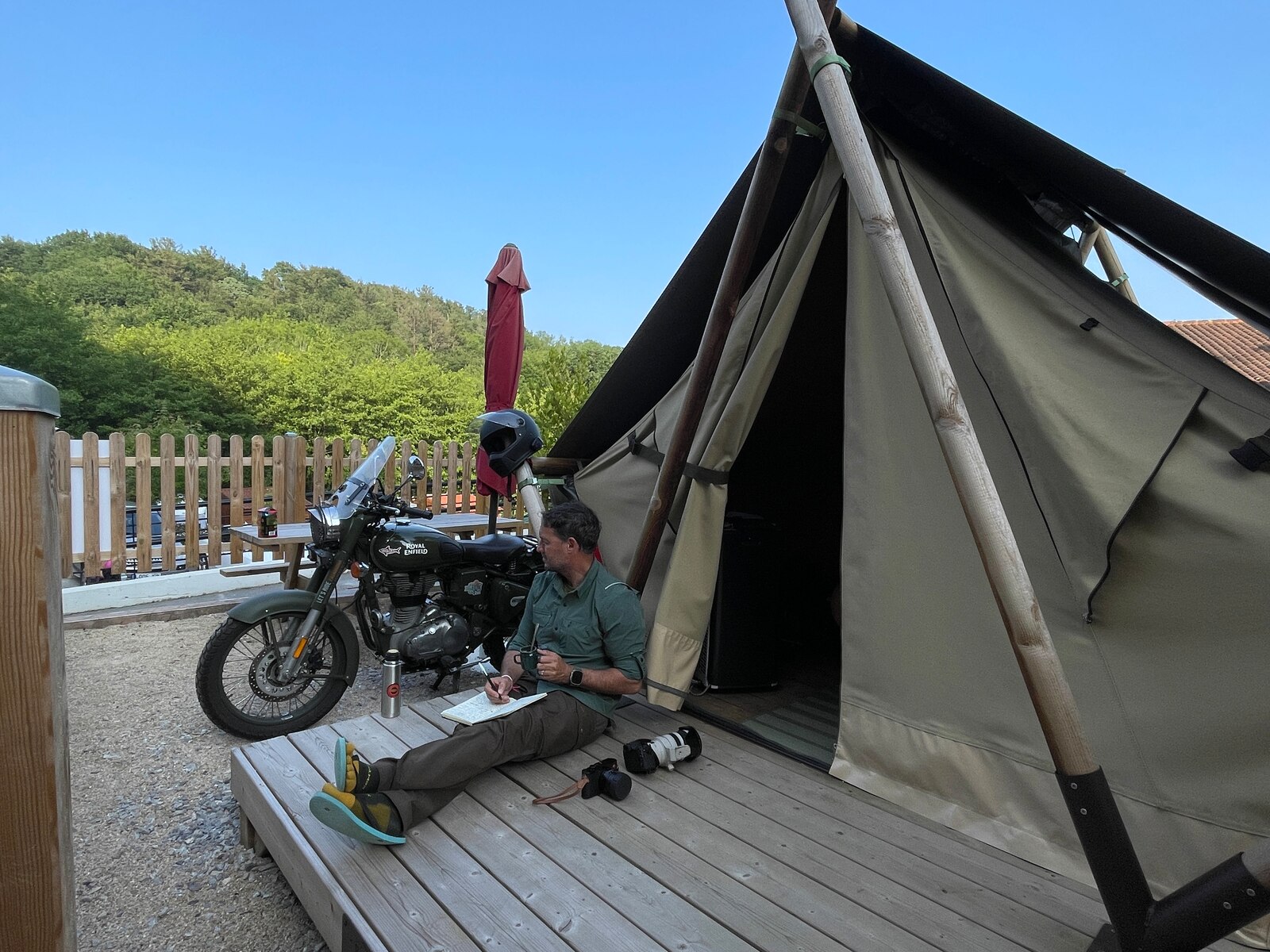
He and Ortelli are also riding companions. They bought matching Royal Enfields and set out through Argentina. On their Patagonian ride, a mechanical problem nearly ends the journey before help from Royal Enfield Argentina and a workshop in Villa La Angostura gets it moving again.
The repaired machine carries them south through Puerto Manzano, Bariloche and El Bolsón. Their attention keeps returning to colour: yellow flowers, violet lupines, the changing palette of Patagonia. The designer’s eye is already doing its work. The difference is that the landscape has supplied the brief, and nobody needs a meeting to approve the flowers.
A journey with return tickets
There is an easy way to tell a travel story: the rider departs, the horizon beckons, ordinary life disappears. Rosón’s version has appointments in it. His American journey was divided into four stages so that he could return to his family and his work. His wife, Silvina, encouraged him; Ortelli took charge of the agency while he travelled.
“La aventura requiere planificación,” he says. Adventure requires planning. The sentence deserves a place beside the map. It describes a dream made possible through arrangements, including the unglamorous ones. Someone keeps the business running. Someone welcomes you home. Someone agrees that the departure belongs in the family calendar.
That structure also changes the meaning of perseverance. A journey can continue through an interval when the motorcycle is parked and its rider is doing something else. The return does not erase the miles already covered. A pause can be part of the design.
On the northern American leg, his brother Mariano joins in an RV. That stage begins with Rosón arriving in Los Angeles in May 2024, checking Frankie with the Royal Enfield team and taking a ride through the canyon and coastal neighbourhoods. He even finds time to skate at Venice Beach before the route heads north.
Mariano’s presence gives the remote sections practical support and company. It is a useful correction to the photograph of a lone motorcycle beneath a large sky. The photograph contains one rider. The journey contains a brother, a partner, a wife, mechanics and friends. Quite a crowd, once everyone gets into the frame.
- 01ArgentinaLa Quiaca to Ushuaia
- 02South AmericaNorth towards Colombia
- 03Central America & MexicoBogotá to Los Angeles
- 04North AmericaLos Angeles to Alaska
Journey sequence, not a distance comparison.
The road edits the plan
A motorcycle makes distance intimate. A broken windscreen matters. Rain changes the afternoon. Fuel becomes a plot point. In his account of the journey from Lima towards Bogotá, Rosón describes difficult conditions on Ecuador’s Troncal de la Sierra: mud, a climb into cloud and visibility reduced to a few metres.
Then a tunnel changes the scene. He emerges into sunshine and dry roads. At Cuenca, the Royal Enfield team welcomes him for lunch. A local friend shows him the city and helps him choose a Panama hat. The scale keeps shifting, from weather big enough to fill a mountainside to something small enough to wear home.
This is the material a travel writer hopes to notice. A route can be recorded as a line, but a line cannot explain why a lunch felt generous or why a sudden patch of sun mattered. Rosón carries both methods of recording: the motorcycle makes the line, and the camera gathers what happens around it.
Farther north, in Costa Rica, an intended surfing stop loses to a missing petrol station. He has to ride in the opposite direction for fuel. Later, a rough coastal road leads to a river crossing. He unloads the motorcycle, assesses the water and works it through when the rear wheel loses purchase.
The episode has the right proportions for his kind of story. There is a problem, a little calculation and a machine that needs assistance. There is also the indignity of having to abandon a perfectly attractive plan because the tank has an opinion. The road allows a traveller ambitions. It reserves the right to rearrange them.
His Mexico-to-Los Angeles account adds other encounters and detours: Baja California, the water at La Paz, friends whose help becomes part of the narrative. The travel writing gives thanks by name to people including Cesar Branda, Ortelli and Henry Von Wartenberg. A record of a ride also becomes a record of who was there.
“La aventura requiere planificación.”
Diego Rosón
Europe, and a different sort of family visit
By 2025, Frankie was carrying Rosón through Europe. There were northern landscapes, motorcycle gatherings and a stop with a family connection: Degaña, in Asturias, the village his grandparents had left for Argentina. A journey across a new continent could also bring him closer to an older family geography.
Edinburgh supplied a less welcome episode. The motorcycle was stolen and recovered by police six hours later. For a traveller whose machine has a name and a place in the story, the interruption had stakes beyond the inconvenience of lost transport. The journey continued, taking in the Lofoten Islands and Nordkapp.
His European ride finished in July at the Finnish Motorcycle Museum in Lahti. Riku Routo and musician and motorcyclist Pelle Miljoona were among the people involved in the welcome. It is an agreeable place to end a long ride: surrounded by other people who are unlikely to ask why anyone would go all that way on a motorcycle.
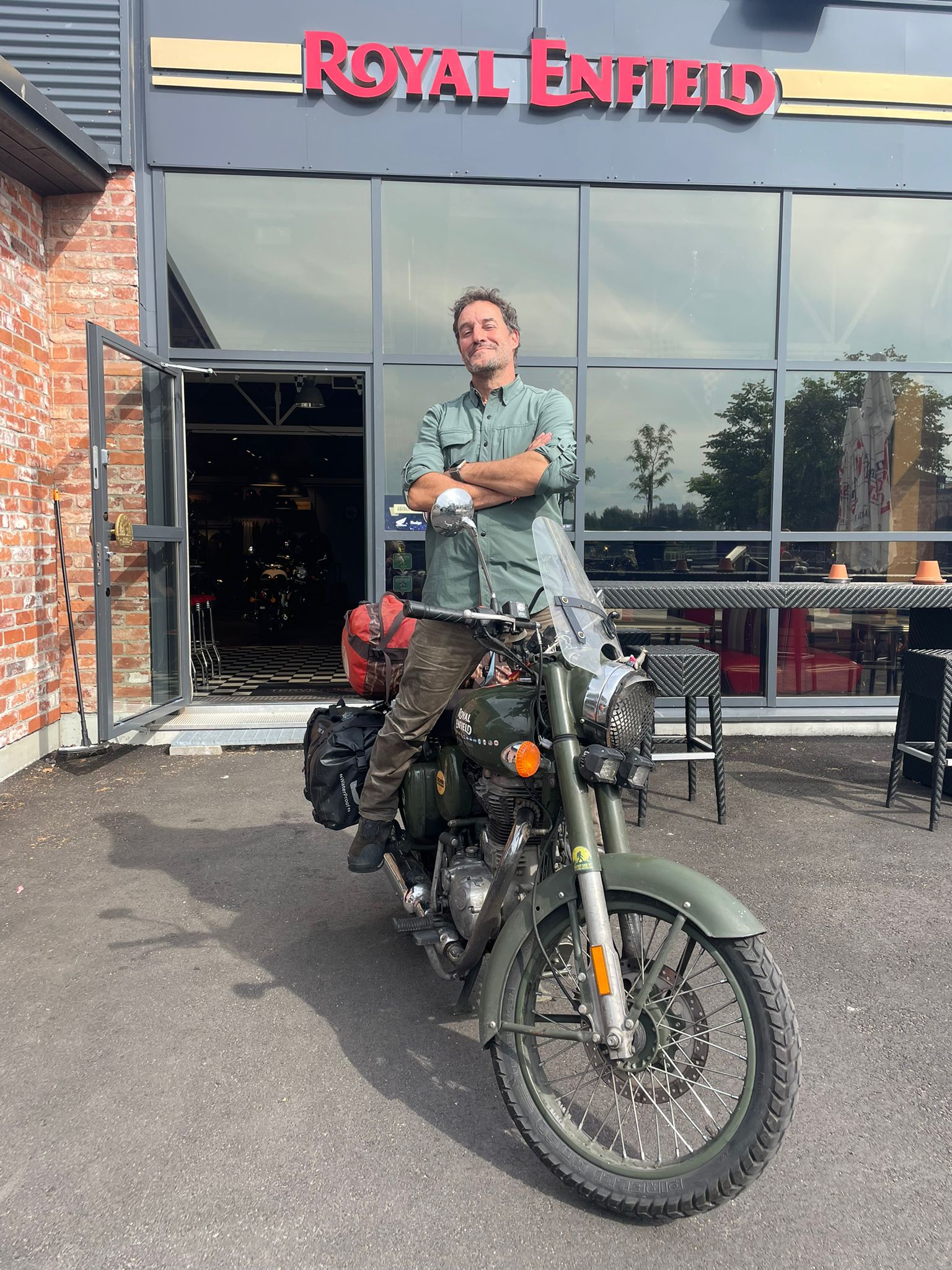
At that stop, Rosón spoke about the suitability of a smaller, simpler motorcycle for a large journey. He also singled out the kindness of people along the way: interest in the traveller, offers of help, a cup of tea or coffee. The welcome was part of the trip’s substance.
He described an ambition to cross every inhabited continent and identified Asia as a future stage. It was an aspiration with a next planning session attached. The map could grow again. For the moment, there was a completed European ride and another collection of photographs to bring home.
The second journey happens on paper
Rosón’s books bring the travelling back into his working life. He photographs the days, writes about what happens and designs the material into volumes. “Mis libros son muy simples,” he says. His description places the emphasis on daily experience and images, an approach that leaves room for ordinary moments alongside distant places.
The process suits someone who knows both how to look and how to arrange what he has seen. A camera gathers more than a book can hold. Design asks for choices: which image opens a sequence, which detail deserves space, when a reader needs another view. After the practical decisions of the road come the practical decisions of the page.
The first volume of his European trilogy follows the opening route from Finisterre to Abbey Road. By February 2026, it was presented as a 112-page colour edition with more than 150 photographs, available digitally and in print. Those figures give a sense of the work after the riding: selecting, sequencing and turning an accumulation of days into an object.
European volume
the journey
Finisterre to Abbey Road / edition described in February 2026
Finisterre is an apt starting point for a designer with another chapter in mind. The place associated with the end of the land becomes the opening of a book. Abbey Road supplies a recognisable destination. Between them sit the less easily summarised parts: weather, conversations, stops and the images that persuaded him to reach for the camera.
The agency founder and the traveller meet here, over a finished page. Both jobs require attention to what another person might see. One begins with a client’s problem. The other begins with something encountered around a bend. Rosón has found room for both, and a way to carry one into the other.
Frankie has to wait outside the printing process. The photographs can go everywhere.