Sylvester Stallone’s name takes up a good deal of the picture. Gold letters sit beneath his photograph, while a ring of light gives the background the atmosphere of an expensive control room. The face is familiar. The arrangement around it is somebody’s work. In this case, the campaign artwork appears in the portfolio of Digital Visions Tech, the agency led by Azhar Saleem in Lahore.
It is a useful place to begin with Saleem. A designer working around a famous personality has a peculiar assignment: use the recognition already in the room, then give it somewhere to go. A photograph attracts attention. Type, spacing and the surrounding image have to turn that attention into a message. Even a movie star needs somebody to mind the margins.
Saleem is the founder and CEO of Digital Visions Tech, with a professional background in graphic design and video editing. His agency offers branding, packaging, social graphics and UI/UX design. The breadth is visible in the work it displays. The more interesting question is how a designer keeps those different assignments together while also running the business that produces them.
A name in gold, a network behind it
The entertainment work gives Saleem’s portfolio an immediately recognizable entrance. His company displays campaign designs featuring Stallone, Ric Flair, Daymond John, Les Brown, Rudy Mawer and Jordan Belfort. His personal collection includes television branding and promotional graphics. Famous faces make a portfolio easy to enter; the design decisions give a visitor a reason to stay.
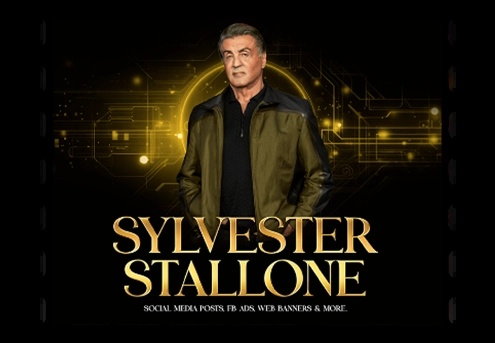
Saleem describes his celebrity campaign experience as work undertaken while collaborating with a US-based marketing agency. That is a practical description of a professional relationship. The work passes through an agency network, with creative contributions made around the person whose name reaches the audience. The resulting image can travel much farther than the designer’s own name.
Look again at the Stallone graphic. Black makes room for the gold. The name anchors the bottom half. The portrait occupies the center, with graphic detail pushed into the surrounding space. These are visible choices in a displayed piece of work. They make the hierarchy legible before anyone begins studying the smaller lettering. Recognition has been given a layout.
That distinction gives Saleem’s story its human scale. The celebrity is the subject of the campaign; Saleem’s business is among the creative businesses making the campaign material. There is craft in the supporting position. A designer has to know when the surrounding treatment adds meaning and when it merely interrupts the person everyone came to see.
The freelancer’s name stays on the door
Saleem’s professional presence still includes individual design services. He offers graphic design, editing and animation under his own name, while leading an agency with a wider service menu. The two identities coexist: the person who can make the work and the founder responsible for arranging its production. That combination is familiar to anyone who has turned a skill into a business.
His personal portfolio includes Inside Success TV branding, show thumbnails and Legacy Maker television posters, as well as packaging projects. Together, they show the different scales at which the same designer’s name can appear. A brand identity establishes a visual vocabulary. A thumbnail has to communicate within a small rectangle. A poster must organize an introduction before its audience moves on.
Video editing adds time to the problem. An image can be examined at leisure; an edit decides when the viewer receives each part of the story. Saleem’s background includes both disciplines. His agency’s design offer puts still images and interfaces beside that editing experience, with the founder’s career connecting work that audiences encounter in different ways.
“Let’s create something cool together!”
Azhar Saleem
There is something approachable in that invitation. The sentence proposes a shared assignment without burdening it with ceremony. It also fits the kind of business Saleem runs: a client arrives with something to communicate, and a designer helps give it form. The finished work has to belong to the client’s purpose, even when the designer brings a recognizable method.
The brief gets bigger than the canvas
Digital Visions Tech’s service range is conspicuously practical. Its portfolio categories include social advertisements, logos, pitch decks, web banners, interfaces, flyers, packaging, product listing design, video thumbnails, social covers and book covers. These are things a business can commission and put to work. Some invite a click. Others explain a company or help a physical product introduce itself.
For Saleem, that range places agency leadership beside the original design craft. Each format comes with a different set of conditions. A book cover has a spine and a shelf. A banner has proportions and a placement. An interface has a person trying to get something done. A useful visual idea must survive the conditions of the object carrying it.
The appeal of a broad agency offer is easy to understand. A client may need several related pieces, all recognizable as parts of the same business. The founder’s operational challenge follows from that promise: keeping the decisions connected while the work changes hands. Color, type, imagery and tone can become a common vocabulary across the assignment.
That is an interpretation of the service model, rather than a claim that every project follows one pattern. Saleem’s company gives clients a menu of connected design services. The portfolio invites a more concrete way of looking at the business: take one format, examine what it must accomplish, then ask how the next format carries the same identity forward.
The revealing detail is a job description
An agency’s hiring requirements can be unusually informative. Digital Visions Tech sought a senior graphic designer comfortable with banners, social advertisements, interfaces, flyers and branding. The requirements included English communication, attention to detail, deadlines and experience with Photoshop, Illustrator and Figma. Creative judgment had to travel with the ability to understand and complete an assignment.
A project management vacancy placed Saleem’s business in Gulberg III, Lahore, and specified an evening-to-overnight shift. It also asked for budgeting, planning, client communication and the ability to handle multiple Fiverr and Upwork projects. The practical implication is a role responsible for keeping concurrent assignments moving. Someone has to know what is due, who is working on it and which answer the client is waiting for.
A project manager’s Lahore shift
The contrast between a campaign graphic and a project plan is instructive. One is designed to attract a stranger’s attention. The other helps colleagues finish the work. Saleem’s position as CEO sits across both activities. Making a good image and making a reliable organization ask different questions, even when they concern the same delivery.
The job requirements give this part of his story some texture. Familiarity with creative software belongs alongside budgets and communication. An agency manager needs enough understanding of the work to discuss it, and enough organization to keep the discussion useful. A magnificent misunderstanding is still a misunderstanding. Design businesses have very little use for those.
A revision has its own place in the process
Digital Visions Tech describes four stages in an engagement: kickoff, design, revisions and final delivery. The opening stage establishes the client’s goals and the scope. The next develops the visual work. Feedback then has a named place before the final files are delivered. It is a plain sequence, which is part of its usefulness.
Revisions are where a client’s understanding and a designer’s proposal meet in something visible. The company promises collaboration during that stage. For a founder with design experience, the subject is concrete: a requested change can affect hierarchy, balance or the relationship between elements. The conversation needs to establish the problem the change is supposed to solve.
Saleem’s role gives him a view of both the making and the coordination. The service promise depends on the work being usable after the conversation ends. A client needs the campaign asset, the identity or the interface design to do a job. Final delivery is the point where the agency’s internal decisions become someone else’s working material.
More than the face on the poster
Video remains part of that working picture. A recent senior editor vacancy at Digital Visions Tech described planning, editing, color grading and motion graphics, with collaboration across designers and marketing teams. It also included organizing footage and delivering assets for digital platforms. These are detailed production responsibilities within the field Saleem identifies as part of his own background.
His career is easiest to understand through that continuing connection to the craft. The company offers a broad range of services; the founder’s professional identity still includes the skills used to make them. Leadership expands the assignment. It adds clients, colleagues, schedules and the obligation to turn a promising first direction into something finished.
Return to the campaign image and its gold lettering. The face supplies a familiar starting point. Around it sit the choices that make the piece readable and give it a particular atmosphere. Saleem’s story occupies that surrounding space: design work made in Lahore, carried into a wider agency network, and organized into a business of his own.
The famous name will probably receive the first glance. For once, it is worth giving the second to the designer.
Follow the work
Azhar’s portfolios, professional profile and agency.