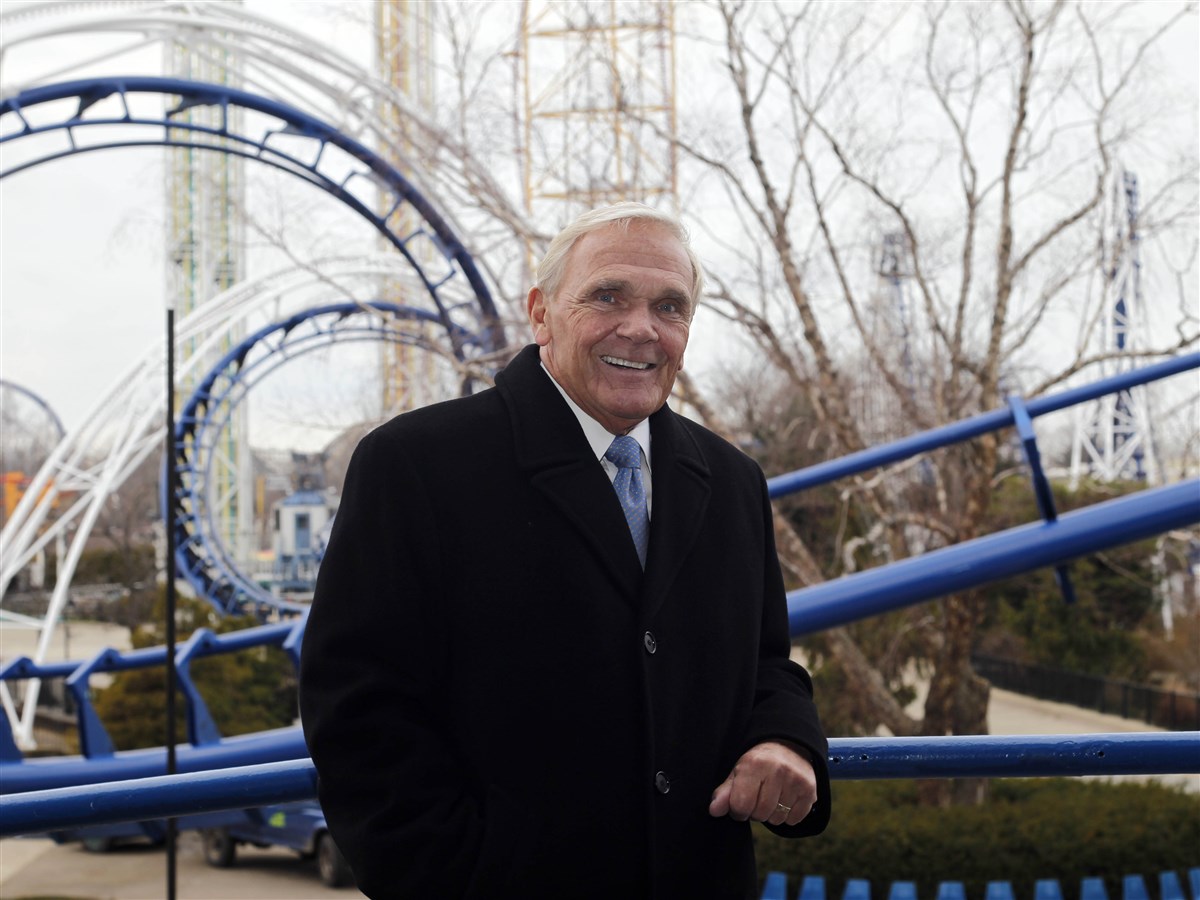
Dick Kinzel kept stopping for the trash. Along the midway at Cedar Point, the chief executive of a publicly traded amusement park company would interrupt his walk, bend down and put litter where it belonged. There were employees whose jobs included doing precisely this. There were also guests watching the person in charge. To Kinzel, the first impression deserved his personal attention.
His granddaughter, Hannah Romell, remembers accompanying him on those walks. He greeted guests and employees as he went. Years later, she described the lesson she took from watching her grandfather: leaders establish expectations through the work they are prepared to do themselves. Her recollection ends somewhere pleasantly ordinary, with retirement conversations over sausage and green pepper pizza and Diet Coke.
The same executive helped put roller coasters above 200, 300 and 400 feet into the Ohio sky. It is tempting to remember the height and forget the bending down. Kinzel’s career makes more sense when you keep both in view. A park could advertise its newest machine across the region. Once a family arrived, someone still had to mind the midway.
Before the skyline, the food stands
A Toledo native, Richard L. Kinzel attended the University of Wisconsin-La Crosse. His amusement park career began in 1972, in Cedar Point’s foods division. By 1975 he was director of park operations. Three years later, he went to Minnesota as vice president and general manager of Valleyfair, the recently acquired park in Shakopee. His route to the top passed through the parts of the business where a day’s mistakes are visible to everyone.
He stayed at Valleyfair until 1986, when he became Cedar Fair’s president and chief executive. At that point the company had two amusement parks. This was a substantial operating job, but it was a different proposition from the chain he would eventually leave behind. The business listed on the New York Stock Exchange in 1987. Its ticker symbol, FUN, offered a cheerful abbreviation for a demanding seasonal enterprise.
Kinzel was an operator before he was the executive associated with giant rides. Food service, park operations and eight years running Valleyfair gave his later decisions a practical setting. Every new attraction would have to join a working park. Every season would arrive with its own opening date, employees and customers. A coaster might take years to develop; the guest’s judgment could arrive before lunch.
A number people could remember
In 1989, Magnum XL-200 opened at Cedar Point, becoming the first roller coaster to exceed 200 feet in height. The threshold gave the park a story that could travel well beyond Sandusky. Two hundred feet required little explanation. You could picture it, repeat it and decide whether you wanted to find out what it felt like.
Kinzel’s bet joined engineering ambition to the everyday business of persuading people to visit. A new coaster gave a returning customer a reason to return again. A record gave the marketing team a particularly economical sentence. The ride became both an attraction inside the gates and an argument for coming through them.
John Hildebrandt, Cedar Point’s marketing executive and later its general manager, helped turn the park’s coaster collection into a recognizable identity. Kinzel supplied the operating commitment behind that identity. This was a collaboration between building something people wanted to ride and making sure people heard about it. Steel alone does not buy a ticket.
The next round number arrived in 2000. Millennium Force stood 310 feet high and reached 93 miles per hour. In 2003, Top Thrill Dragster took the height to 420 feet and the speed to 120 miles per hour. Those are the specifications of the rides at their debuts, successive markers in the period when Kinzel’s Cedar Point kept finding another hundred feet to discuss.
Another hundred feet to talk about
The arithmetic under the track
Kinzel could talk about those rides in the language of an enthusiast. He also brought the conversation back to return on investment. Discussing Millennium Force in 2000, he described estimating construction costs, the extra attendance required, what visitors would spend and the time needed to recover the investment. The mountain of track began with a pencil.
That calculation helps explain his particular kind of ambition. An impressive machine had to serve the park’s business. Demand encouraged manufacturers to develop new ideas; successful rides encouraged other operators to invest. Kinzel saw the relationship as a commercial exchange, with parks, engineers and guests each supplying a reason for the next project.
There was room for much less spectacular expenditure, too. During his tenure, Cedar Point added Soak City, hotel accommodation and Camp Snoopy. Water slides, rooms and children’s rides widened what a family could do with a visit. A person who came for a coaster might be travelling with someone whose preferred excitement involved a swimming pool.
The practical limits remained. Steel cost money. Seasonal parks had limited time to earn it back. By 2011, Kinzel was openly discussing how the economy and materials costs complicated the case for another very tall coaster. His appetite for new rides survived; the numbers still needed to cooperate. Even an executive fond of altitude had to live on a calendar.
Five parks in one purchase
Cedar Fair expanded well beyond its original pair of parks. Dorney Park joined in 1992. Other acquisitions brought properties including Worlds of Fun and Knott’s Berry Farm into the group. Each purchase added customers, employees and another local history. The executive who had learned to run one park was now responsible for a collection of them.
The largest step came in June 2006, when Cedar Fair completed the purchase of Paramount Parks from CBS for $1.24 billion in cash. Five amusement parks arrived together: Canada’s Wonderland, Kings Island, Kings Dominion, Carowinds and Great America in Santa Clara. It was expansion by an entire portfolio, with the financing obligations to match.
The geography had a rationale. Different regions offered some protection against weather or economic weakness in one market. Yet ownership did not erase the distinctions between the parks. Kinzel defended keeping their individual identities. A visitor’s attachment to Kings Island or Canada’s Wonderland could not simply be packed into a new corporate name.
There was an awkward challenge inside that expansion. The close supervision that works at a familiar park must somehow extend across a much larger organization. Kinzel wanted the attentiveness of a family business inside a stock-exchange company. Growth made that ambition harder to practice. The distance between the executive office and any particular midway had increased.
Five Paramount parks. One cash transaction.
A different sort of drop
The financial story became difficult as the recession put pressure on the company. Acquisition debt left less room for disappointment. The rides still had to operate and the parks still needed investment, while investors had their own view of what the business should be worth. A successful attraction and a comfortable balance sheet were separate achievements.
In December 2009, Cedar Fair agreed to a sale to affiliates of Apollo Global Management. The proposed price was $11.50 per partnership unit. Investors including Q Funding opposed the transaction. By April 2010, the deal lacked the support it needed and the parties terminated it. Cedar Fair agreed to reimburse Apollo $6.5 million in expenses.
The disagreement reached the structure of the board. In January 2011, after unitholders supported separating the chairman and chief executive positions, Kinzel relinquished the chairmanship. C. Thomas Harvie became independent chairman. Kinzel continued as chief executive through the succession period. His long tenure now included a public demonstration that investors could insist on a different arrangement.
It would be too tidy to make the whole career a sequence of higher rides and larger crowds. The final years involved debt, disputed decisions and limits on managerial authority. Tim O’Brien’s biography, published in 2015, gives those years a place alongside the coaster successes. They belong in the same life. Kinzel had helped build the company that investors were now arguing over.
The ride he could laugh about
Kinzel had a less expensive way of explaining a mistake. At an industry panel in 2016, he revisited Avalanche Run, the bobsled coaster later enclosed and rethemed as Disaster Transport. He described the disappointing ride and the attempt to improve it by putting it inside a building. The enclosure, in his telling, had cost $4 million.
“We had a bobsleigh ride, which was designed as a horse and came out as a camel,” he said. The joke carries an operator’s frustration: spending more on the presentation did not resolve his dissatisfaction with the ride underneath. He could describe a failed experiment without requiring the audience to sit through a management euphemism.
That candor gives some texture to the executive behind the height records. His industry recognized him with induction into the IAAPA Hall of Fame in 2006 and an Amusement Today Legends Series award in 2011. He could accept the honors and still have a story about an attraction whose name had become rather inconveniently apt.
A summer without an opening date
Matt Ouimet became Cedar Fair’s president in June 2011 and succeeded Kinzel as chief executive in January 2012. Kinzel’s career with the business had lasted 39 years, including 25 as its leader. The handover meant surrendering more than an office. The work had supplied the rhythm of his summers for decades.
“I have never had any hobbies outside of this industry.”
Dick Kinzel / on approaching retirement, 2011
“I have never had any hobbies outside of this industry,” he said as retirement approached. The remark sounds extravagant until you consider the occupation: other people’s holidays were the days his parks most needed to be ready. An amusement park sells leisure by asking a great many people to work through it.
His connection to the parks continued after the executive title ended. Central Catholic High School, his Toledo alma mater, honored the 1958 graduate with its Citizens Award in 2023. In September 2025, Ouimet publicly credited his predecessor’s operating knowledge and coaster strategy when reflecting on Cedar Fair’s growth. The successor recognized the foundation he had inherited.
And there is the granddaughter’s memory of the walks, the greetings and the litter. The high steel remains an obvious way to measure Kinzel’s career. The smaller gesture explains something the skyline cannot. Before a guest could remember the ride, that guest had to enjoy being in the park. Kinzel kept stopping to do something about it.