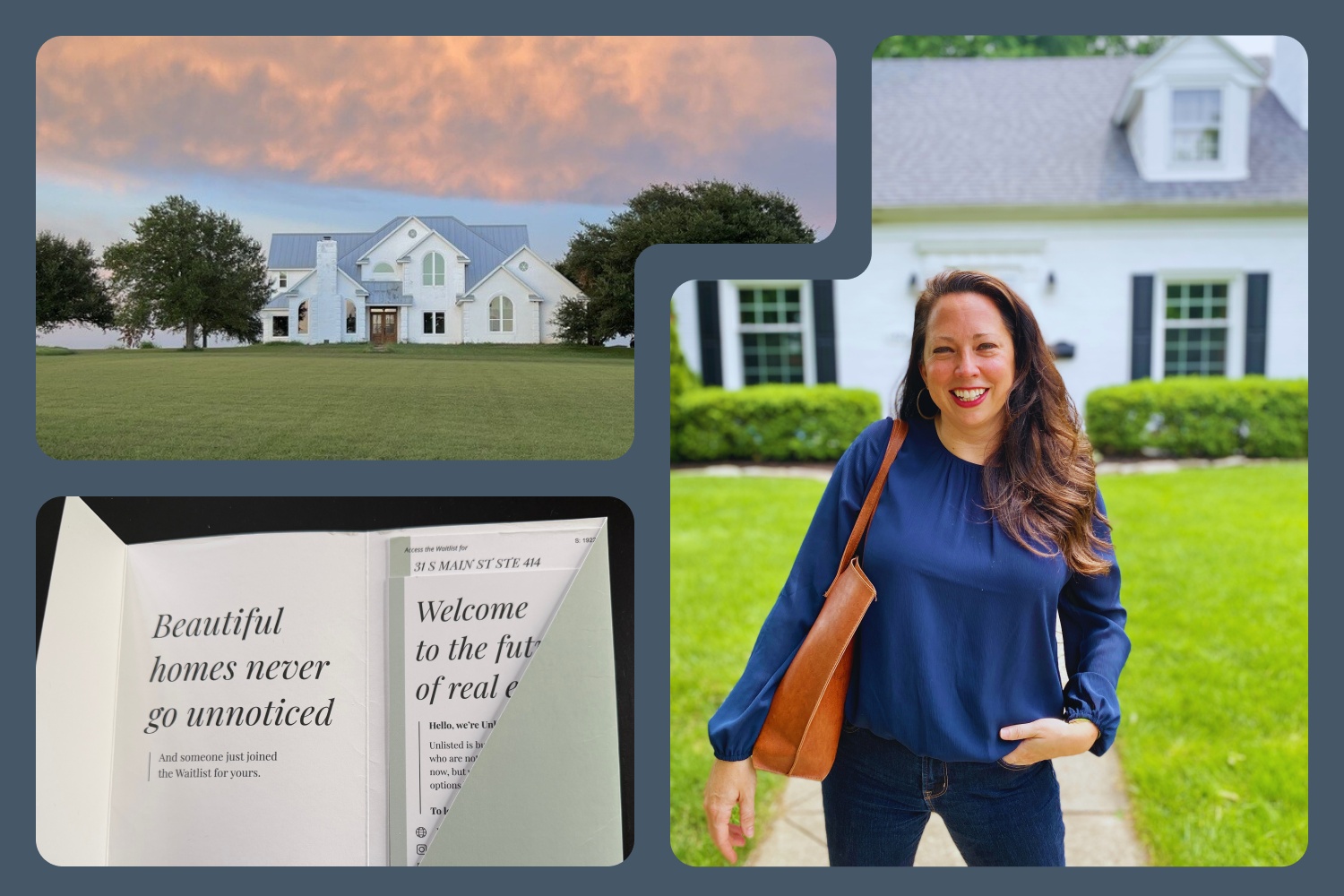
Katie Hill wanted the house across the street. It had a little swimming pool, and her two daughters liked to swim. It also offered something harder to put in a property filter: a different home without a different neighborhood. There was one inconvenience. Its owner had made no announcement that he intended to leave.
One day, while he was mowing, Hill went over and expressed her interest. The response surprised her. He had begun thinking about retirement. A move was possible, though some distance off. They agreed she would have the right of first refusal when he was ready. An ordinary conversation had given both neighbors information they could use.
That small exchange became the premise of UNLISTED, the real estate technology company Hill now runs. Her subject is the interval before a property becomes a listing: the years when a person might move, might stay, or might be persuaded to consider either. A house can be occupied quite happily while its owner's next chapter is taking shape.
The business of being early
Hill came to this problem with a marketing background. Earlier in her career, she spent seven years at Leo Burnett in Chicago, managing technical marketing tools and operations for domestic and international clients. She graduated from Illinois State University in 2001 with a marketing degree, later earning her executive MBA at Chicago Booth in 2013.
Her first company, Commuter Advertising, used location to give a message its moment. Short audio advertisements played aboard public transit vehicles at particular points along a route. A business could reach passengers as the bus approached it. Transit partners shared in the advertising revenue. The useful thing was the combination of information, place, and timing.
Read alongside UNLISTED, that earlier venture suggests a recurring interest: what happens when a message reaches somebody at a more useful moment? On a bus, the moment is geographical. For a homeowner, it may arrive months or years before a moving van. The technologies differ. Both businesses depend on making a connection that would otherwise be easy to miss.
Two chairs, then a city
Dayton entered Hill's life through a contract. In 2008, while living in Chicago, she learned of a request for transit advertising proposals there. Her team promised to establish the business in Dayton if it won. The contract came through, and the move followed. At the Entrepreneurs' Center, their early office equipment included a folding table, two folding chairs, and two laptops.
It is an agreeable origin for somebody who would later spend her working life discussing homes: first, find somewhere to put the folding furniture. CommuterAds stayed at the center for five years and grew to ten employees. Hill subsequently became an entrepreneur-in-residence there, helping other founders work through the decisions she had encountered herself.
Her advice carries that experience of receiving help and later supplying it. Give when you can and take when you need.
It is a compact description of a professional community in which the person asking for an introduction today may be the person making one tomorrow.
“Give when you can and take when you need.”
Katie Hill, January 2025
A cookie at the front door
UNLISTED was operating by 2021. Its early approach to a potentially awkward introduction included vanilla-frosted cookies. Buyers could send a personalized mailing inviting an owner to join the platform and discuss future property plans. The cookies softened the arrival of a stranger's interest. Software handled the connection; something edible supplied the manners.
In May 2022, the company won the University of Chicago's Alumni New Venture Challenge and received a $40,000 investment. Eight finalists had presented at the virtual final. Hill, by then a single mother in her forties, spoke about the value of an alumni program that made room for founders whose lives differed from the familiar young-startup-founder picture.
The detail matters because Hill already had a business career behind her. She was returning to a university network with an idea drawn from her life as a homeowner and parent. That experience supplied the question. The competition gave her another group of people with whom to test the answer.
Alumni New Venture Challenge investment
Flyer Pitch first-place prize
Pitch HearstLab equity investment
What a waitlist can actually say
The current idea is easy to describe. A buyer finds a home and joins its waitlist. The owner can collect interest, claim the property's profile, update information, and decide whether to engage. The property can remain off the market throughout. Interest creates an opening for a conversation, with the decision to sell still belonging to the owner.
This is where Hill's original encounter remains useful. Her neighbor's plans were already developing when she asked about the house. Her question made them visible to each other. UNLISTED attempts to provide that opening for people who would prefer a platform to approaching somebody on a lawn.
A waitlist also has limits. A name on a list establishes interest; it does not establish a purchase price, a timetable, or a completed sale. The homeowner may keep living there. An interested buyer may change plans. Those possibilities are part of the premise. Hill is making room for tentative intentions, which are often how consequential decisions begin.
- 01Interest expressed
- 02Owner considers
- 03Conversation opens
The owner chooses whether and when to proceed. A waitlist is no promise of a sale.
The invitations get more formal
By March 2026, Hill was describing a postal introduction with a different social reference: a repurposed wedding invitation. When somebody waitlisted a property, the company mailed its owner an invitation explaining the interest and providing a way to message the buyer. That is a revealing design choice for a technology company. An envelope still has a job to do.
She also had a practical answer to the question of whether she had bought the house that inspired the business. I'm still waiting!
The owner had considered a possible move around Christmas, but it had not happened. Hill said she was in no rush. The founder was living with precisely the elastic timetable her platform was built to accommodate.
There is some charm in a company advancing faster than its founding house purchase. There is also consistency. A business organized around future possibilities has to allow its original homeowner a future of his own choosing.
For someone considering a move, an early conversation can also separate two questions that tend to arrive together: whether another home appeals, and whether now is the time to act. Hill’s own arrangement allowed the first question to have an answer while the second remained open. That is the appeal of the idea, and the constraint on it. A company can organize expressions of interest. The people involved still have to fit a move around their lives. Any account of UNLISTED that skips the waiting would miss the experience that gave Hill the idea in the first place.
Taking the pitch beyond Dayton
Hill won Dayton's Flyer Pitch with UNLISTED in 2023, receiving a $60,000 first-place prize. In April 2024, she won Pitch HearstLab in New York, bringing a $100,000 equity investment and entry to the investor's portfolio. The sequence took a neighborhood question through university competitions and into a media company's venture network.
By the end of 2024, UNLISTED had raised a $2.25 million seed round led by HearstLab, with VC 414 and StageNext Fund also participating. A partnership with Hearst Newspapers accompanied the company's development. In September 2025, UNLISTED was announced as a member of TechCrunch's Startup Battlefield 200 cohort.
These are distinct milestones: competition prizes, investment, a partnership, and selection for a startup showcase. Each gave Hill a different opportunity to explain what she was building. A pitch can earn a meeting or a check. The next task is getting a homeowner to understand an unfamiliar invitation arriving through the mail.
More than the day of the sale
Hill's other work has kept her close to founders facing their own version of that explanation problem. She has served as a business advisor to Lunnie and on the advisory board of Illinois State's Means Center for Entrepreneurial Studies. In 2015, she was among the alumni who established the university's MPW-Pay it Forward Business Scholarship, which recognizes student leadership.
The scholarship rewards students who are already taking responsibility on campus. Its emphasis on leadership and participation gives another view of Hill’s connection to her university. The relationship continues after graduation through people who contribute money, time, and access to experience. A degree supplies a date on a biography; an advisory role or a shared scholarship describes an ongoing commitment.
That network extends from her first degree to her current company. It also makes the usual solitary-founder portrait feel incomplete. Hill's record includes clients, transit partners, university programs, other entrepreneurs, investors, and the homeowners whose responses determine whether the idea works beyond a presentation.
Her stated ambition for UNLISTED is to stay useful throughout homeownership. In conversations about the platform, she describes agents helping clients maintain property information and understand interest between transactions. A home changes as people live in it. Its digital description can change along with it, well before anyone schedules a viewing.
The house across the street gave Hill a practical way to think about that longer relationship. She could make her interest known and then get on with her life. The owner could consider his next move without committing to it. Their arrangement left space for both people. For a founder with a company to run, a family to raise, and a house still to wait for, that space has become the work.