A property listing looks like an answer: three bedrooms, two bathrooms, a price. Look again. To a buyer, it is a possibility. To an agent, it is evidence about a neighborhood. To someone learning machine learning, it is one row in a much larger puzzle. IDXExchange has organized its offerings around those different readers of the same record.
- Branded IDX websites combine property search, market analytics, and home-value tools.
- Brokerages can commission white-label platforms; homeowners can propose commission terms through NameYourCommission.
- A separate training and internship operation turns MLS data into engineering projects.
The Idaho company, founded by Aidan Nguyen, works in the territory between real estate data and the people trying to use it. Its customers include agents and brokers who need an online presence, and homeowners looking for properties or representation. Its students have another problem: getting beyond a tutorial to something that actually works.
01A website with a second opinion
Start with the agent’s website. IDXExchange offers a base website model on a custom domain, with MLS property search, market-statistics visualizations, and a home-value estimator. The practical appeal is the combination. An agent can offer visitors a place to browse and a way to investigate what they are seeing, under the agent’s own brand.
Its public product links lead to California and Idaho search sites. Separate Tableau reports cover those markets, with additional reports devoted to agents and offices. In the California county view, median sale price sits beside sale-to-list ratio, price per square foot, and average days on market. Each measure supplies a different piece of the conversation.
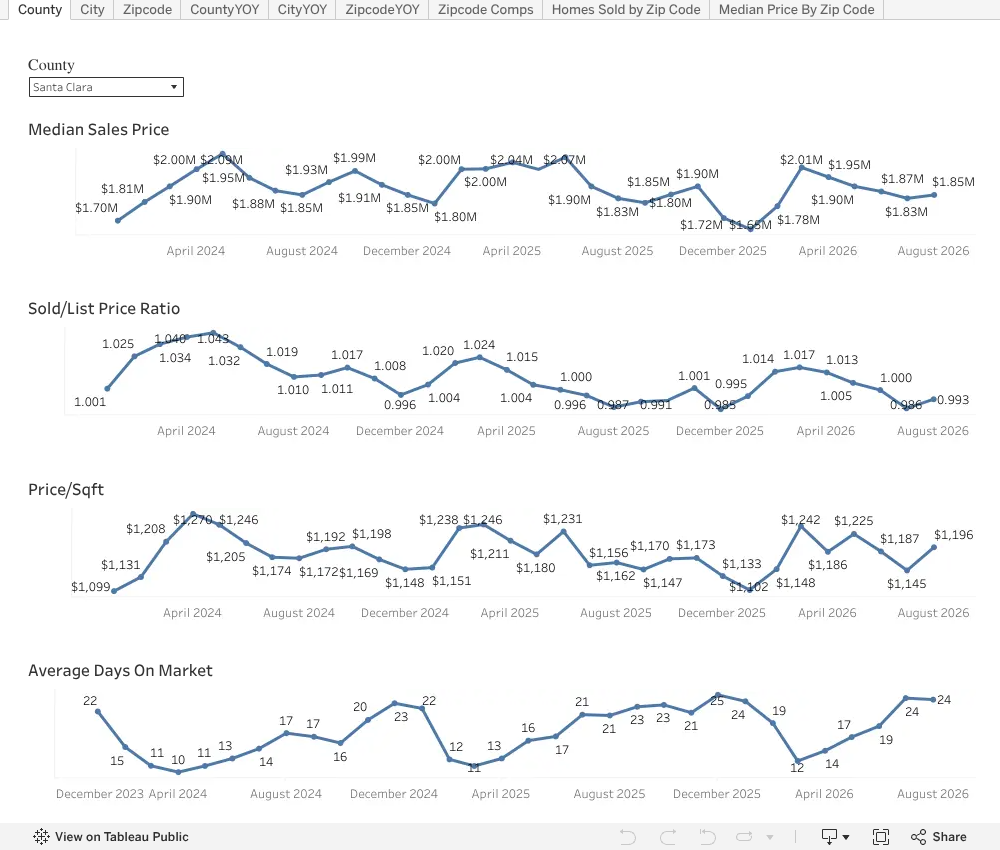
A price trend alone invites a quick verdict. Put it beside time on market and the relationship between asking and selling prices, and the verdict becomes a question. Are homes taking longer to sell? Are sellers getting what they ask? The value of the dashboard is that an agent can examine those questions together.
The company describes its commercial model as subscription software. For brokerages, it also offers white-label platforms with control over agent-facing websites and lead distribution. That changes the buyer: an individual agent needs a usable site; a brokerage needs a system it can put its name on and organize around its agents.
02The plumbing earns its place
IDXExchange says it integrates with Trestle and Bridge, platforms used to distribute and license real estate data. Its MLS Partners page includes California Regional MLS and Intermountain MLS among many organizations. Behind the tidy search box sits a less glamorous requirement: getting the right listing information into the right product.
For a brokerage considering the service, the useful question is specific. Does it support our MLS, our required data, and our intended use? A national-looking partner list cannot settle the details of a local deployment. A property tool becomes useful only when its coverage matches the market where someone is trying to work.
One kind of data. Three different jobs.
Alternatives include IDX Broker and Showcase IDX, which also sell IDX search and lead-engagement functionality. IDXExchange’s proposition combines websites with valuation and analytics, then adds education elsewhere in the business. Buyers can compare that bundle against their actual needs. A longer feature list matters less than whether the next client conversation becomes easier.
03The classroom attached to the company
The education operation makes this company unusual. Its Summer 2024 directory identifies Alyssa Hu as a data-science team lead. A company profile describes her team developing and improving house-price prediction models. The work links a familiar business question, what a home might sell for, to the less visible task of building the machinery behind an estimate.

By Fall 2026, the public directory lists 266 interns across six disciplines, including NLP and AWS cloud engineering. Treat that as a cohort listing, rather than an employee count. The separate internship page advertises seven twelve-week tracks, each organized around building and presenting a practical deliverable.
“Work with real MLS data. Walk away with something real.”
IDXExchange / training program
Paid training provides another route in. Nine tracks cover subjects from business intelligence to software and AI. The pricing needs a careful read: the training page lists individual program fees from $49 to $220, while registration advertises $49 for one module, $75 for three, and $129 for all nine. Those published terms differ; prospective students should confirm the applicable offer.
The teaching premise is easy to borrow: begin with a real business question and finish with an inspectable result. A student can show a dashboard or working application and explain the decisions inside it. That gives the work an audience beyond the person who assigned it.
04Let the seller make the offer
NameYourCommission extends the company’s interests into matching homeowners with agents. The homeowner proposes the listing-agent commission terms; the service seeks an agent willing to accept them. Its website identifies IDXExchange as its parent company and describes continuing access to professional services such as pricing, marketing, and showings.
The mechanism gives the homeowner a starting position in the discussion. Its usefulness still depends on finding an agent whose services and economics fit those terms. Naming a preferred rate is the opening move. Agreement, and the work of selling the property, must follow.
05Start with the question
There is a practical lesson running through these offerings. Decide who needs the information and what they need to do next. A buyer needs relevant homes. An agent needs local context. A learner needs a problem worth finishing. The same database can support each, provided the product respects the difference.
That also sets the conditions. Analytics need appropriate, current data; predictions need testing against outcomes; a branded website needs people who will use it. IDXExchange’s interesting bet is that listing information can keep earning its place after the search results appear. The record is the beginning of the work.