Ten minutes is a small unit of time to put at the centre of a business. Long enough for a cup of tea. Short enough for a passenger to start watching the road. In 2015, Dewan Shuvo wanted it to become the interval between asking for a car and seeing one arrive. First in Dhaka, then across Bangladesh. It was an ambitious appointment to make with traffic.
Shuvo was leading Chalo, a young car-booking venture with a name that invited movement. His explanation began with the familiar irritations of arranging transport: the search for an available vehicle, the bargaining over a fare, the uncertainty about the driver. An app offered a way to organize those loose ends. The difficult part would happen after someone pressed the button.
By then, he had already built a business around another sort of distance. At Proactive Media, customers in California could work with image-production teams in Bangladesh. Later, his working life would turn toward construction. Put those chapters together and a question keeps returning: how do you get people, information and work to arrive where they are needed?
Seven years between a meeting and a company
The Proactive Media story has a long introduction. In Bangladesh in 2005, printing professor R. K. Molla introduced Shuvo to Charles Cunningham, the chief executive of San Francisco printing and graphics business Prepress, Inc. Molla’s field was colour reproduction; his book was Electronic Color Separation. The connection belonged to the working world of images before it belonged to a company history.
Shuvo had held management positions in image-editing and graphics businesses in Bangladesh. In June 2012, he moved to San Francisco to form Proactive Media. The following month came a partnership agreement with Cunningham. Seven years after the introduction, the two men had a practical reason to work together.
The company paired customer service in California with production in Bangladesh. That arrangement gave Shuvo a position close to the people buying the work while retaining a production base overseas. His earlier experience now had a different setting: a conversation about an image could begin on one continent and become a finished file on another.
A printing connection is an appropriate beginning for that kind of enterprise. A picture has to survive the journey from what somebody wants to what somebody else produces. Somewhere along the way, a person has to understand the brief. The business was built around that handoff.

The city behind the app
The next venture took the problem of coordination into the street. Chalo launched in May 2015. Shuvo returned from San Francisco with his family, bringing his attention back to the journey between one place and another in Bangladesh. A photograph could travel through a connection. A passenger needed a car, a driver and a road.
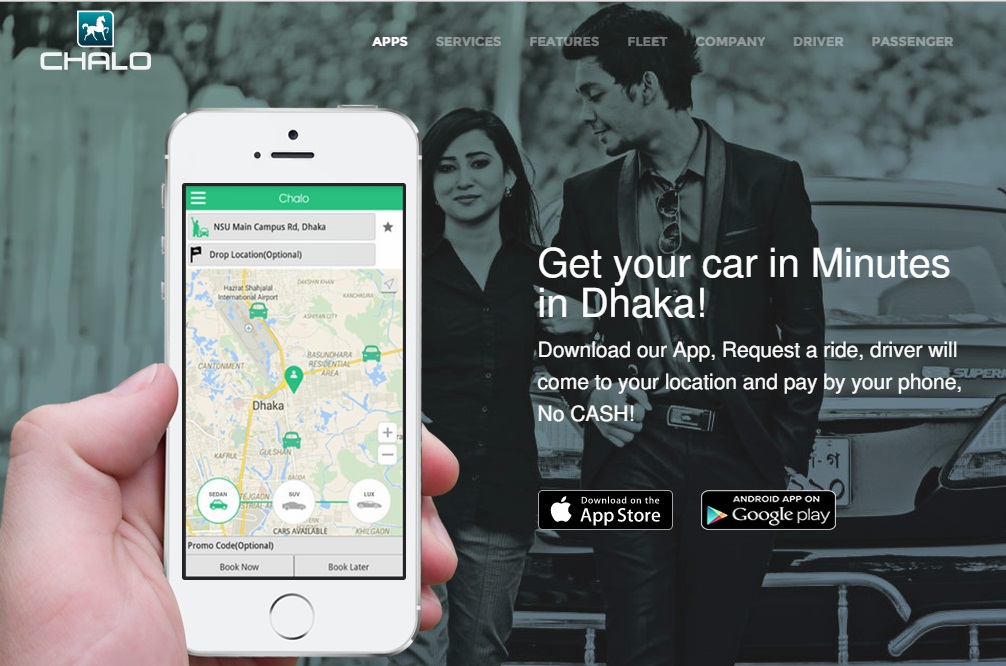
Chalo’s proposition included locating vehicles on a map, paying electronically and leaving feedback about a trip. Those features brought several parts of the journey into one place. In 2016, Shuvo also talked about a proposed motorcycle offering called Chalo Bondhu. A sedan and a motorcycle answer different questions when the city is busy.
The ten-minute ambition was particularly memorable because it could be tested by anybody wearing a watch. In his early explanation, nearby cars would respond to requests, with vehicles distributed around the city. This was the plan behind the promise. A pickup target belongs to the passenger’s experience; arranging enough available cars belongs to the operator’s working day.
He also described verification of customers and drivers, vehicle tracking and local payment options. These were details about making a service usable in its intended setting. Shuvo’s answer to a question about his most satisfying moment was revealingly modest: he valued people’s appreciation of the initiative and their patience while waiting for the full app. At that stage, waiting was part of the company’s own story too.
Shuvo’s stated pickup target, first for Dhaka and eventually nationwide. An ambition, rather than a measured delivery record.
When the app needed a text message
By late 2016, Chalo was trying to occupy more of the customer’s day. Its additions included air tickets, parcel delivery, microbuses and booking by SMS. The last item is easy to overlook beside the larger plans. It is also one of the most telling: a customer without an internet connection could still try to arrange a journey.
An app business had found a use for an older communications tool. There is a certain good sense in that. The customer’s requirement remains transport, whether the request arrives through a polished interface or a text message. Making another entrance can matter as much as decorating the front door.
The services had different practical purposes. Microbuses were offered for family outings that needed a larger vehicle. Chalo Packet advertised document and parcel delivery within two hours in Dhaka. Air-ticket booking extended the business beyond travel on local roads. These were announced offerings, with their own promises attached.
Shuvo described the broader aspiration as becoming part of everyday life, with people opening the app twice a day. That is a different goal from being remembered when someone occasionally needs a rental car. It asks a company to earn a place in a routine. The customer has to find enough reasons to return.
The financing also crossed borders. Chalo received seed backing from Silicon Valley’s Desh Ventures; a subsequent investment from undisclosed Japanese investors was reported in November 2016. The sequence puts money alongside product expansion in this chapter. Adding services meant more than finding new words for a menu.
A bigger map, a more expensive promise
In December 2016, Shuvo signed an agreement with Bangladesh Computer Council on Chalo’s behalf. The cooperation aimed to bring technology-based transport solutions to 64 districts by 2020. It was a national ambition expressed through an institutional partnership. The proposed map was considerably larger than the first pickup zone.
The agreement is best understood as a commitment to work toward that coverage. A signature records an intention and a relationship; reaching each district requires the service to function there. The difference matters in a career where so many early statements were about what might happen next.
He was also taking part in the country’s startup conversation. At the Digital Start-ups Conference in 2016, Shuvo appeared among founders discussing their experiences. It placed Chalo within a wider group of local companies trying to build businesses around changing habits. Transport was one demanding example among several.
The programme’s other participants included bKash chief executive Kamal Kadir and bdjobs.com chief executive Fahim Mashrur. Discussion extended to investment and the policy changes startups needed. Chalo’s presence in that company is a reminder of how young businesses share a setting even when their products differ. A transport operator’s problems could sit beside questions about payments, employment and the willingness of established businesses to support smaller ones.
His attitude toward a much larger entrant was open. In October 2016, he said, “We welcome Uber to the space.” His reasoning was that competition could help more people understand the service. He also recognized the difference in financial resources, arguing that Chalo brought local experience. Welcoming attention to a market and financing a position inside it are separate jobs.
“We welcome Uber to the space.”
Dewan Shuvo · October 2016
Further proposals followed. In February 2018, Shuvo announced a blockchain initiative for Chalo, with Aphaea Capital expected to provide technical support. The proposal concerned data protection and reducing costs. It belongs to the period’s plans for the service, alongside the effort to make transport work better for passengers and drivers.
The later account was blunter. In January 2022, speaking as Chalo’s former chief executive, Shuvo said the company had shut down because ride-hailing required too much investment. He also argued that local operators struggled to compete without sufficient investment and government support. This was his explanation of the outcome.
It gives the earlier confidence a harder edge. The ten-minute target, the additional services and the bigger geographic plans all required an operating business underneath them. A service can be easy to describe and expensive to keep available. Chalo’s ending belongs beside its beginnings if the story is to be about Shuvo’s working life rather than a collection of launch announcements.
- 2012Proactive MediaCalifornia customer service, Bangladesh production
- 2015Chalo launchesApp-based car booking in Dhaka
- 2018Construction focusSIMEX turns toward the family business
The road back to the family business
Construction brought Shuvo back to an older enterprise. He had founded SIMEX Bangladesh in 2005, initially pursuing import-export work. His younger brother, Dewan Jamil, joined him in 2012. Their work included jute, nautical antiques and business-process outsourcing before the transport venture.
SIMEX dates its turn toward their father’s construction business to 2018. Today, its management page identifies Shuvo as CEO and Jamil as COO. The company works in areas including marine infrastructure, foundations and steel structures. The family connection gives this change of industry a history of its own.
It would be tidy to make every move look inevitable. The dates suggest something more interesting: a working life with several attempts at organizing a service, different partners and very different materials. In one chapter the deliverable was an image file. In another it was a ride. Now the work includes structures that stay where they are built.
The ten-minute promise remains a useful place to begin because it makes the scale of that challenge visible. A customer experiences an arrival. Behind it sit the relationships, resources and decisions that make an arrival possible. Shuvo’s career has repeatedly taken him into that less visible part of the job, long after the invitation to get moving has been issued.