Asikul Alam Khan’s elder sister still gives him 500 taka when he visits. He has described the ritual himself: his nephew wonders why she bothers, now that his uncle earns enough. She smiles. A founder can acquire investors, build a distribution network and speak at international gatherings. An elder sister remains impressively unmoved by the pitch deck.
It is a useful way into Khan’s story, because money here carries two meanings. There is the amount, which can be counted, and the relationship, which cannot. His working life has increasingly revolved around small shopkeepers whose businesses depend on both. The person behind a counter knows the neighbourhood. Keeping that counter supplied is another matter.
Khan is the founder and CEO of PriyoShop, the Bangladesh business that moved from consumer e-commerce into supplying small retailers. His career offers an unusually concrete example of a founder being corrected by his customers. He had an idea about what the neighbourhood shop could become. The shopkeepers had a more immediate request.
A shopping idea, stuck in traffic
His first business experiment arrived in 2006, while he was a student at Jagannath University. With friends, he started Student-wish.com, an education website. Web entrepreneurship came before the retail company, and before the language of fundraising entered his account of building a business.
Splendor IT followed in 2010. The firm took on website and software work for clients in Bangladesh and overseas. Building e-commerce sites for other people helped make a local possibility tangible: Dhaka residents spent time fighting traffic simply to buy things. A shopping website offered a way around that particular urban tax.
The idea needed preparation. Khan and his team worked on their skills and resources before formally launching PriyoShop at an e-commerce fair on 7 February 2013. There is something pleasingly literal about the sequence. First learn to build the shop; then open its doors.
His educational route was through business administration. Programming had interested him during college, and the combination carried into his work: commercial questions pursued with technical tools. His later MBA in marketing at Jagannath University belongs to the same mix of customer behaviour and practical construction.
The initial financing was close to home. He saved money from tutoring and borrowed from his sisters. Years before professional investors appeared, the people underwriting his ambition already knew him well. That later story about a 500-taka gift has a longer family history behind it.
“Understanding your customer is the key.”
Asikul Alam Khan, 2016
In 2016, Khan described a company that had grown from three people in a 600-square-foot office to a team of 30. He emphasised control over fulfilment and the convenience of combining a customer’s purchases into one delivery. The interesting detail is his attention to the unglamorous end of a transaction: whether the order actually arrives in a useful form.
The customers rewrote the assignment
PriyoShop’s route to the corner store was gradual. In 2018, the business shifted toward rural e-commerce, working with small shops as a way to reach customers offline. Shopkeepers received digital catalogues that let them offer products beyond the stock physically sitting in their premises.
Then came the request that changed Khan’s direction. Retailers wanted help obtaining their own inventory. The catalogue might let them sell something new; replenishment would help them carry on selling the things their customers already came for. PriyoShop began planning its change in late 2020 and pivoted to B2B in July 2021.
The team visited shops, wholesalers and distribution houses. Khan’s earlier work had put him in contact with brands as well as retailers; the new model brought those relationships together. An education in the market was already under way, conducted on both sides of the supply chain.
That change deserves a moment. Founders are often encouraged to hold a vision steady. Khan’s experience shows the value of allowing the assignment to move. The shopkeeper was close enough to the customer to understand demand, yet still needed help buying stock. The opportunity was sitting on the other side of the counter.
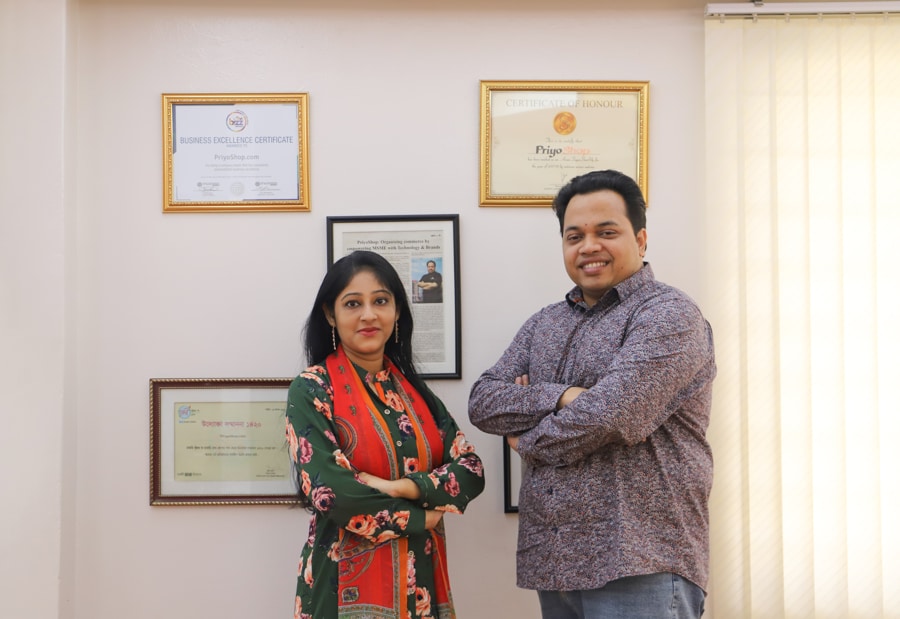
Co-founder and chief marketing officer Dipty Mandal is part of that story. Her background includes Grameenphone, with experience in customers and people leadership. A business serving small retailers has to persuade people to change a familiar routine. Understanding that routine is part of the work, alongside the software and delivery schedules.
suppliers
fulfilment
retailers
Keep the shopkeeper at the counter. Bring the stock to the shop.
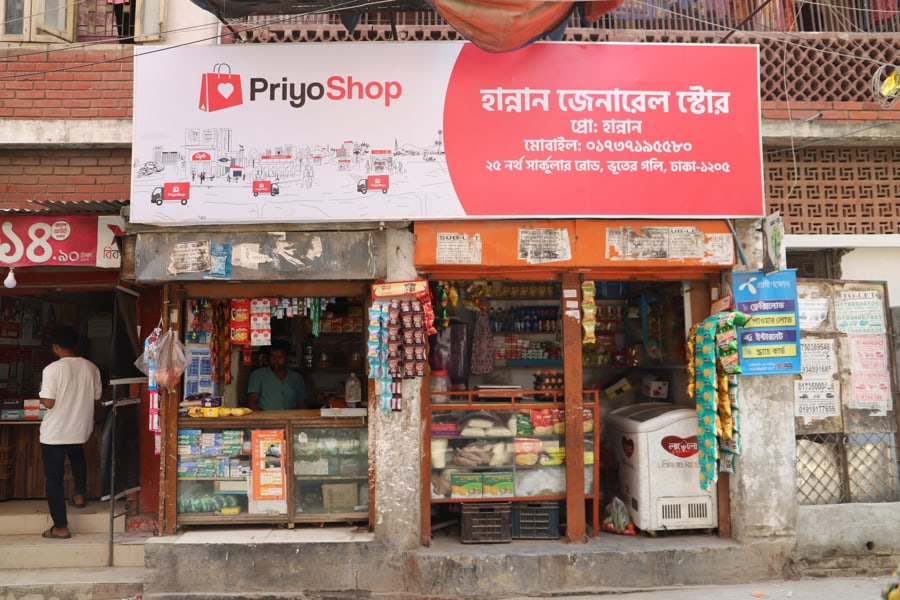
Five million dollars, and a daily delivery test
In February 2024, PriyoShop announced a $5 million pre-Series A round led by Century Oak Ventures. Other participants included Iterative, Orbit Startups, GFR Fund and Accelerating Asia. Khan said the money would support technology, geographical expansion and financing services.
At that point, he put the platform at roughly 55,000 merchants. Its proposition included next-day delivery and access to goods through an asset-light marketplace. For a retailer, the useful question is wonderfully resistant to financial theatre: can I get the stock I need, at a price that lets me sell it?
LankaBangla became part of the financing effort. Working capital matters because a shop can have customers and still lack enough money to buy inventory. Bringing finance closer to procurement gives Khan another part of the retailer’s daily problem to work on. A financing announcement eventually has to prove itself in a purchase.
The numbers became larger. In February 2026, PriyoShop reported operations in 16 districts, with 40 hubs and 1,428 routes. It also said its work with banks had helped 10,000 small businesses access credit cards. These are company-reported figures, tied to that point in the business’s development.
PriyoShop’s reported network · February 2026
A route is a useful unit in which to think about Khan’s progress. It has addresses, timing and people waiting at the other end. It makes the scale of a digital business physical. Thousands of orders still have to travel along actual streets.
A wider circle around the counter
Khan’s public work extends beyond running PriyoShop. A 2018 BASIS event publication listed him as co-chairman of its Digital Commerce Standing Committee. The role placed him in Bangladesh’s wider technology and commerce community while his own company was still changing shape.
He has also spent time with students. At the University of Liberal Arts Bangladesh’s Digital Marketing Club, he participated in live sessions and helped judge its national marketing competition. Sharing a career while it is still being made has a particular usefulness: the lessons have not yet been polished into inevitabilities.
His conversations increasingly include finance. At the 2025 Digital Financial Inclusion Conference, he moderated a session on alternative data and scoring models for access to credit. The topic follows directly from his work with retailers. A small business leaves evidence in orders and transactions; making that evidence useful to lenders is a further task.
There is a media venture too. Khan co-founded ChutneyAds, appearing alongside co-founders Dhawal Shah and Razy Shah in an April 2025 discussion about digital out-of-home advertising and small businesses. The neighbourhood shop could carry messages as well as merchandise. It is another commercial possibility attached to a place he already knows.
His longer interviews have become a record of these changing interests. A 2023 founder conversation explored margins, retention and the economics of distribution. In January 2025, he appeared on The Generalists to discuss the path through education technology, IT services and PriyoShop. The career has accumulated chapters rather than arriving fully labelled.
From Bangladesh’s shops to a larger argument
By March 2026, Khan was describing PriyoShop as a network combining commerce, credit and data. A company account published that month put its active retailer base at 182,017. He also described work on a wallet and payment infrastructure called SimplePay. These were ambitions and reported operating measures with dates attached, rather than a finished destination.
That year brought an international stage. At the United Nations Science, Technology and Innovation Forum in New York, Khan represented Bangladesh and discussed the infrastructure problems facing small retailers. The company’s June account reported more than 200,000 retailers and more than 42 hubs.
The underlying aspiration had widened: build a model with relevance to other emerging markets. Bangladesh remained the operating setting, while the question travelled. How can a retailer with limited working capital obtain the tools and dependable supply that a larger business takes for granted?
“No retailer should be left behind due to limitations in supply, access or infrastructure.”
Asikul Alam Khan, 2026
In his public writing, Khan has linked each additional retailer, brand, delivery and transaction to the usefulness of the wider network. It is a description of compounding relationships. The next challenge follows from the first one: those connections have to remain useful to the person placing the order.
His career began with websites and an idea about saving shoppers time. Shopkeepers drew him toward the less visible work behind the purchase. The through-line is a willingness to let a familiar problem become more specific. Somewhere between the catalogue and the wholesale market, Khan found a different business to build.
And when he visits his sister, the familiar ritual continues. The founder may talk about commerce, financing and networks. She can still hand her little brother 500 taka. Some relationships have their own accounting system.