Consider a factory that has accumulated years of maintenance notes. The records exist. The machinery exists. The engineer who knows which instruction applies to which machine may be somewhere else. An AI system can read the notes and still miss the relationships that make them useful. This is the territory Deepexi Technology has chosen: the awkward distance between knowing something about a business and knowing enough to work inside it.
- The bet: teach AI the company’s own objects, rules and working knowledge.
- The machinery: data infrastructure, enterprise models and a platform for agents.
- The next test: DeepWorks now offers open registration and token-based usage charging.
The company dictionary
Founded in Beijing in 2018 by Zhao Jiehui and Yang Lei, Deepexi came to enterprise AI through data software. FastData arrived in 2019. FastAGI, its enterprise AI solution, was commercialized in late 2023. That sequence matters. Before the company sold software that could act on business knowledge, it sold software for getting business data into usable shape.
FastData still handles collection, integration, development, governance and analysis. Its current product design exposes data capabilities through tools that engineers and agents can call. A request expressed in ordinary language can become a sequence of data operations. The existing platform remains useful; the way people reach its capabilities changes.
The newer system, DeepexiOS, brings together an enterprise model, the DeepWorks agent platform and Deepology knowledge and skills. Its organizing idea is an ontology: a description of the things a business cares about and how they relate. A machine, a maintenance interval, a part and an approval are connected objects. Those connections help turn an ambiguous request into a bounded task.

In the enterprise model’s product description, this knowledge is meant to keep changing as the business changes. Documents, operating procedures and employee experience become organizational memory. Planning must account for business rules; orchestration must identify the systems, people and approvals involved. The useful distinction is between retrieving a relevant passage and understanding what that passage allows someone to do. The latter demands an explicit account of responsibility. A maintenance recommendation can be sensible while still requiring a supervisor’s approval before anyone touches a machine.
A job for the software
DeepWorks is the working surface. It connects a desktop environment with cloud capabilities, company knowledge, files and tools. Administrators can configure permissions, workflows and review. The intended output is work that crosses systems: an analysis, a document, a diagnosis or a completed sequence of approved actions.
The specialist agents give that ambition a shape. DeepSense addresses industrial work, including equipment maintenance, quality and process optimization. Its product description emphasizes industrial knowledge, persistent task state and logs of interactions with production systems. DataSense addresses operating decisions, with skills for store operations, merchandise planning and goods management. A retailer and a factory need different vocabularies, even when both ask for “better performance.”
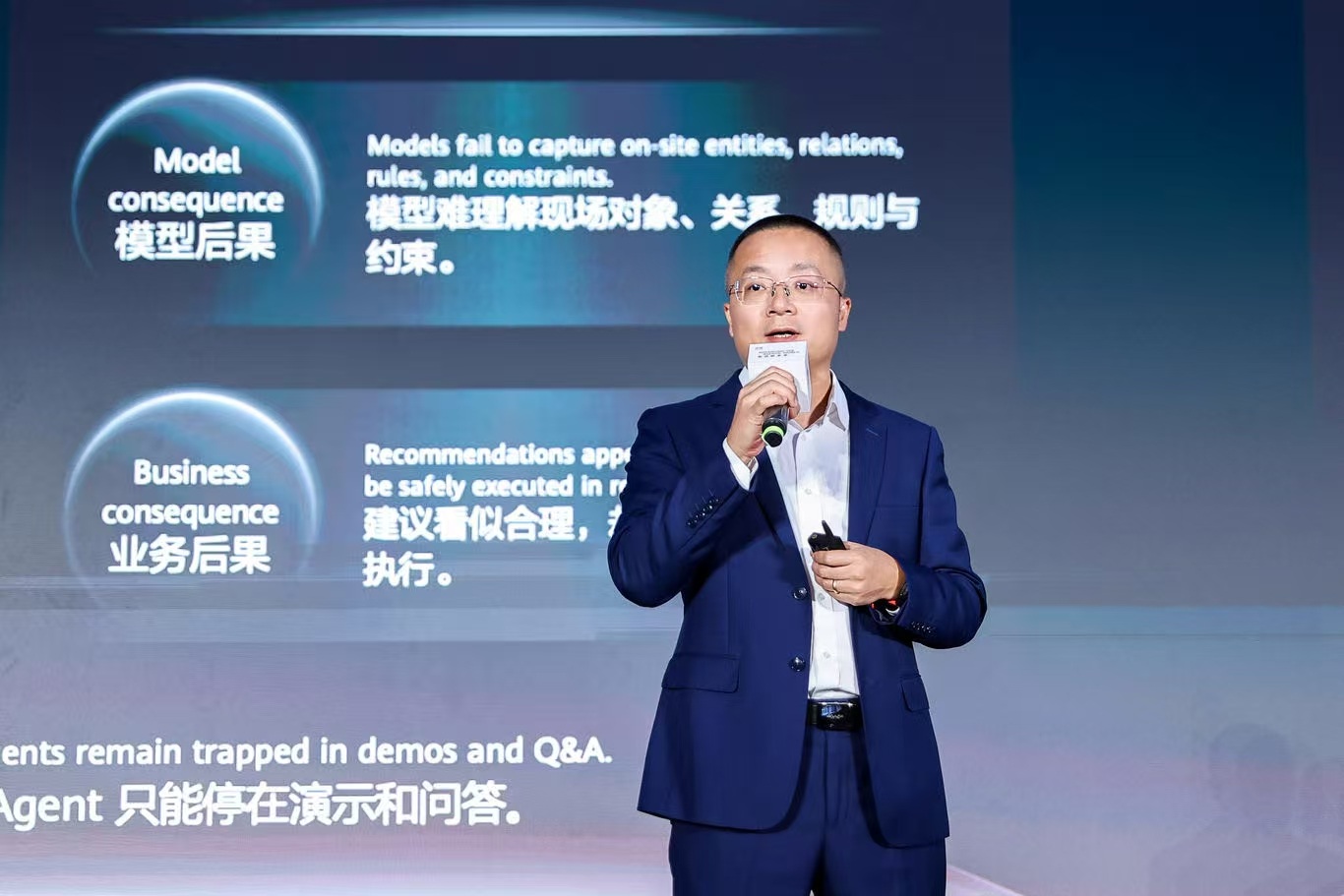
The customer relationships extend beyond a generic office assistant. Deepexi and Belle Fashion co-launched a Data+AI product in 2022. In September 2026, Deepexi announced work with Beijing Hangxing Transmission on an enterprise AI foundation, and medical-AI collaboration with Xiamen University researchers. Its relationship with Huawei Cloud places it inside a larger infrastructure ecosystem.
The photograph of Yang captures the problem in unusually plain language. His slide says, “Models fail to capture on-site entities, relations, rules, and constraints.” It is a compact explanation of why a convincing demonstration can stall at a customer’s door. The company’s engineering background is visible elsewhere: its public GitHub includes application scaffolds for Egg.js, Spring Cloud and Dubbo. These are practical building blocks for software teams, a reminder that connecting AI to a business remains partly an ordinary software integration job.
That positioning also defines the alternatives. A buyer can assemble cloud data services, models and agent frameworks itself, or buy a more integrated enterprise platform. Deepexi’s pitch is the connection between those layers, with business knowledge carried into execution. The distinction is architectural; it does not establish that every customer will get a better result.
The first cracks are in the handoffs
Deepexi’s engineering writing is more revealing than the phrase “AI employee.” One post describes four breakpoints: task state scattered through chat, execution in the wrong environment, permissions enforced only by prompts, and missing histories of what happened. These are published design problems, not an account of a named customer’s outage.
An AI employee still needs a job description, a set of keys and a record of what it did.THE PRACTICAL QUESTION
The proposed response is concrete: preserve task state, declare the runtime’s capabilities, structure the task’s materials and acceptance criteria, check actions against system rules, and record an event timeline. This gives buyers a useful evaluation method. Ask what happens after a restart, when permission is refused, or when someone needs to reconstruct a decision.
From project fees to the token meter
The commercial transition is visible in the numbers. FastAGI supplied 37.2% of revenue in 2024 and 61.3% in 2025. Total 2025 revenue reached RMB415 million. Yet the effort required real spending: RMB107.7 million in research and development, alongside RMB198.9 million of operating cash outflow. Those are company-wide figures, not a customer’s implementation bill.
FastAGI share of annual revenue. The data business remained part of the foundation.
Deepexi listed in Hong Kong in October 2025, raising HK$710.01 million gross. A year later, its October 20 announcement described another route to customers. DeepWorks had opened self-registration on October 15, offering new users a free allowance and charging for continued cloud use according to token consumption. Enterprise deployment and integration remained separately contracted.
That creates two buying experiences. An individual can try the software. An enterprise must connect its systems, establish permissions and prepare its knowledge. A free allowance makes discovery easier; it does not remove the organizational work required to put an agent into production.
A useful place to start
The copyable lesson is modest. Choose one task with a recognizable finish. Name the business objects it touches. Connect the tools already used to do it. Decide which actions require approval. Then inspect whether the result is correct, recoverable and worth its cost. This is an inference from Deepexi’s architecture and engineering notes, rather than a promise of customer savings.
The fit weakens when company data is inaccessible, authority is unclear or integration costs exceed the value of the work. A team seeking occasional writing help may need far less machinery. Deepexi’s more interesting proposition begins where a company’s particular rules matter. The question for a buyer is whether the software can carry those rules all the way to a finished task.