The awkward part of starting a technology company is deciding how many companies you are actually starting. Ashish Baghel chose to grow a consulting business and build a data platform alongside it. He has described launching NuoData while scaling NucleusTeq as one of his toughest decisions. People in the industry advised against attempting both. His answer was to proceed: clients needed help doing the work, and software that could make the next piece of work easier.
There is a small rebellion in that choice. Consulting rewards attention to a particular customer. Product development asks which parts of that customer's problem might recur elsewhere. One business gets paid to understand the exceptions; the other has to find the pattern. Baghel put the two under the same entrepreneurial roof. The tension is central to his story.
Today, as founder and CEO of NucleusTeq and NuoData, he is making a related argument about artificial intelligence. Companies have already accumulated systems, data, contracts and habits. He wants to make that existing estate useful for AI. Starting over can be a very expensive way to announce that one has started.
A mechanics degree, then the machinery of business
Before the platforms and partnership discussions, there was applied mechanics. Baghel studied for an M.Tech at the Indian Institute of Technology Delhi in 1998-1999. His public professional profile records the President of India Gold Medal for his performance in 1999. It is an arresting detail in the biography of someone now concerned with how information moves through companies: his formal postgraduate training dealt with a different kind of machinery.
His subsequent career included TCS, Cognizant and Impetus. At Impetus, he served as vice president and global head of banking and financial services. Those names place the entrepreneurial chapter after a substantial apprenticeship in enterprise technology. His work involved large organizations and the practical obligations of delivering technology across borders.
The banking remit is particularly relevant to the business he later built. A financial institution cannot treat the meaning of a number, or the identity of the person permitted to see it, as an afterthought. A useful system has to survive questions about ownership and access. A pleasant demonstration is only the opening conversation.
Baghel's official biography describes more than 25 years in the industry, including work with Fortune 100 clients. Its inventory spans enterprise architecture, data, cloud, consulting, sales and responsibility for business performance. This is the background of a founder accustomed to both the technical diagram and the meeting in which someone asks what the diagram will cost.
The second business inside the first
NucleusTeq's operating story begins in 2019. Baghel's ambition was to combine a product organization's ability to develop reusable technology with a services firm's ability to deliver for individual clients. NuoData became the product expression of that idea. The consulting business would work on enterprise transformation; the platform would bring related data tasks into a shared environment.
That arrangement creates an interesting test for a founder. A customer can request something immediately useful to one project. A product team has to decide whether it belongs in the platform. Put everything in and the software becomes a cupboard whose contents nobody remembers. Refuse every exception and the customer wonders why the consultants are in the room.
Baghel's decision to pursue both businesses makes that negotiation part of the job. The ambition is understandable: learn from implementation, then reduce how much implementation must be repeated. The hard work is maintaining enough discipline that the service and the software keep improving each other.
The question beneath the chatbot
In his conversation billed as The Road to an AI-Ready Enterprise, Baghel directs attention to fragmented information, disconnected systems and gaps in governance. These are the obstacles that become conspicuous when an AI demonstration is expected to handle actual business. His interest lies in the distance between an impressive answer and an answer an organization can safely use.
Consider an ordinary business question about a customer. The information needed to answer it may sit in several places, with different access rules and different definitions. Giving an AI system a conversational interface leaves those differences to be resolved somewhere. The sentence on the screen is the visible end of a much longer chain.
NucleusTeq's current services cover that chain: strategy, data engineering, governance, modernization, analytics and enterprise AI. The range helps explain why Baghel keeps returning to foundations. When the assignment includes the underlying systems, enthusiasm about the interface has to coexist with responsibility for what feeds it.
There is an unfashionable patience in the proposition. The user may want an answer immediately. The company must also know whether the answer uses the right information. Both expectations are reasonable. A founder selling enterprise AI has to build a business capable of respecting them at the same time.
Let the data stay put
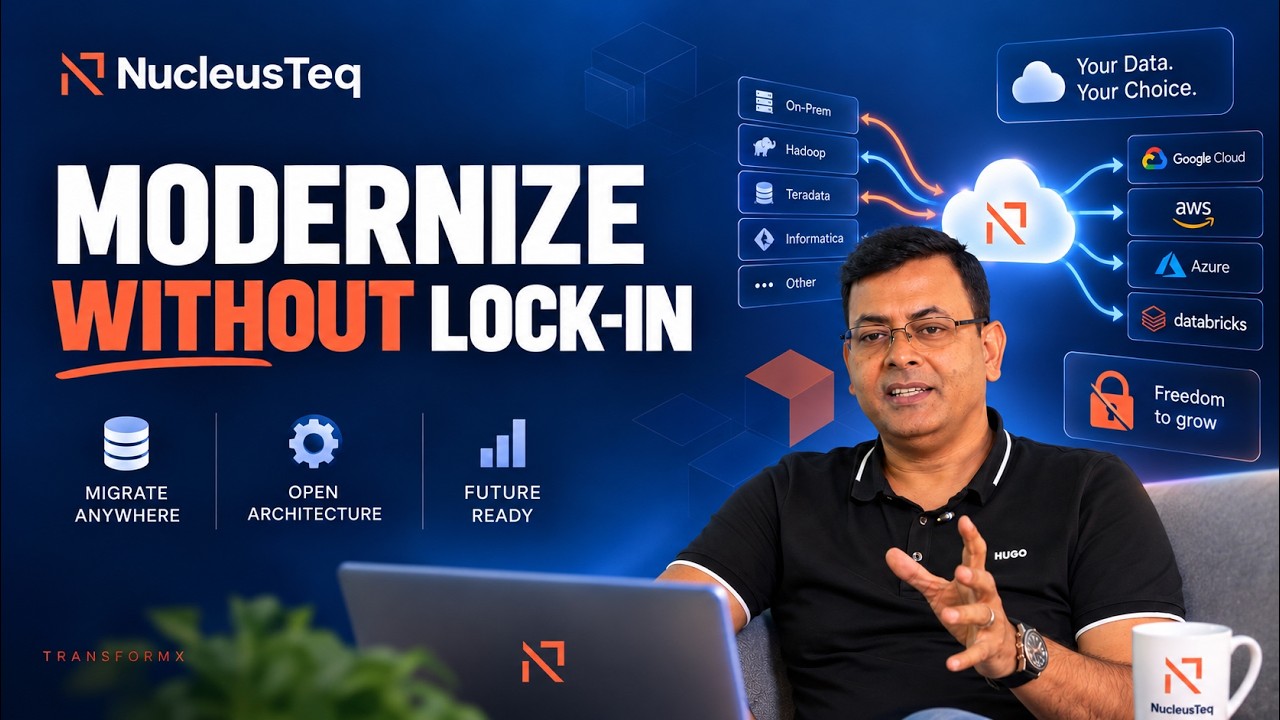
NuoData presents itself as a unified, open data and AI platform. Its current proposition includes working across existing data environments, with governance, engineering, analytics and AI capabilities brought together. Baghel's public writing repeatedly returns to the customer's freedom to choose storage and computing tools. The emphasis is on making existing investments usable.
This gives his product strategy a recognizable shape. A company has accumulated technology for reasons that made sense at different moments. Asking it to move everything before doing anything new adds another dependency to an already complicated undertaking. Baghel is selling a way to begin while that history is still present.
Conceptual illustration of the platform thesis.
The word open carries much of the argument. In this context, it concerns choices about where information sits and which engines work on it. For a buyer, those choices have consequences long after a sales presentation. The freedom to change one part of a system can matter as much as the convenience of buying the whole arrangement.
A founder who wants the proof before the applause
In March 2026, Baghel published an essay on moving data engineering beyond vibe coding. He argued for specifying the desired result and having a platform produce an execution plan with validation built into the process. Generating something quickly was only part of the assignment. The outcome also needed checking.
“Speed without validation becomes expensive speed.”
Ashish Baghel, March 2026
The sentence has the economy of someone who expects to be asked about the invoice. His examples included checking changes to data structures, confirming access permissions and testing data quality. He also argued that AI should be activated where it adds measurable value, within governed workflows. A company selling AI can still have reasons to be selective about where it runs.
His October 2025 writing on NuoData Astra took the argument into documents, emails, images and other unstructured material. He described cataloging that content, extracting information about it, applying policies and preserving its history. Enterprise knowledge extends well beyond the tidy rows in a database.
Read together, the essays reveal the problem he keeps choosing: making information usable without losing the ability to explain what happened to it. The machinery should carry a record of its work. That concern connects the consulting experience with the platform ambition more closely than any list of AI features could.
The people have to connect, too
Baghel's public welcome to new engineers spans NucleusTeq, NuoData and Fyndr. The grouping is a reminder that his founder portfolio reaches beyond corporate data infrastructure. Fyndr is a marketplace for local offers, services and events. Its vocabulary belongs to customers deciding where to go and businesses trying to reach them.
Fyndr's company profile dates its founding to 2020 and describes operations in Arizona, California and Nevada. A neighborhood marketplace and an enterprise data platform have very different users. Together, they give Baghel a portfolio that stretches from corporate technology budgets to the search for something nearby to buy or do.
Within NucleusTeq, he has described practices including town halls, leadership meetings and all-hands discussions, alongside an emphasis on ownership and curiosity in hiring. Such habits are less photogenic than a product launch. They are also where an expanding organization works out whether people understand the same priorities.
There is a more domestic change of scale in his account of life outside work: soccer with his son, tennis with his daughter. No platform vocabulary is necessary. The appeal of the detail is its ordinariness. After the multinational delivery discussion, someone still has a ball to return.
What he is trying to make repeatable
Baghel's stated ambition is to grow NuoData's role in enterprise data management and help larger companies put generative AI to practical use. His own writing also places the platform in direct comparison with established competitors. He is willing to argue about architecture, breadth and the customer's room to maneuver.
The enduring question in his story is whether experience from difficult client work can become software that makes the next client's work less difficult. He chose to pursue that question while building both businesses. Years later, it still explains the shape of the bet: useful intelligence, built on what a company already knows, with enough discipline to trust the result.