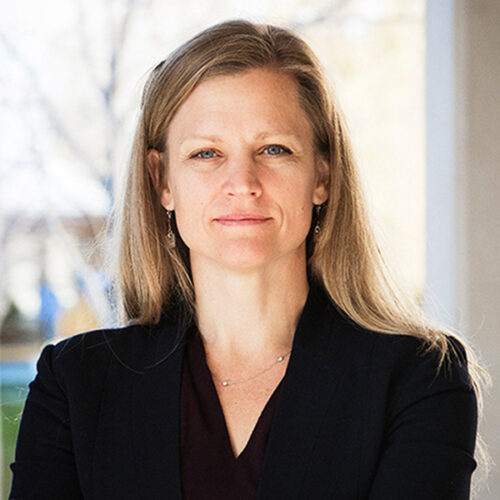
The Story
A robotics company that refuses to pick a lane
Start with what Deborah Theobald is building right now, because it explains everything else. Her company, b Inc., makes telepresence robots. A child stuck in a hospital bed can drive one through a museum. A student who cannot make the field trip can still take the tour. A relative on another continent can wheel down a hallway and sit at the dinner table. The technology is the least interesting part of the sentence. The point is the person on the other end of it.
b Inc. was, until recently, called Vecna Technologies. The rebrand came with a four-word thesis stamped across everything: Better Technology, Better World. Underneath it sits a stubborn conviction that Theobald repeats like a metronome: technology should serve humanity, not overshadow it. That is easy to put on a wall. It is harder to run a company that way for more than two decades. She has done both.
The range is almost comic. This is a company whose product history includes the BEAR robot - short for Battlefield Extraction and Recovery, a machine built to carry a wounded soldier out of harm's way - and also a check-in kiosk that shortens the line at a hospital front desk. QC Bots that haul supplies down clinical corridors. QC PathFinder, a surveillance system that hunts hospital-acquired infections before they spread. Patient self-service software. Telepresence tours of zoos and aquariums. Most founders spend a career narrowing. Theobald spent hers widening, on the theory that the connective tissue is always the same: get the machine out of the way so the human can do the human part.
Technology should serve humanity, not overshadow it.
Deborah Theobald, on the b Inc. philosophy
The engineer who almost went to space
Before any of the robots, there was the Vomit Comet. Theobald earned her SB in Aerospace Engineering at MIT, then did graduate work in space robotics at the University of Maryland's Space Systems Lab. Along the way she strapped in aboard NASA's KC-135 - the reduced-gravity aircraft that flies parabolas until your stomach files a complaint - to study how the human body holds posture when there is no down. It is the kind of resume line that points straight at a career in orbit.
She pointed it at hospitals instead. The training did not go to waste; it just changed altitude. Understanding how a body moves through space turns out to be extremely relevant when you are designing a robot to move safely through a crowded emergency department. The instinct that took her toward NASA - solve the physical problem of a human in a hostile environment - is the same one that now shows up in every product b Inc. ships. The environment simply changed from zero gravity to the American healthcare system, which is arguably more hostile.
She co-founded the company in 1998 alongside her husband, Daniel Theobald. Two engineers, one company, a marriage, and eventually five children. She has been Chairwoman, President, and CEO, providing the strategic vision, executing the tactical work, and - being an engineer to the core - still designing next-generation product solutions rather than delegating that part away.
Too communal
One story explains how she thinks better than any org chart. When Theobald applied to have the company recognized as a women-owned business, she was rejected. The reviewers' complaint was unusual: her language was too communal. She had written "we did this" instead of "I did this." She had, in other words, given her co-founder credit and described a partnership - which was accurate, since she and her husband held distinct responsibilities. The certification process did not want accuracy. It wanted a single owner claiming a single achievement.
So she rewrote it. She revised the language to emphasize personal ownership, reapplied, and was approved. She calls it a formative lesson in self-advocacy - the discovery that describing your work honestly and describing it in a way institutions will reward are sometimes two different tasks, and that a founder has to be fluent in both. It is a small bureaucratic anecdote that doubles as a whole philosophy of how women get counted in tech.
Ask for coffee; ask for a phone call. Put yourself out there and ask for what you want.
Her advice on board leadership
The charity that treats a database as a lifeline
In 2009 Theobald founded VecnaCares, a charitable trust with a deceptively humble mission: design, develop, and deploy technology for low-resource places. In practice that meant putting digital health-record systems - the CliniPAK and related tools - into clinics across Nigeria, Kenya, Liberia, Haiti, and parts of the United States. Places where the electricity is intermittent and the connectivity worse, and where a patient's history is otherwise a stack of paper or nothing at all.
Her framing of the work is characteristically stripped down. "An information system, no matter how technologically advanced," she has said, "is simply a tool to record every encounter a person has with that system." A checkup. A class. A prescription. A bag of supplies handed across a counter. Record the encounter, and you can measure whether the help actually helped. In a humanitarian context, that measurement is not paperwork. It is the difference between a program that works and a program that only believes it does.
It is the same idea as the telepresence robot and the hospital kiosk, wearing different clothes. Strip the technology down to its honest job - recording, connecting, moving a person from A to B - and then get out of the way. Theobald has been named among the Top 100 Women-Led Businesses in Massachusetts, and she serves on boards including VecnaCares, the Mass Technology Leadership Council, and GRIT. But the through-line is not the accolades. It is a refusal to let the machine become the point.
The parts that don't fit on a slide
She is a certified SCUBA diving instructor. She is a mother of five. She built a company with her spouse and kept it independent and mission-driven through more than twenty years of a startup economy that mostly rewards the opposite. b Inc. still offers fully paid medical and dental from an employee's first day and unlimited time off - the kind of policy that reads like marketing until you remember the motto is Better World, and that she seems to mean the employees too.
The neat version of this story would say the aerospace engineer traded the stars for something more grounded. That is not quite it. She did not trade down. She took the exact same question she trained to answer - how do you keep a human safe, capable, and connected inside a system that was not built for them - and pointed it at the places most people had given up on. Waiting rooms. Refugee camps. Hospital corridors at 3 a.m. The robots are just the answer. Theobald has always been more interested in the question.
#robotics#healthcare-it#telepresence#MIT#women-in-tech#social-impact#founder#automation