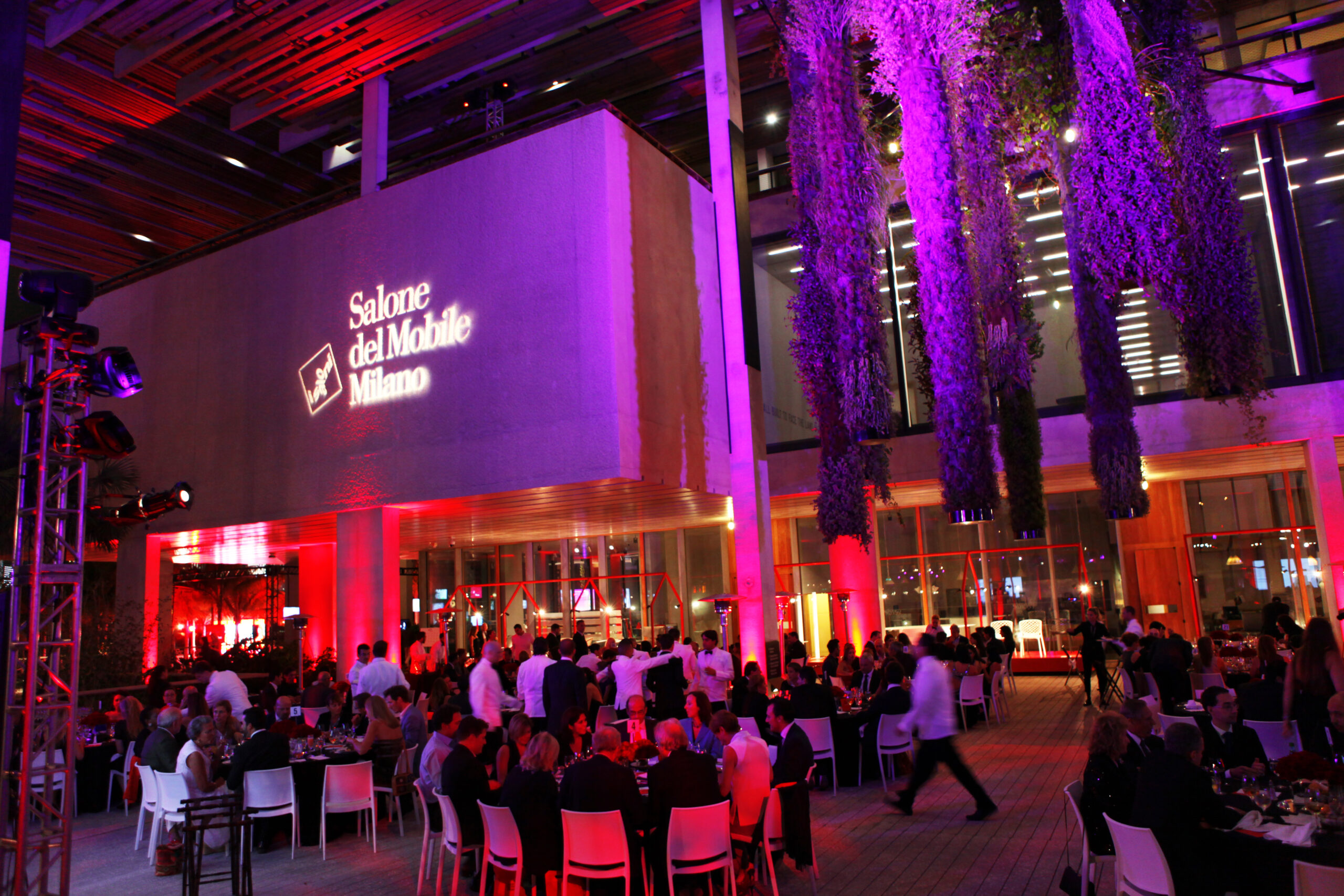
At the Pérez Art Museum Miami, the problem was not where to put the logo. The problem was how to fit Milan inside a building in Florida. Salone del Mobile had asked DDM Branding to make its idea legible in America. DDM's answer involved the entire museum, exhibitions, installations, entertainment, catering and a dinner for 1,000 seated guests. The reported budget was €5 million. By the time the room filled, branding had become indistinguishable from choreography.
That evening makes a good introduction to DDM because it reveals the agency's favorite trick: it keeps walking after most branding firms have stopped. A conventional engagement might end with a position, an identity and a handsome manual. DDM carries the same thought into a pavilion, a gala, a product tag, a press dinner or a building. The deliverable is not merely a look. It is agreement between what a brand says and what a guest encounters.
Two shores, one operating system
Founder Danilo Di Michele is the hinge. Born in Italy and based in Miami since 1997, he built the agency around an exchange that sounds simple and is difficult to execute: take the refinement and industrial memory associated with Made in Italy, then combine it with the speed, reach and appetite for spectacle of the United States. DDM lists Miami, Verona, New York and Paris in its footprint. Its legal entity is registered in Verona; its company profile puts headquarters in Miami Beach.
The dates tell two versions of the origin. Biographical material says Di Michele founded the agency in 1993. The company LinkedIn page lists 2000, and the current website says it began around the turn of the millennium. The useful fact is not the disputed birthday. It is the continuity of the proposition. DDM has spent decades working the same border, carrying Italian design businesses and institutions toward American audiences while bringing American communication habits back across the Atlantic.
The leadership makes that breadth plausible. Di Michele supplies strategy and the network. Giorgio Canale, an architect and creative director, handles the point where graphics become structures. Jerry Chery, the US strategist, brings experience across markets, photography and fashion. It is an unusual triangle for an advertising company. It also explains why DDM can speak about type, public relations and floor plans in the same conversation.
Research before decoration
DDM calls its first service “Deep Diagnostic.” The language is theatrical, but the work underneath is sensible: examine competitors, market threats, cultural context, customer perception and the brand's own history. Only then come purpose, position, identity and campaign. The order matters. It prevents the seductive error of making something visually new before deciding what should remain culturally true.
Vinitaly is the cleanest example. When DDM was asked to rebrand and reposition the wine exhibition's communication, the team studied the event's history and 25 years of visitor perception. The new message, visual system and tagline followed that inquiry. In DDM's account, the teaser that introduced the work began with the traditional heart of Vinitaly and moved toward the new image. Heritage was not a sepia filter. It was the opening scene.
The same method scales down as well as up. Verona Stone District needed a collective identity for a group of natural-stone companies without sanding away each member's individuality. DDM used research and collaborative workshops to define a shared language for online and offline communication. This is a harder branding problem than it first appears. A district brand must be loud enough to help everyone and quiet enough not to replace anyone.
The account that kept getting larger
Marmomac shows what happens when a client changes its mind about what an agency can do. DDM says it began handling the stone fair's online and offline advertising in 2007: catalogs, brochures, maps, billboards, merchandise and image coordination. In 2015, after a competition involving agencies from several countries, DDM won a broader communication assignment. The scope then spread beyond the campaign.
The agency introduced a gala-dinner format, helped create a cultural and experimental Pavilion 1, and devised the Marmomac Awards to recognize exhibitors' stands and communication. In 2023, the previous year's campaign, which used Antonio Canova's Bust of Peace to connect marble, art and technology, won two graphic-design distinctions at the DNA Paris Design Awards. A trade event about quarried material had found an image in a sculpture whose serenity was made from exactly that material. The association feels obvious after someone else has made it.
Long relationships recur in the portfolio. DDM describes nearly a decade working with Tenax, moving from advertising, image coordination and website construction into product tags, sales support and trade-fair stands. For Belgian materials company LCD Textile, it combined social management and press releases with dinners and international placement, bringing the installation The Cake to Miami during Art Basel in 2022 and Palm Springs in 2023. Each new channel became another test of the original idea.
Where DDM fits: between a brand consultancy, a creative agency, an exhibition studio and an event producer. That combination is most useful when a client has heritage to interpret, multiple audiences to align and a physical occasion where the brand must perform.
It is less naturally suited to a company that wants a cheap isolated logo, a single performance-marketing channel or a quick campaign with no internal access. The diagnostic model depends on time, institutional memory and permission to coordinate several parts of the experience.
The useful trick is sequence
Readers do not need a museum or a seven-figure budget to copy the strongest part of DDM's method. Begin by asking what the organization cannot afford to forget. Gather the memories of customers, employees and partners before opening the design software. Reduce the research to one defensible idea. Then test that idea in places the brand cannot fake: a sales conversation, an invitation, a physical space, the first minute of an event.
The cost of the Salone project is public because its scale was part of the story. Most DDM fees are not. That is typical for bespoke agency work, where the budget changes with media, fabrication, venues and production. The more useful economic observation is that DDM's model can consolidate work that clients often split among a strategy consultancy, design studio, PR firm and event producer. The benefit is coherence. The risk is dependence on one lead partner and the management discipline required to keep many specialties moving together.
DDM calls itself a cultural atelier. The phrase could sound precious, except the portfolio keeps dragging it back to earth: stone dust, exhibition maps, dinner tables, product tags, museum walls. The company sells strategy, certainly. It also sells the persistence required to make strategy survive contact with a room full of people. Somewhere between Milan and Miami, that persistence became the brand.