A farmer has produce to sell. A buyer wants to know the price. In March 2017, Davy Uwizera and Joshua Ocero put that exchange inside a Messenger bot. They called it FARMBOT. The setting was a 24-hour hackathon in Kigali, where the assignment was to build something that addressed a local issue. The problem they chose had very little patience for the word disruption. Somebody needed to buy the crop.
The pair finished as runners-up and earned a trip to Facebook’s F8 developer conference in San Jose. Their bot connected farmers or cooperatives with buyers and estimated crop prices by location through its interactions. They also envisaged using the information for food-security warnings and rural transport planning. A conversation about produce could, in principle, become information about a wider economy.
Today, as founder and CEO of Huzalabs, Davy K. Uwizera works across AI, software and technical training. That early bot offers a useful introduction to his career. Again and again, he has worked on the awkward distance between a technical capability and the circumstances in which someone might use it. The journey passes through fields, bus stops, phone cameras and maps.
The assignment before the applause
Before FARMBOT, there was an internship with a less theatrical challenge: delivering work across a dispersed team. In summer 2016, Uwizera, Samuel Nzaramba and Aline Umubyeyi Gasana spent three months with Thomson Reuters’ TR Innovation Lab. They were Master of Science in Information Technology students at Carnegie Mellon University’s Rwanda campus. Their project concerned Bankable Farmer, an agricultural initiative with ambitions beyond Rwanda.
Uwizera led the student group. The work included a data-analytics pilot plan and an agribusiness value-chain platform intended to support decisions with data. Gasana handled client relations and communications; Nzaramba worked on risk-algorithm flow and data accuracy. The division of labour is a small but useful detail. Even a data project contains people, handovers and the possibility of a misunderstanding arriving precisely on schedule.
Uwizera identified project delivery as the central challenge. Leading colleagues and completing the tasks without onsite supervision mattered to him. He already had a background in statistics and economics. Here, the exercise was also managerial: helping a group turn its separate skills into something another organisation could use.
In 2017, he graduated from CMU-Africa with an MS in Information Technology. That year he received the Lakshmi Subramanian CMU-Africa Student Excellence Award, an award recognising leadership, academic performance and contributions to student life. The recognition places his community activity alongside his technical training. Both would continue to feature in his work.
A return ticket to Kigali
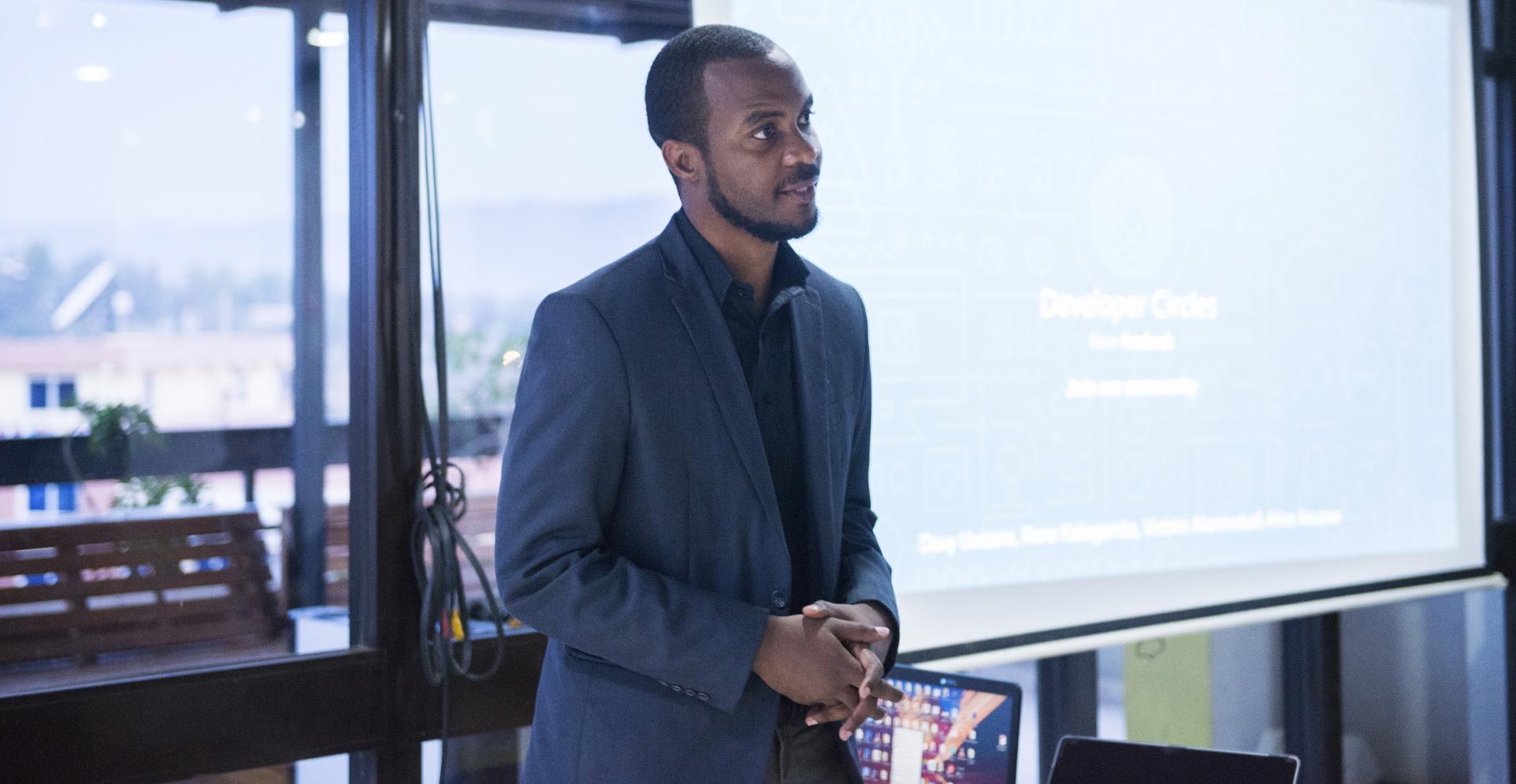
After F8, Uwizera helped create a place for other developers to meet. He formed Rwanda’s first Facebook Developer Circle in August 2017. By October, he had been selected among 20 active African circle leads to travel to Nairobi for training and attend the first TechCrunch Startup Battlefield held in Africa.
The travel was memorable, but his ambitions remained anchored in Kigali. He wanted the city to be recognised for its technical skills and described plans to bring Developer Circles into Rwandan universities, giving undergraduates practical experience and the chance to turn projects into businesses. His account moves readily from attending an international event to organising opportunities closer to home.
“We have a vision of Kigali being recognized as a city where world class tech skills can be found.”
Davy Uwizera, 2017
There is something pleasingly unglamorous about that ambition. A developer community needs meetings, projects and people willing to answer questions. A conference can supply excitement for a few days. A local group has to find a reason to meet again.
The bus has entered the calculation
In March 2018, Uwizera was named among 16 finalists in the Next Einstein Forum’s Challenge of Invention to Innovation competition. His project, S-Transport, proposed an AI system for public transport in African cities. Cameras, sensors and GPS trackers would gather information about buses, passengers onboard and people waiting at stops.
Operators would see the information through a dashboard. Passengers would receive updates through SMS and information panels. The proposal joined several views of the same journey: the person waiting, the vehicle travelling and the operator trying to match supply with demand. It also included fleet management.
A bus timetable can look admirably decisive on paper while leaving a passenger with very little information at the stop. S-Transport’s proposition was to make the moving parts more visible. The finalist selection records the proposal’s recognition at that stage. The idea itself brings Uwizera’s interest in data into contact with a familiar urban experience: waiting for something that is supposed to arrive.
When the camera gets the person wrong
His work at Smile Identity brought the question of usefulness down to the scale of a face on a phone screen. In a July 2020 essay, Uwizera examined bias in facial recognition, following the problem through camera settings, face detection and the data used to train recognition models.
The account is specific about the setting. Digital services need ways to establish who their users are. A recognition system trained or evaluated on an unrepresentative collection of faces can work unevenly for the people asked to use it. An impressive general score may conceal a frustrating experience for a particular customer.
Uwizera described Smile Identity’s use of African facial images, customised preprocessing, transfer learning and human review. He also explained the company’s commitment to consent-based verification and its decision to avoid surveillance applications. His engineering brief included both the performance of the system and the purposes it would serve.
A co-authored technical paper with William Bares and Catalin Voss pursued the issue through smartphone-based, frontal-face authentication. The researchers used 22,330 images and reserved 30% of the dataset for evaluation, separating subjects between training and evaluation. The task was narrower than recognising anybody in any photograph: it concerned people authenticating through a phone.
That specificity matters. The team investigated how training with African face data affected a model in this setting. Choosing the data and the test conditions was part of defining the problem. A benchmark becomes more informative when it resembles the encounter the product will actually have with a customer.
A photograph can also be an impostor
By May 2022, Uwizera was writing about another problem in identity verification: spoofing. A system might match a face while missing the fact that it is looking at a photograph, a screen or a manipulated image. Getting the resemblance right leaves another question open. Is the person actually presenting themselves?
His examples included printed portraits, screenshots, cardboard cut-outs and deepfakes. The catalogue gives the work an unexpectedly physical quality. Computer vision may involve sophisticated mathematics; someone trying to fool it may arrive with cardboard. Engineering has to accommodate both participants in that conversation.
Uwizera described combining learning from known attacks with methods for identifying suspicious new patterns, followed by human review. The recurring task was to keep adapting as attempts changed. In this account, a working AI system requires attention after its first successful demonstration. It has users, adversaries and an operating life.
From a phone screen to the road network
His research with Charles Ruranga and Patrick McSharry expanded the field of view. A December 2022 paper examined deep learning and satellite imagery for classifying economic areas in East Africa, focusing on Rwanda. It considered five categories: high-, middle- and low-income residential areas, commercial buildings and industrial areas.
The purpose was to help assess how cities were developing and provide information relevant to planning. The study reported an F1 score of 99% for its proposed techniques. That figure belongs to the study’s classification task and evaluation. Its practical interest lies in the question beneath it: how can planners obtain useful information about a changing city?
Reported F1 score · December 2022
Reported accuracy · March 2023
Different evaluation measures for separate research tasks. These results describe the studies, rather than every road or neighbourhood.
A March 2023 paper by the same three researchers addressed road conditions and infrastructure priorities. It combined satellite imagery with mobility information from anonymised call-detail records. Images helped assess road conditions; mobility patterns helped consider which connections might deserve attention. EfficientNet-B3 achieved a reported classification accuracy of 99% in the study.
The pairing of those inputs gives the work its practical character. Knowing a road’s condition answers one question. Understanding how people move between places helps frame another: where might an improvement matter? The proposed approach connected physical infrastructure with patterns of use, bringing an economic decision into the model’s brief.
The place belongs in the brief
Alongside building and research, Uwizera entered formal policy discussions. In August 2020, Rwanda’s Cabinet appointed him to the advisory board of the Center for Artificial Intelligence Policy and Innovation, Rwanda C4IR. The appointment placed him on a board chaired by Paula Ingabire, with members including Moustapha Cisse and Manuela Veloso.
In 2023, he co-authored A new research agenda for African generative AI, which argued for research grounded in African contexts and evidence about the technology’s benefits and risks. The shift in scale is considerable: from a particular classifier to the conditions under which a technology develops across societies.
That August, he also appeared on an African Center for Economic Transformation event programme about how big data enables and constrains African AI development. The panel brought together people from policy, business, research and technology. Huzalabs’s account of the discussion emphasised local needs, education, policy and collaboration.
Huzalabs combines AI and software development with digital-skills training, serving organisations including businesses, governments and NGOs. Its advertised technical work includes natural language processing, computer vision, data engineering and IoT. The combination gives Uwizera’s early interest in practical projects and developer communities an organisational home.
The distance from FARMBOT to Huzalabs is measured in more than years. It includes the client waiting for delivery, the commuter waiting for a bus, the customer holding up a phone and the planner considering a road. Those encounters give his career its shape. The crop still needs a buyer. The useful question is what the software can help them do next.