The hard part of marketing Hart House is that there is no single thing called Hart House. There is a building, certainly: a 200,000-square-foot Gothic Revival landmark at the University of Toronto. But inside it are a theatre, an art gallery, dining rooms, fitness and recreation, meeting spaces, concerts, debates, workshops, clubs and nine standing student committees. There is even a 150-acre farm outside the city. The name sits over an improbable collection of reasons to show up.
That variety is the attraction. It is also the communications problem that lands on Davina Chan's desk. Chan is Hart House's Senior Director and Chief Marketing Officer, a title that sounds corporate until you look closely at the product. She is not selling one subscription or steering one campaign toward one checkout button. She is helping students, staff, faculty and neighbours recognize which door might be theirs.
In that sense, the work resembles wayfinding. A person has to notice an invitation, understand it, believe it applies to them and know where to go next. The message may begin on a website or a screen across campus. It may arrive through a weekly email, an Instagram post or another U of T unit. It succeeds only when somebody crosses from awareness into participation.
A marketer learns to translate
Chan's path to the Warden's Office ran through organizations where clarity and trust carry real weight. Her public career includes work at TD Canada Trust, HomeEquity Bank, Scotia iTRADE and Reliance Home Comfort. By 2017, she was leading marketing at MedicAlert Foundation Canada. Its 2018 annual report lists her on the senior management team as Director of Marketing and Communications.
The institutions differ, but the operating muscle is portable. Each has specialized language, multiple internal constituencies and an audience that does not want to study an org chart before making a decision. The marketer's job is to turn the machinery into a useful next step.
Former colleagues describe Chan as unusually specific about that process. One collaborator recalled a leader who could state the vision in concrete terms, frame the opportunity, assemble a cross-functional plan and stay involved through execution. Another remembered a manager with a sense of humour who could build consensus when the organization faced a complicated decision. Those accounts describe less of a campaign impresario than an operator: someone comfortable moving between the whiteboard and the checklist.
When Chan arrived at Hart House in 2019, the institution was preparing to celebrate its centennial. An anniversary is a gift to a marketer because it supplies a story, a date and a reason to pay attention. It is also a trap. The spectacle can crowd out the ordinary work that gave the institution a reason to endure.
The anniversary and the ordinary Tuesday
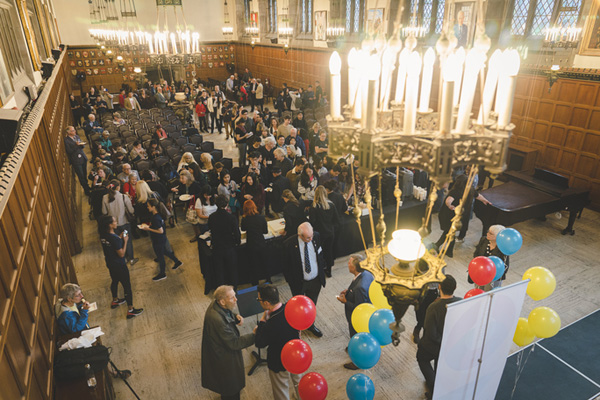
Hart House treated the centennial as a yearlong program rather than a single backward glance. There was a gala, an art commission, concerts, fairs, exhibits and an open-house celebration. Chan explained at the time that students had been involved at the strategic planning level from the beginning. She also made a more operational point: events were planned through the lens of keeping the regular offerings uninterrupted.
That pairing is revealing. Bring the people an institution serves into the planning room, then protect the day-to-day experience while the big story unfolds. The gala may make the photograph. Continuity earns the trust.
For Open Hart House, Chan wrote an invitation that moved between novelty and memory. Visitors could explore the building's activities; alumni could return and reminisce. In one message, the same place could be a discovery and a reunion. That is the peculiar time horizon of campus institutions. They have to mean something to a first-year student who arrived last week and to a graduate whose memories have had decades to settle.
Eight doors into one public story
The centennial also put a harder piece of Hart House history into view. The building opened in 1919 as a men's student centre, and women did not receive full membership until 1972. A modern invitation to everyone therefore lives beside a documented history of exclusion. Marketing cannot repair that history by sanding off its edges. It can help an institution make its present commitments visible, and it can create routes for people who were once kept outside to shape what happens within.
Recognition is infrastructure
A small discussion from 2021 shows Chan working at street level. Hart House's student committees were adopting formal name changes. Longer titles created practical questions about branding and social accounts. Chan advised against changing familiar social handles because those handles were how people recognized and found the groups. The official name could explain who was hosting an event; the established handle could remain the path people already knew.
This is not glamorous brand theory, but it is useful institutional judgment. A mature organization contains memory in odd places: a nickname, a URL, a recurring email, a sign on a door. Change everything at once and the institution may look tidier from inside while becoming harder to navigate from outside. Keep everything forever and old language becomes a constraint. The work is to know which recognition is an asset and which habit has become friction.
Chan's advice preserved the route while allowing the formal structure to change. It is the communications equivalent of renovating an entrance without removing the street number.
The participation path
When the building became a broadcast
The most severe test arrived soon after the centennial, when much of campus life had to move online. In an October 2020 presentation, Chan outlined a distribution system for virtual and in-person programming: Hart House's own website, other university websites, a weekly newsletter, social media and digital slides on screens around campus. The channels were deliberately redundant. Different audiences would encounter the institution in different places.
Programs ranged across arts education, student clubs, dialogue, theatre, recreation and community outreach. Some could be live. Some had to work across time zones. Student ambassadors reported that interpersonal connection on social media mattered, especially when students already spent their classes looking at screens. The communications challenge was not simply to publish a schedule. It was to preserve a sense that participation still involved other people.
The distribution list also revealed the shape of the organization. Hart House could speak directly, but university partners could carry an invitation into communities that might never seek out the central account. Student ambassadors could add peer credibility that an institutional voice could not manufacture. Screens could catch a passerby; recorded material could serve someone who missed the live hour. Each channel solved a different piece of access. Together they made the institution less dependent on a person already knowing where to look.
That distinction survives the emergency that produced it. A calendar tells you what is available. A human invitation helps you imagine attending. Chan's remit sits between the two: enough structure to make a large institution understandable, enough warmth to keep understanding from feeling administrative.
The coach behind the CMO
Outside the day job, Chan's public record has a recurring mentorship thread. She coached high-school entrepreneurs with Y2 Entrepreneurship Labs from 2016 to 2019. She mentored through the Cherie Blair Foundation for Women from 2018 to 2020. Since 2019, she has listed service chairing promotions and partnerships work for the UWC National Committee of Canada, a connection that loops back to her own education at Pearson College UWC.
Coaching and marketing share a useful discipline. Neither can do the participant's work for them. The coach can clarify an opportunity, ask a better question and help turn a broad intention into a concrete sequence. The marketer can make the invitation visible and the next step intelligible. Agency remains with the person on the other side.
Her UWC connection adds a personal continuity to that pattern without requiring a grand theory. Pearson College UWC appears in her own education; the Canadian national committee appears later in her volunteer service. The roles are different, but both sit within an international education network built around students crossing boundaries and learning in community. Promotions and partnerships, in that setting, are again less about polish than about widening the route into an experience.
Chan earned the Chartered Marketer designation, a professional credential that gives her work a formal frame. Yet the more distinctive pattern is practical. Her career repeatedly brings her to crowded intersections: strategy and execution, institutional history and a new audience, formal names and familiar handles, one central building and three campuses.
Today, Hart House's directory places her in the Warden's Office alongside the institution's senior leadership. Recent governance records continue to list her at the table as Chief Marketing Officer. The work is ongoing because the audience keeps renewing itself. Every year brings students who have never heard the old stories, do not know the shortcuts and have not yet decided whether the place is for them.
A century-old building can wait for people to discover it. A living institution cannot. It has to explain itself again, without losing what makes it worth explaining. Chan's brief is to make the many parts cohere just long enough for someone to choose a door. Then the room, the program and the people inside have to keep the promise.