At the Indian Institute of Technology Kanpur, Pooja Sankar could see other students finishing their computer science assignments. She could also see the distance between their desks and hers. She was one of three women in her class; asking the men for help felt harder than staying up with the problem. A university can fill a room with brilliant people and still leave one of them stranded. Piazza began with that small, expensive silence.
- Piazza lets a class ask questions in public or with anonymity options, then build shared answers with instructor oversight.
- Its first trial was painfully quiet: Sankar recalled 12 questions in four months before a redesign.
- The company later added an opt-in recruiting network; employers cannot see classroom Q&A posts.
- Classroom use now follows a mix of free access and paid instructor, department, or institution licenses.
Sankar carried the memory into her engineering career and then to Stanford Graduate School of Business. There, she learned that her experience was hardly peculiar to one campus or one country. Other women described the same shortage of support. In 2009 she built a prototype herself, learning Ruby on Rails and taking it directly to professors. The product was intended for a recognizable hour: late at night, homework open, office hours closed, and a question that feels too basic to ask in front of everyone.
Twelve questions in four months
The first test offered a useful humiliation. Sankar later recalled that it produced only 12 questions across four months. That is three a month, an awkward figure for a product meant to make asking easy. Piazza changed its front end by December, and each iteration drew more engagement. The lesson is portable: if a tool meant to change behavior meets silence, the interface may be making the old behavior easier. A launch is evidence; a launch party is not.

Piazza launched publicly at Stanford in 2011. Sankar's design brief was less “social network for school” than a practical promise: one student asks, everyone can learn from the answer. A professor answers once instead of repeating the same explanation in a procession of emails. A teaching assistant can spot where the class is stuck. A student can discover that the “obvious” question had been bothering half the room.
“I started Piazza so every student can have that opportunity to learn from her classmates.”Pooja Sankar, founder
One question, two answers
The mechanism is unusually fussy in a good way. Piazza gives each question one community-edited student answer and one separate instructor answer. Classmates can improve the first; instructors can make their own response unmistakable and endorse useful contributions. That structure keeps a discussion from becoming a corridor of nearly identical replies. It also lets a partial answer improve without pretending the first person to type was the final authority.
For a mathematics or programming class, the details matter. Piazza supports LaTeX, syntax highlighting, and code blocks. Its feed flags questions that still need attention. Instructors can run polls, post resources and announcements, see participation statistics, and control the class space. The service connects through LTI to learning management systems including Canvas, Blackboard, and Moodle, so it can live beside the course roster and syllabus rather than asking a school to replace them. Mobile apps and notifications keep the conversation moving between lectures.
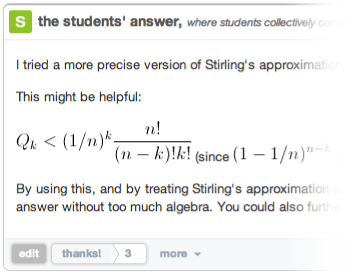
Its closest alternatives include Ed Discussion, Campuswire, and the discussion boards already built into campus systems. Piazza's wager is narrower: the classroom needs an answer desk with a memory. A chat room rewards speed; a wiki-style response rewards repair. That distinction is most valuable when questions recur, answers evolve, and one instructor cannot plausibly hold office hours for everyone at once.
The bill for a town square
A popular classroom utility still needs someone to pay for it. Piazza says online-learning signups rose fourfold as classes moved online. It shifted toward paid licenses, with premium polls, statistics, and class locking tied to paid access from August 2021. Its published instructor prices run from $379 to $479 per term, depending on class size. Department licenses are listed at $9,000 or $12,000 a year for specified student caps; institution-wide licenses are negotiated. Classes of up to 25 students and K-12 classes have a free route, and Piazza describes a contribution-supported model for basic use.
The recruiting business grew from a different observation: the students already doing technical work on Piazza were also about to look for jobs. In 2014 the company launched Piazza Careers and announced an $8 million Series B led by Khosla Ventures, with Bessemer participating. Earlier, Bessemer had led a $6 million Series A. Early recruiting users named in the launch included Box, Palantir, SpaceX, and Yelp. Piazza now calls the employer offering Piazza Talent or the Piazza Network, with company profiles, events, interview signups, and student outreach.
That extension carries a delicate boundary. Piazza says students actively opt in to the Network, can leave it, and control their career profiles. Employers may search fields students provide, but cannot view or search classroom Q&A content. The product's proposition is wider recruiting beyond the same few campuses, with particular attention to women and underrepresented students in STEM. It works only if a student can ask an unpolished question in class without imagining a hiring manager reading it later. Piazza's consent rules are therefore part of the product, not fine print at the end of its pitch.
A more useful kind of scale
Piazza says millions of students use it across thousands of universities in 90 countries, and that more than 100,000 professors have chosen it. Those are company-reported cumulative reach figures, not a measure of how lively any given course feels on a Tuesday. The individual instructor still has to seed discussions, answer promptly, and teach students that a good question helps the next person too. An empty forum remains an empty forum, however handsome its software.
The company has expanded access through integrations, including a Microsoft Teams app launched in 2020. Its website now names Ethan O’Rafferty as CEO, while Sankar remains its founder and the voice of the original mission. The business spans education software and early-career recruiting, a combination that sounds odd until you look at the same student twice: first as someone seeking help, then as someone seeking an opening.
What can another founder copy? Start with the moment a user declines to do the sensible thing. Sankar did not need to invent questions; she needed to make asking one less costly. Then she had to watch the first attempt fail quietly, change the interface, and keep the answer useful after the original asker had gone to bed. That is Piazza's most durable idea. A classroom's knowledge is already in the room. The trick is persuading it to speak.