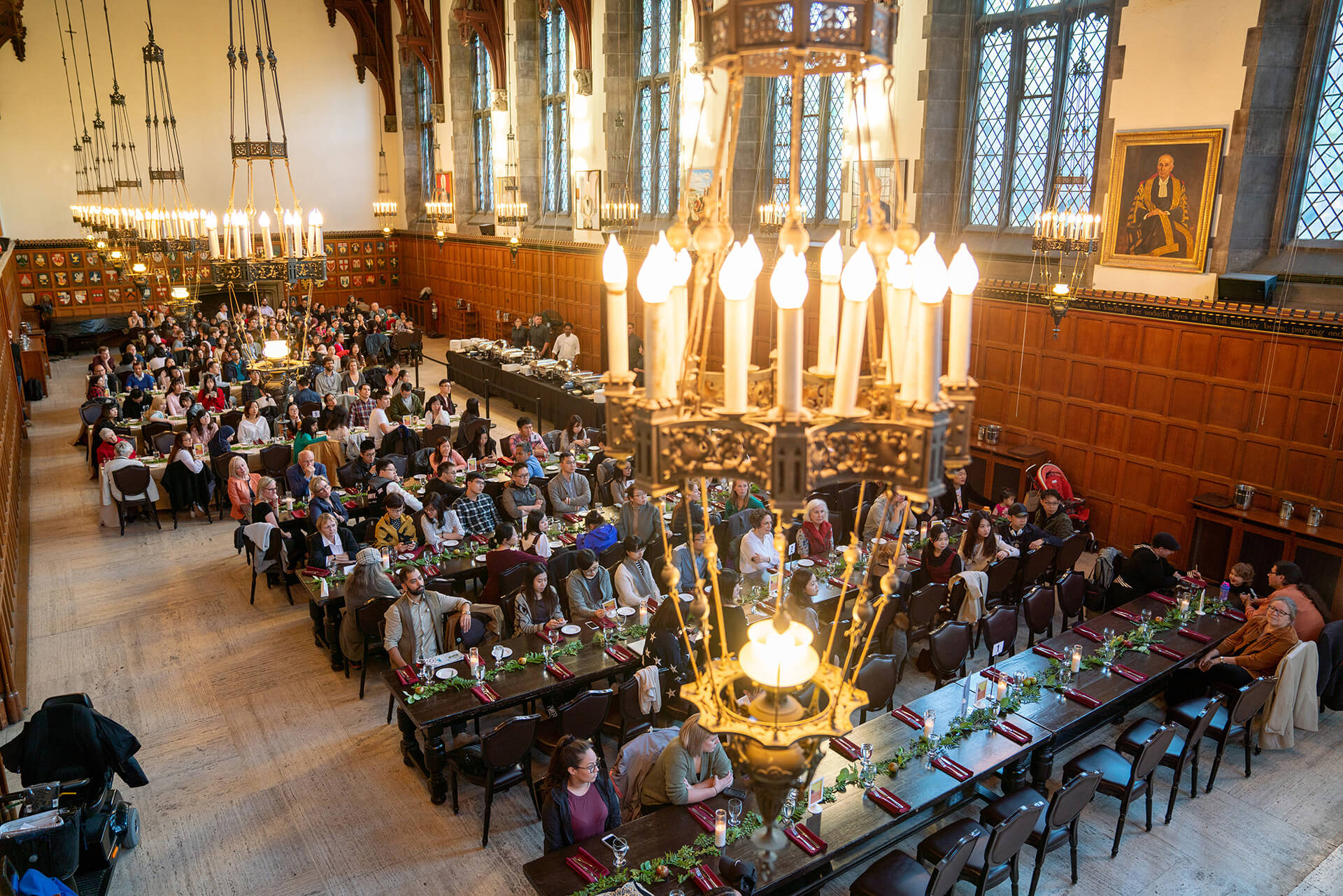
At lunchtime, Hart House can feel like several buildings accidentally sharing a postal code. A swimmer comes up from the pool. A bride inspects the Great Hall. Students drift toward a CA$5 lunch while, somewhere upstairs, six antique viols sit behind glass and wait to be played. There are actors rehearsing, chess clocks tapping, weights clanging and people who entered only because it was cold outside. The confusion is the product.
Hart House, at the University of Toronto, is a 200,000-plus-square-foot student and community centre opened in 1919. Calling it a student centre is accurate in the way calling a department store a room is accurate. It runs a fitness centre and pool, a semi-professional theatre, clubs and student committees, two dining rooms, catering, event rentals, a permanent art collection and community programs. It also oversees a 150-acre farm in Caledon. University reporting puts annual traffic above 1.5 million visits, including roughly 300,000 fitness-centre visits.
The problem it solves is not a lack of activities. Toronto has gyms, galleries, restaurants and theatres. The problem is fragmentation. Academic life is good at sorting people by course, cohort and credential. Hart House puts unrelated reasons for showing up beside one another, then lets proximity do some quiet work. A fitness member passes an exhibition. A student committee books a room. A wedding subsidizes an old hall that students can use on Tuesday.
What it actually didBuild many doors into one house
The operating idea is wonderfully literal: give people different doors into the same community. One person arrives for archery, another for a play, another for lunch, another for a grant of up to CA$1,000 to run a student project. The program does not demand that everyone share an identity or an ambition. They need only share a place often enough for recognition to begin.
Its customers overlap without being identical. Eligible U of T students receive core access through ancillary fees. Faculty, staff, alumni and community members buy fitness memberships. Diners book lunch; audiences buy theatre tickets; companies, couples and campus groups rent rooms and catering. Youth programs and public events extend beyond the university. This is less a membership funnel than a plumbing diagram: many inputs, one busy house.
The business model is equally mixed. Student fees supply a dependable base. Earned income comes from fitness memberships, training and classes, dining, catering, theatre and event hire. Donations, grants, operating reserves and university support pay for programs and capital work. The 2021-2026 strategy aimed to keep student fees at no more than 65 percent of the budget - a practical acknowledgement that access matters, but dependence on one payer is risky.
2025-26 operating and capital snapshot · CA$ millions
What it costFirst CA$2 million. Now, a reported CA$240 million.
The first cost overrun arrived before the public did. Construction began in 1911 with an estimate of CA$500,000. Massive foundations and a war later, the completed building cost about CA$2 million. The sub-basement had already served the First World War effort as a trench-warfare training space. Hart House formally opened on November 11, 1919, a grand gift from the Massey Foundation with very expensive bones.
Those bones are now the plot. A 2012 assessment found about half the building's systems had exceeded their expected lifespan. Board minutes describe heavily corroded water infrastructure, a leaking hydro vault, obsolete voltage, roofs under repeated patchwork and an old air handler whose parts are nearly impossible to find. Deferred maintenance worked until it became a strategy for borrowing trouble from the future.
Phase 1 of the renewal carries a CA$30 million budget and a late-2026 target. It includes new electrical and mechanical rooms, upgraded power, duct banks and work around the squash courts, theatre and Great Hall. The Varsity has reported CA$240 million across roughly 20 years for the broader project. Funding is expected to combine university money, donors, government contributions, grants and Hart House reserves. The project is phased so the building can remain open. Community, apparently, has uptime requirements.
The bricks and mortar are but the bones, the community must provide the spirit.Vincent Massey, at Hart House's opening in 1919
What failed firstThe original definition of community
The pipes were not Hart House's first design failure. The institution opened as a men's club. Women could sometimes enter under restrictions, but they were denied full membership for more than half a century. In 1957, when John F. Kennedy came to debate, women asking to listen were refused. They picketed outside; one reportedly entered dressed as a man. In 1967, women permitted only at the back of a debate room sat with male students and were booed and hissed at.
What changed the institution's mind was not an elegant internal memo. It was decades of letters, pressure, public embarrassment and direct action, followed by the death of Vincent Massey, who had defended the restriction. Full membership opened to women in 1972. The lesson is less flattering and more useful than a tidy redemption story: institutions can host debate while resisting the people doing the arguing.
That history gives the current language of inclusion some weight and a test. Hart House's plan calls its central metaphor a table, insisting students should know the table is already theirs. New renewal plans include ramps, lifts, barrier-free facilities, inclusive change rooms and more flexible social space. The shift is concrete, but never complete. Access is not a slogan when the elevator, fee, doorway or program schedule still decides who gets in.
Why it is differentA portfolio of reasons to return
A normal gym competes on equipment and convenience. A normal event venue competes on rooms and service. A normal campus club competes for attention. Hart House bundles them, which changes the comparison. The fitness centre can sell a CA$21 day pass or a public membership listed at CA$100 a month, while eligible students may already have access through fees. The Gallery Grill can serve weekday lunch under stained glass. The theatre offers productions, workshops and volunteer jobs. Nine standing committees let students govern parts of the institution rather than merely attend it.
The expertise is orchestration: heritage operations, hospitality, recreation, arts production and student development at the same address. Hart House Theatre says more than 1,000 students participate each year. The permanent art collection, begun with a CA$200 A.Y. Jackson painting in 1922, now holds more than 600 works. The Finnish Exchange, established in 1951, sends small groups into three-month work and cultural placements with universities in Helsinki. These are not features in a single product category. They are durable rituals.
Partnerships widen the circle. Hart House and U of T Sport & Recreation work with The 519 on sports programming for 2SLGBTQ+ newcomers and refugees. Theatre programs collaborate with outside companies. Concert series bring in Toronto music organizations. Student art and Indigenous initiatives connect to the Art Museum and campus partners. The house is most useful when it behaves less like a castle and more like civic infrastructure.
What readers can copyThe playbook is smaller than the building
Nobody needs a Gothic quad to borrow the mechanics. The most transferable parts are inexpensive, repetitive and slightly unglamorous.
The most copyable product may be the Good Ideas Fund. Eligible students can request up to CA$1,000 for an event or initiative, and at least 67 recipients have been supported since 2017. The money is modest enough to distribute, meaningful enough to start something and structured enough to teach budgeting. It converts the organization's question from “What should we program?” to “What will members make if the first obstacle disappears?”
When would this not work?
The model weakens without regular foot traffic, affordable access, patient funding and staff who can coordinate many small programs. Bundling also becomes clutter if every unit protects its own audience. A beautiful room cannot compensate for high prices, hostile rules or members who have no authority. And a phased renewal only works if the organization can tolerate years of disruption without asking its community to wait outside.
Where it fitsSomewhere between campus service and city institution
In market terms, Hart House sits at an awkward intersection: education, recreation, culture, hospitality and events. That awkwardness is an advantage. Competitors can beat one part. A newer gym has shinier equipment. A dedicated theatre has a cleaner mandate. A hotel ballroom may have easier loading. What is harder to reproduce is the traffic between uses, the institutional memory and a century of members making the schedule.
Its future depends on keeping that traffic legible while construction moves through walls and floors. Renewal renderings promise a café, maker spaces, improved reading rooms, modern building systems, air conditioning and more accessible routes. Those are overdue. The risk is familiar to anyone who has watched a beloved place become impeccably renovated and strangely empty: comfort can be engineered, but attachment cannot.
Hart House's best defense is already in its old quotation. Bricks are bones; people supply spirit. The updated version needs an asterisk: people supply spirit only when the door opens, the price permits it and somebody hands them more than a visitor badge. For a house that once got those terms badly wrong, the next 20 years are a chance to make the architecture finally catch up with the invitation.