David W. Pijor has a demanding definition of a banking relationship. You should know whom to call on a Sunday night when something goes wrong. A telephone number attached to a person, with enough knowledge of your business to make the conversation useful. For a founder who has spent decades around contracts, credit and company owners, that is a compact way of describing the job.
He returned to this idea in a May 2025 radio conversation about tariffs and small businesses. Owners were trying to decide whether to buy inventory, invest or expand while the rules of trade kept changing. Pijor resisted offering a neat prediction. The uncertainty itself was a problem, he argued. A bank could at least supply informed advice and someone familiar with the customer’s circumstances.
That sounds modest beside the promises routinely attached to financial technology. It is also a rather serious service standard. Sunday night is when the branch is closed, the presentation is over and the relationship acquires an inconvenience. Pijor’s career has been an extended attempt to make that kind of availability into a business.
A graduation ceremony he could do without
His independence showed early. As a high-school valedictorian working a summer steel-mill job to help pay for Michigan, Pijor faced a clash between work and graduation rehearsal. School officials insisted on attendance. He went to work and missed graduation. He later recognized both the strength and the danger in such stubbornness.
Born in Austin, Texas, and raised in Lorain, Ohio, he grew up with a community banker for a father. His father’s advice combined independence with a warning against assuming he knew everything. Years later, Pijor kept an advertisement celebrating his father’s bank in his office. Banking offered a way to combine professional skills with that example of local responsibility.
The lesson kept changing. Pijor acknowledged that starting FVCbank required determination, while building its leadership team demanded greater collaboration. The young valedictorian’s confidence had its uses. A bank full of capable colleagues required him to make room for theirs.
Before the balance sheet, the law
Pijor studied economics at the University of Michigan, earning a bachelor’s degree with honors and high distinction, then earned his Juris Doctor at Georgetown University Law Center. His professional life developed in Fairfax, Virginia, where he practiced corporate and tax law before taking on FVCbank’s chief executive role.
The legal career matters to the banking career. A business attorney spends time with the machinery behind a company: ownership, transactions, obligations and the consequences of an agreement. Pijor’s work gave him a view of business from that side of the desk. His subsequent banking roles moved him closer to the decisions about which ventures would receive capital.
James Monroe Bank opened in Arlington in June 1998 with $7.4 million in initial capital and nine employees. Pijor was its founding chairman; John R. Maxwell served as president and CEO. These distinctions are useful. Pijor’s first bank-building chapter involved oversight and direction alongside an operating partner.
By 2004, the institution was reporting annual asset growth of 47% while investing in staff, markets, technology and premises. It was a small commercial bank making a specific wager on its region and its customers. In 2006, James Monroe was sold to Mercantile Bankshares for $143.8 million. Pijor had helped build an institution that someone else wanted to buy.
James Monroe Bank opens in Arlington.
James Monroe sells for $143.8 million.
FVCbank opens on November 27.
Starting again, with unfortunate timing
FVCbank began operations on November 27, 2007. Pijor was its lead organizer, chairman and chief executive. The date places the beginning beside the approaching financial crisis, an awkward moment to establish an institution whose essential raw material is confidence. A founder could hardly have ordered a less reassuring backdrop.
The bank concentrated on commercial customers in the Washington region, including government contractors, nonprofit organizations and professional service firms. These are businesses and institutions with particular cash-flow patterns, obligations and deadlines. Knowing the geography helps; understanding the customer’s work helps more.
His earlier bank supplied experience. FVCbank also required a team that could make the next institution function. Patricia Ferrick joined at its founding as chief financial officer and later became president. Pijor’s story includes that continuity: people who helped establish the bank remained involved as its responsibilities expanded.
Growth eventually carried it across jurisdictional lines. The acquisition of Colombo Bank closed in October 2018, bringing more than $188 million in assets and extending the bank into Maryland and the greater Baltimore market. The home territory became broader without becoming abstract. Fairfax, Washington and Baltimore are connected markets, each with customers whose needs still arrive one account at a time.
The large cheque has a smaller point
At the bank’s 2017 shareholder meeting, Pijor helped present the L. Burwell Gunn Citizenship Awards. Cornerstones and Volunteer Fairfax each received $2,500. The gathering also recognized employees who had been with the bank since its beginning, including Pijor and Ferrick.
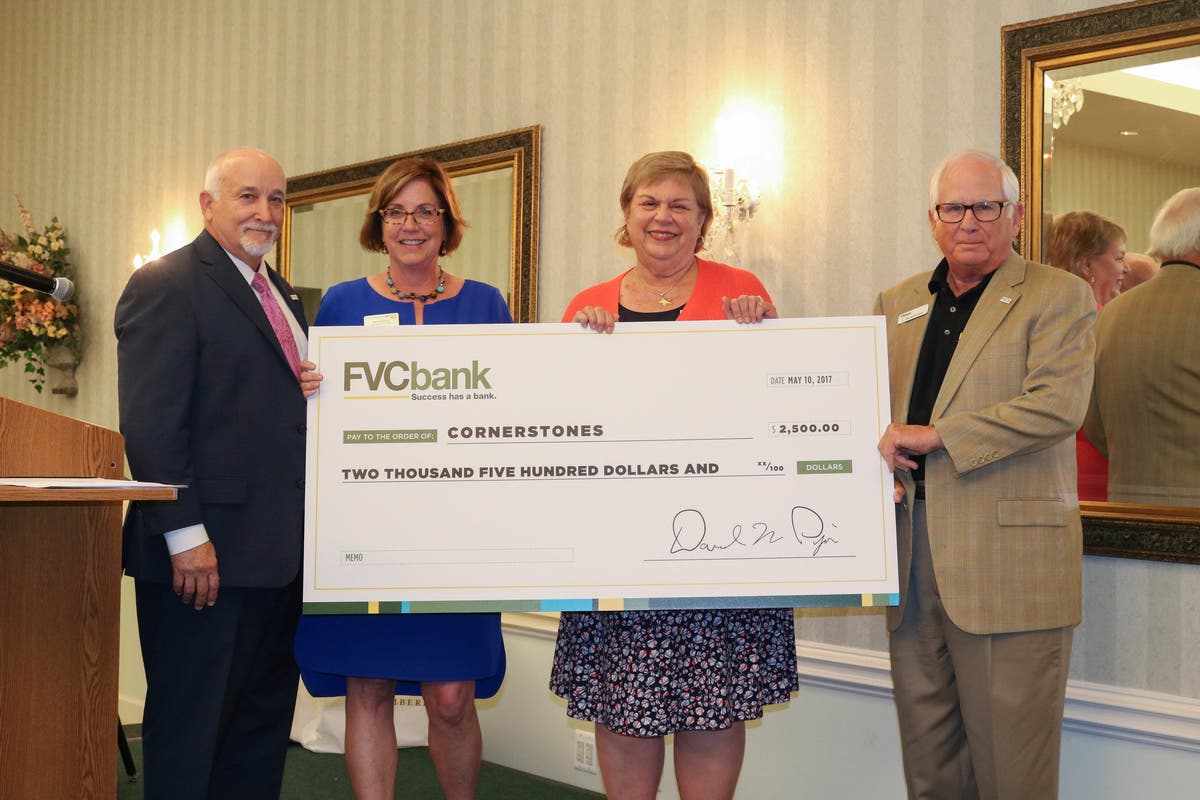
An oversized presentation cheque is a familiar piece of civic theatre. Here the recipients give it substance. Cornerstones works on needs including food, shelter and affordable housing; Volunteer Fairfax connects volunteers and donors with nonprofit organizations. These activities sit beside the commercial side of community banking, keeping its definition of community reasonably concrete.
In May 2025, Pijor’s appointment to the Compass Pro Bono DC board added another connection. Compass brings business professionals together with local nonprofits to provide strategic advice. His contribution would draw on financial and management experience. “Strong nonprofits build strong communities,” he said. The sentence is brief; the board role supplies an obligation behind it.
A banker’s phone, with better software
Pijor’s emphasis on personal relationships has accompanied a sustained investment in technology. In his 2023 shareholder letter, he described the adoption of Q2, bringing previously separate online, voice and mobile banking systems into a single integration. He also described Lightning Lending, built on Numerated’s loan-origination platform, and Business Insights, developed by Monit.
His explanation for these investments was practical: digital convenience could free calling officers to spend more time with customers. The time saved was part of the service. A banker working through fewer disconnected systems might have more attention available for the business behind the account.
Business Insights illustrates the proposition. Customers connect accounting software to view cash-flow forecasts, financial trends and comparisons with similar businesses. FVCbank offers the tool at no additional cost to its business customers. An owner without an internal finance department gets another way to inspect the numbers before a shortfall becomes urgent.
There is a recognizable connection to Pijor’s earlier professional life. The customer still has to make a decision. The banker can improve the information available, ask useful questions and understand the consequences. Software expands that conversation’s raw material. It also leaves plenty for a human being to explain.
The transaction that stopped
Expansion did not always produce a completed deal. In July 2021, FVCBankcorp and Blue Ridge Bankshares announced an agreement to combine. The proposed organization would have put Pijor in the executive chairman’s seat, with Brian K. Plum as chief executive and Ferrick leading the combined bank as president and CEO.
On January 20, 2022, the companies mutually terminated the agreement. Each would cover its own expenses; neither would pay a termination fee. Their boards had concluded that continuing was imprudent after considering the transaction and the benefits they expected to achieve.
It is an essential interruption in a founder’s growth story. Announcing a larger institution and creating one are different events. Pijor’s career continued at FVCbank, with the proposed combination remaining a plan that the companies decided to end.
What steadiness looks like in numbers
For 2025, FVCBankcorp reported $22.1 million in net income, compared with $15.1 million for 2024. Deposits ended 2025 at approximately $2 billion, and loans reached $1.94 billion. The figures describe the institution Pijor and his colleagues were responsible for managing, including the less theatrical tasks of funding, pricing and balance-sheet discipline.
Full fiscal years. Reported net income, rounded to the nearest $0.1 million.
The October 22, 2026 results brought the record forward: third-quarter net income of $6.6 million, up 19% from the comparable 2025 quarter, and $21.2 million for the first nine months. Pijor highlighted loan diversification and a reduction in commercial real-estate concentration. His language concerned selective growth, a useful qualification when someone is responsible for other people’s deposits.
His public commentary has followed a similar preference for predictability. In a February 2026 radio interview, he argued that a Federal Reserve pause could itself be a deliberate policy decision. Businesses benefited from being able to plan, he said, even while many borrowers naturally wanted lower rates. For an entrepreneur deciding when to commit money, a quieter interest-rate environment could have value.
The Sunday-night test, revisited
In March 2026, Pijor joined Ferrick and Vince Coglianese for a conversation about stewardship. He described capital, relationships and confidence as things entrusted to a bank, carrying an obligation to protect them and pass them forward. He emphasized preparation and candor when discussing fraud, cyber threats and institutional trust.
“Trust is built slowly and lost quickly.”
David W. Pijor, March 2026
That view gives his Sunday-night test a larger meaning. Knowing the person to call is one part of it. The institution behind that person must be prepared, its decisions explainable, its commitments dependable when circumstances become difficult. Across two banks, a legal career and years of local business relationships, Pijor has kept returning to that obligation. The telephone is a small object to carry so much responsibility. It remains a useful place to start.
Keep the conversation going
- FVCbank
- David Pijor on LinkedIn
- Watch: stewardship with David Pijor
- Listen and read: the Sunday-night conversation
- Early life and career interview
- James Monroe Bank, 2004 annual report
- 2023 shareholder letter
- 2025 annual report
- October 2026 earnings release
- Compass Pro Bono board appointment
- 2022 merger termination
- Community award photograph and announcement