The most revealing object in David Peacock’s new office is not the sort that announces itself. Vaxxas’s high-density microarray patch is small, flat and covered with microscopic projections. Its ambition, by contrast, touches factories, refrigerators, clinics, governments and the practiced ritual of rolling up a sleeve. Peacock arrived in January 2026 to help it travel that distance. After 25 years at Merck, where he had most recently led the global commercial strategy for a vaccine business generating more than $10 billion a year, he chose the uncertainty of a clinical-stage biotechnology company in Brisbane.
It was a move from scale to possibility, from managing a vast portfolio to commercialising a platform. The contrast is almost comic: a global executive career compressed into a patch that can sit between finger and thumb. Yet the scale of the problem may be what appealed. A vaccine is not useful merely because it exists. It must be manufactured, transported, stored, administered and accepted. Each verb has its own bureaucracy. Peacock has spent his working life among those verbs.
A career written in airport codes
Peacock trained first as an economist, earning his undergraduate degree at the University of Massachusetts Amherst, completing coursework at the London School of Economics and later taking an MBA at Northwestern University’s Kellogg School of Management. The tidy academic sequence soon gave way to a career with the geography of a departures board. There was Bain & Company in Australia, commercial work in the United States, Singapore and Vietnam, finance in Japan, leadership in Hong Kong and Macau, the top MSD job in Britain and Ireland, and a return to Asia as regional president.
The titles changed with the places. He was chief financial officer of MSD Japan, chief of staff to Merck chairman and chief executive Ken Frazier, managing director in the UK and Ireland, and president of MSD Asia Pacific. By 2024, he was president of Merck Global Vaccines. The route gave him more than cultural fluency. It showed him that a medicine can meet a different health system, payment logic and public expectation every time it crosses a border.

builder
operator
president
CEO
Consulting taught the framework. A startup supplied the risk. Merck supplied the scale. Vaxxas now asks for all three.
There is an instructive detour near the beginning. Peacock co-founded Nuun & Co., known for dissolvable hydration tablets. The product and the patch belong to separate worlds, but they share a useful instinct: make the format smaller, more portable and less troublesome. It would be too neat to call Nuun a rehearsal for Vaxxas. It does, however, reveal that Peacock’s CV was never entirely corporate. The builder was there before the corner offices.
“Where I can add value in my role is bringing the team together and trying to create a culture where we all understand this is a shared business.”David Peacock, on the work of a managing director
The unglamorous distance between vial and arm
The vaccine business is usually described through its scientific peaks: discovery, trials, approval. Delivery lives lower on the poster. It is nevertheless where a great deal of value can evaporate. Conventional vaccination may require refrigeration, trained administrators and appointments that fit both a health system and a patient’s day. Remote settings magnify every complication. Rich systems have complications of their own: labour pressure, missed appointments, crowded clinics and budgets with little patience for extra steps.
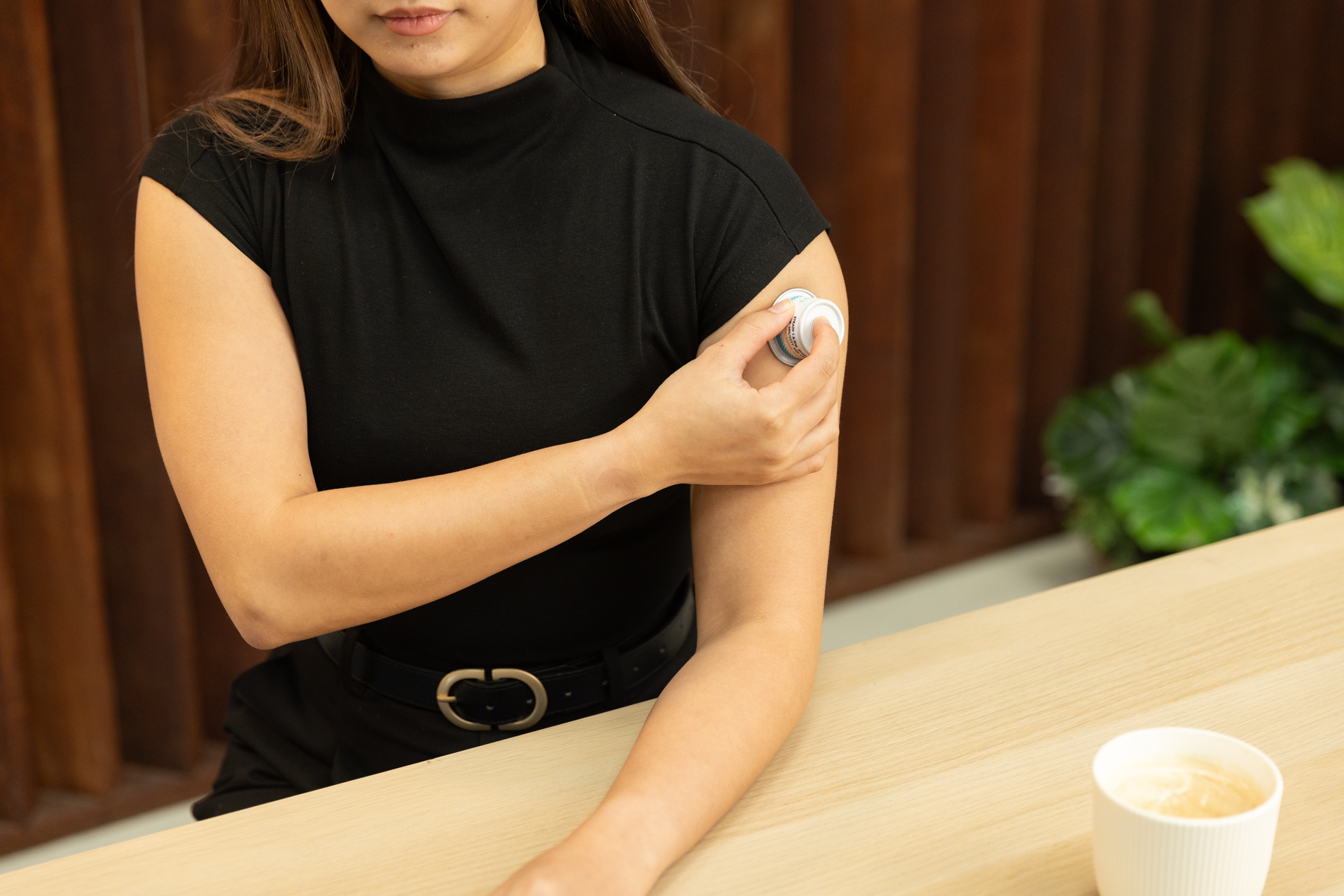
Vaxxas’s investigational answer is the HD-MAP. Thousands of microscopic projections carry a dry-coated vaccine and target immune cells just beneath the skin. The company is studying whether the approach can reduce reliance on cold-chain distribution, use smaller doses and eventually support self-administration. Its platform has been used with more than 750 participants across multiple clinical trials. None of that makes the product commercially inevitable. HD-MAP-delivered vaccines remain investigational and are not approved for sale.
+ regulators
+ manufacturing
+ easier use
+ wider access
Peacock’s assignment starts precisely where the glossy diagram ends. Vaxxas already has a licensed biomedical facility in Brisbane and automated lines for sterile production. It also has research relationships with governments and international organisations. What it needs is the connective tissue of a market: pharmaceutical partners willing to pair antigens with the platform, regulators satisfied with the evidence, manufacturing that behaves at volume and users comfortable with a new ritual.
The partnership doctrine
Years before Vaxxas, Peacock was unusually explicit about how he thought pharmaceutical companies should behave. While running MSD in Britain, he argued that the industry had to move beyond broadcasting product messages and become a genuine partner to health systems. Patient organisations, he said, belonged inside the conversation because companies could not understand circumstances or needs from a distance.
The pandemic supplied him with an example of institutional speed. In the first rush of hospital demand, he watched MSD, the NHS and regulators coordinate sourcing and supply in days. Work that would normally have taken a year happened within 48 hours. Peacock’s point was not that crisis should become a permanent management style. It was that large organisations could shed their habitual drag when purpose was clear.
“We need to move past being suppliers to healthcare systems towards becoming true partners.”David Peacock, 2020
At Vaxxas, that belief is less philosophy than job description. The company cannot build a new delivery category alone. In February 2026 it joined SK bioscience and IDT Biologika in winning the first phase of a European Union tender for next-generation influenza vaccines. The initial €12.9 million supports a Phase I study combining an influenza vaccine with the HD-MAP, alongside preclinical work on a version intended for pandemic preparedness. Later phases are competitive, a useful reminder that public funding buys a chance to advance, not a ceremonial ribbon.
The consortium is also asking a question that engineering cannot settle. In September, Vaxxas launched research in Germany, France and Italy on how people perceive self-administered vaccination and interact with the patch. Convenience looks magnificent in a slide deck. Trust is harder to graph. Peacock said the work would help the company understand confidence, willingness and the practical design of future use. A platform meant to give people more agency must begin by listening to them.
A small company meets a large-company education
Peacock did not arrive as the laboratory founder or inventor. His role is more recognisably that of an operator at an awkward threshold. Vaxxas has crossed some early technical ground but has not reached commercial sale. The CEO must respect what the science has proved, be precise about what it has not, and persuade partners to invest time before the destination is certain.
Bain in Australia and the co-founding of Nuun put consulting structure beside startup exposure.
Finance, commercial operations, country management, a CEO’s office and regional leadership built a view across the institution.
As president of Merck Global Vaccines, Peacock took responsibility for commercial strategy in a business producing more than $10 billion a year.
He joined Vaxxas to lead the passage from clinical validation to commercial execution.
His public language tends toward coordination rather than conquest. He talks of shared businesses, partnerships and aligning people. Even his optimism comes with plumbing attached. When he praised Britain’s health ecosystem, his question was how to tie together the system, the payer, the data and the scientific base. The language fits a generalist who has occupied finance, commercial and operational seats, and who has argued that organisations should let people cross those boundaries too.
There is also a clear appetite for building. Announcing his move, Peacock described himself as someone who loves creating businesses and tackling complex problems. The phrasing matters. Vaxxas is not merely selling a smaller syringe. It is asking vaccine manufacturers and health systems to reconsider the delivery layer, then making that reconsideration economical. The elegance of the object does not excuse the messiness of adoption.
The bet hidden inside the patch
Peacock’s career has now folded back on itself. He began with a startup, spent a quarter-century learning what a global pharmaceutical company needs, and returned to a company that must work with such institutions without becoming one overnight. His former employer is part of Vaxxas’s own history as a collaborator. The networks overlap; the scale does not.
The next chapters will be written in evidence and agreements, not biography. Can automated manufacturing deliver consistent patches? Will pharmaceutical companies license the platform for existing or future vaccines? Will regulators, governments and the public accept a different route of administration? Can reduced cold-chain dependence and potential self-use produce savings outside controlled studies? These are sober questions, and the company’s investigational notice correctly keeps them open.
For Peacock, that uncertainty is the attraction and the burden. At Merck he could see the limits of conventional delivery from inside one of the world’s largest vaccine businesses. At Vaxxas he is responsible for converting that view into a product, a partnership model and, eventually, an ordinary act. If the work succeeds, the memorable part may be how unremarkable it becomes: a patch pressed to skin, a dose delivered, an appointment and a refrigerator no longer required. The grand ambition is to make the final inch feel small.